Lunar Eclipse August 28: 96% of Disk in Earth's Shadow
The Moon passed through the deepest partial lunar eclipse of the year in the early hours of August 28, with up to 96 percent of its disk inside Earth's shadow, according to NASA data.
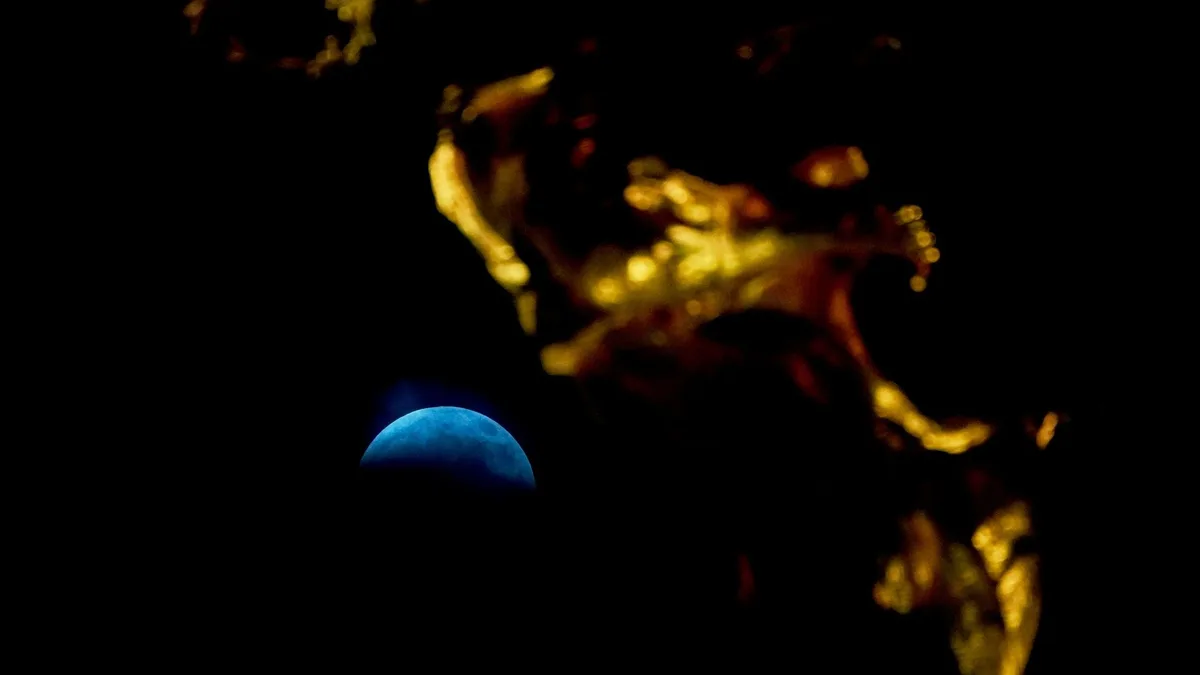
The Moon passed through a deep partial eclipse in the early hours of Friday, August 28, the deepest of the year. At the peak phase, when Earth’s dark shadow covered most of the lunar disk, 96.3 percent of the Moon’s visible surface sat inside the shadow, according to data from NASA’s Scientific Visualization Studio. The event began developing on the night of August 27 into 28 and was visible to the naked eye, with no protective glasses or special equipment needed, from the Americas, western Europe and western Africa.
NASA’s Scientific Visualization Studio, the branch of the US space agency responsible for visualizing astronomical events, published a diagram and a visibility map of the eclipse in advance, along with precise timing for each phase. The eclipse belongs to Saros series 138, a family of eclipses that repeats every 18 years, 11 days and 8 hours. The previous eclipse in the same series occurred on August 16, 2008, and the next is due on September 7, 2044. This one also arrived just sixteen days after the total solar eclipse of August 12, the first total solar eclipse visible from continental Europe since 1999.
Why the reported times differ from source to source
NASA calculates two separate figures when describing how much of the Moon entered the shadow. Umbral magnitude measures what share of the Moon’s diameter the dark shadow covers, and for this eclipse that figure is 0.9319, or about 93 percent. Obscuration measures what share of the visible disk is covered, and that number comes out higher because it accounts for the area of a circle rather than just the diameter. That is why reports on this same eclipse cite both 93 percent and 96 percent.
A similar gap shows up in the times different sources give. Serbian outlet 021 reports that the Moon began entering Earth’s penumbra at 3:23 a.m. Central European Summer Time (1:23 UTC), that the partial phase began at 4:34 and that the maximum occurred at 6:12. NASA’s Scientific Visualization Studio lists the partial phase beginning at 2:34 UTC (4:34 CEST) and the maximum at 4:13 UTC (6:13 CEST), while the astronomy portal Star Walk gives a start of 2:33 UTC (4:33 CEST) and a maximum of 4:12 UTC (6:12 CEST). The differences are under a minute and come from rounding and from the different moments each institution used to calculate the Moon’s position, not from any disagreement about the event itself. All three sources agree that the partial phase ended at 5:52 UTC, that the Moon left the penumbra at 7:01 UTC, and that the eclipse lasted 5 hours and 38 minutes in total, of which 3 hours and 18 minutes were the partial phase.
During a deep eclipse the Moon’s color shifts from orange through dark red and brown to nearly black, since the shadowed portion is lit only by sunlight refracted through Earth’s atmosphere. NASA notes that the coppery color becomes clearly visible less than an hour after the partial phase begins, once an observer’s eyes adjust to the dark.
In central and eastern Europe, including Serbia, the Moon was setting during the deepest phase or shortly after it, so the full course of the eclipse could not be followed from the region. The next eclipse from the same Saros series is not expected until 2044.
The figures in this article come from calculations by NASA’s Scientific Visualization Studio and the astronomy portal Star Walk, not from field observation. Such calculations predict the geometry of an eclipse in advance and generally match what observers later report, but the actual visibility and color of the Moon at a given moment also depend on local weather, air pollution and the Moon’s height above the horizon, factors the calculations do not account for.