

Venus and the Harvest Moon: Eight Sky Sights in September
In September, the Moon passes Mars, Jupiter and Venus, the autumn equinox falls on September 23, and the month closes with a harvest full Moon on September 26, with Saturn nearby.
Portal 021 and the sky events calendar published by Astronomija.org.rs, which draws on data from NASA’s Goddard center, released an overview today of what can be seen with the naked eye and with binoculars in the sky above Serbia during September. The rundown covers a series of Moon passes near planets, the autumn equinox and the full Moon that closes out the month, spread from the start to the end of September, with exact dates and times given in Belgrade local time.
The Moon was already drawing attention from observers in late August. On August 28, the portal reported on a partial lunar eclipse, when Earth’s shadow covered 96 percent of the Moon’s disk. September continues the run of sky events, though without an eclipse this time, through a series of conjunctions (the apparent close approaches of the Moon and planets in the sky) that require no equipment beyond a clear night.
The Moon near Mars and Jupiter at the start of the month
In the early morning hours of September 6 and 7, a thin crescent Moon will sit close to Mars, separated by only a few degrees. Both bodies will be visible to the naked eye in the eastern sky before sunrise.
A day later, on September 8, the Moon rises around 2:29 a.m. Belgrade time and closes in on Jupiter through the morning. The Astronomy Magazine calendar puts the Moon-Jupiter conjunction at a separation of 0.8 degrees, or roughly two full-Moon diameters apart.
The new Moon falls on September 11 at 5:27 a.m., which means the nights around September 11 and 12 are nearly moonless. Those are the best nights of the month for spotting fainter objects and the Milky Way, ideally from a location away from city lights.
When is the best time to see Venus?
On September 14, a thin crescent Moon will appear near Venus in the evening, right after sunset. Since Venus sits low above the horizon, an unobstructed view to the west, free of tall buildings and trees, is needed to catch it.
The answer to when Venus is easiest to spot comes four days later: on September 18, the planet reaches its greatest brightness for this stretch of evening visibility. Venus is, after the Sun and the Moon, one of the brightest natural objects in the sky, so on that day it is visible to the naked eye even from cities, despite light pollution, low in the west after sunset.
Mars near Castor and Pollux: two dates in the sources
Here the two sources disagree on the date. Portal 021 states that on the morning of September 25, Mars will line up almost exactly with Castor and Pollux, the two bright stars of the Gemini constellation. The Astronomy Magazine calendar, on the other hand, places the Mars-Pollux conjunction on September 17, at a separation of 5.9 degrees. The two accounts differ by eight days, so observers hoping to catch that exact close pairing are left to watch the sky on both dates.
The harvest Moon and the end of the month
The full Moon, known as the harvest Moon, arrives on September 26 at 6:49 p.m., rising in Belgrade around 6:08 p.m., with Saturn nearby. The name harvest Moon comes from its closeness to the autumn equinox, which this year falls on September 23 at 2:06 a.m. Belgrade time. The same calendar also lists a Neptune opposition for September 26, the moment when the planet sits on the opposite side of the sky from the Sun as seen from Earth and is best positioned for observation, though it still requires a telescope given its distance.
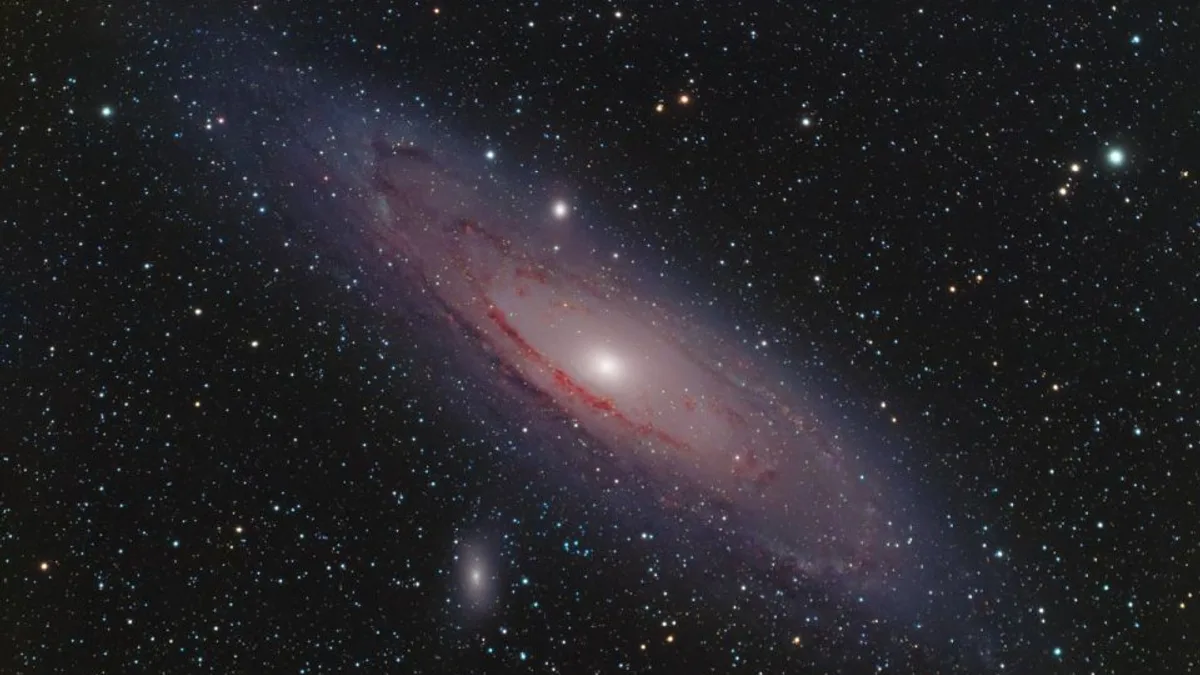
Throughout September, the Andromeda galaxy, our nearest large galactic neighbor, also remains visible in the sky. Its visibility improves as the Moon wanes toward the new Moon in mid-month. From dark locations it is barely discernible to the naked eye as a faint smudge, while binoculars make it considerably easier to find.
For a quick overview, here are all the events by date:
- September 6 to 7, morning: the Moon near Mars
- September 8, morning: the Moon near Jupiter, 0.8 degrees apart
- September 11, 5:27 a.m.: new Moon, the best nights for faint objects
- September 14, evening: crescent Moon near Venus in the west
- September 17 or 25 (sources differ): Mars near Castor and Pollux
- September 18: Venus at its brightest
- September 23, 2:06 a.m.: autumn equinox
- September 26, 6:49 p.m.: harvest full Moon, with Saturn nearby and a Neptune opposition
Most of these events need no telescope, just a clear sky and, for low-horizon conjunctions like the one with Venus, an unobstructed view to the west. What no calendar can guarantee is the weather: cloud cover and light pollution remain the biggest obstacles to observation, and the exact times in these calendars hold for a clear sky and an observer outside a lit-up city center.


