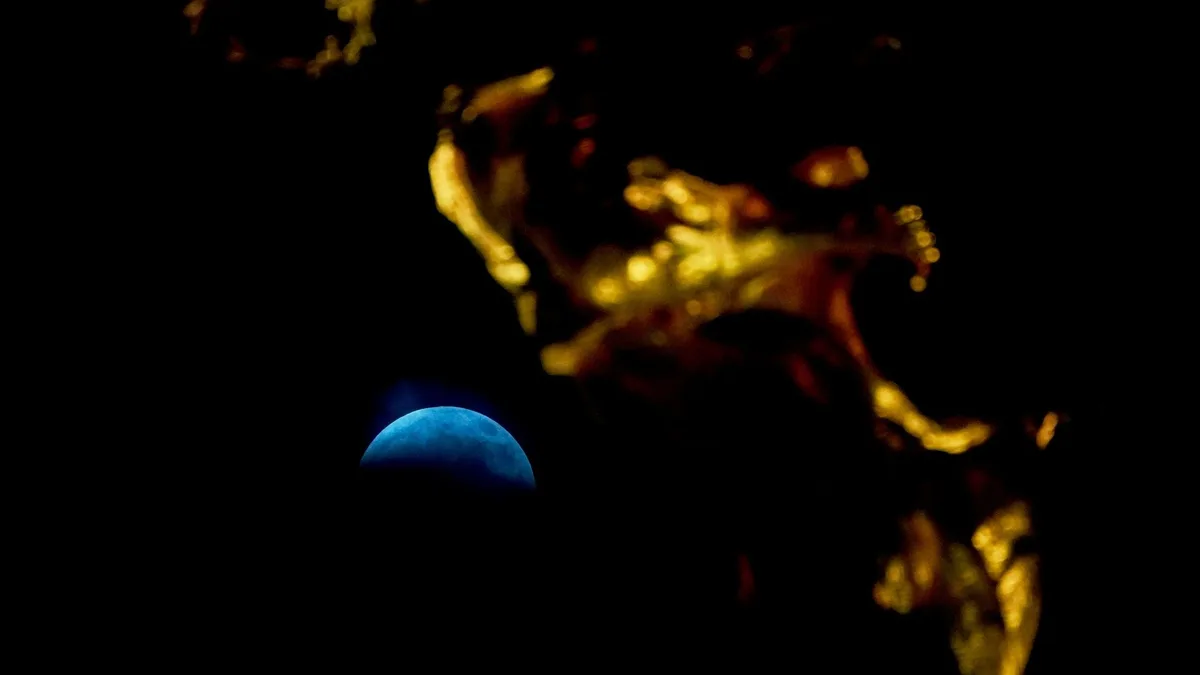
Moon Occults Jupiter Over North America in Daytime
On September 8, the Moon covers Jupiter for about an hour over North America, while from Serbia only their close approach before dawn is visible.

On September 8, the Moon will pass in front of Jupiter as seen from the North American continent, in an event astronomers call an occultation. According to the website Starlust, citing the Asheville Astronomy Club, the whole event runs from 17:03 to 20:25 UTC, or 19:03 to 22:25 Central European Summer Time. By that point the Moon and Jupiter have already set below the horizon from Serbia, so the occultation itself cannot be seen from Serbian territory.
The event is visible from Canada, Greenland, the eastern part of Russia, Alaska, most of the continental United States, and the Caribbean islands. The visibility window differs by region: for Canada the occultation runs from 17:33 to 19:55 UTC, for Alaska from 17:18 to 18:39, and for the continental US from 18:24 to 20:17.
City by city, the timing is more precise. Jupiter disappears behind the Moon and reappears at the following times, in UTC:
- Boston, from 18:57 to 19:55
- Washington, from 19:01 to 20:00
- Chicago, from 18:50 to 19:51
- Denver, from 18:54 to 19:28
- Miami, from 19:29 to 20:15
- Halifax, from 18:56 to 19:51
Depending on the observer’s location, the planet stays hidden behind the Moon for anywhere from half an hour to more than an hour. The occultation itself happens in daylight, at a point when the Moon, according to the website When the Curves Line Up, sits roughly 45 degrees above the southwestern horizon in the US Central time zone, around 13:50 local time. Watching it requires binoculars or a small telescope, since Jupiter in daytime looks like a small, grayish blue disk, too faint to pick out with the naked eye next to the Sun.
Unlike the occultation itself, the close pairing of the Moon and Jupiter before dawn on the same day is visible from Serbia as well. An hour before sunrise on September 8, the Moon and Jupiter are 4.1 degrees apart, with Jupiter standing more than 15 degrees above the eastern horizon. Jupiter sits in the constellation Cancer during this period, while Mars is in Gemini, about 27 degrees up and to the right of Jupiter. On the dark side of the young Moon, before dawn, earthshine is also visible: sunlight bounced off Earth’s oceans, clouds and land, which looks its best right around a thin lunar crescent.
Sources disagree on exactly how illuminated the Moon is that morning. Starlust puts the waning crescent at 7 percent illuminated, while When the Curves Line Up gives 9 percent. The gap is small and doesn’t change what’s actually visible in the sky, but the two sources don’t agree on the figure, and that discrepancy stands unresolved.
This isn’t the only close pairing of a planet and the Moon coming up in the next few weeks. The next occultation happens on September 14, when the Moon covers Venus. The Moon occults Jupiter again on October 6, during the lunar cycle that brings the full Moon known as the Harvest Moon: in Boston the occultation begins at 2:26, in Chicago at 3:22, in Atlanta at 2:15, and in Kansas City at 3:19, all local time. September’s full Moon itself falls on September 26, peaking at 12:49 US Eastern Daylight Time.
For observers in Serbia, this date brings no occultation to watch, only a chance to catch Jupiter near the thin lunar crescent before dawn, with binoculars or the naked eye, earthshine visible on its dark side. The next opportunity for the Moon and Jupiter to come this close together is tied to the October 6 occultation, but that one won’t be visible from Serbia either, since it happens early in the morning North American time, when it’s already daytime here.