Viminacijum: 13.7-Meter Barge Found in Old Danube Channel
Archaeologists near Kostolac pulled a third barge and sixth vessel from a closed Danube channel. The 70,000-year age was an internal guess, says Miomir Korac.
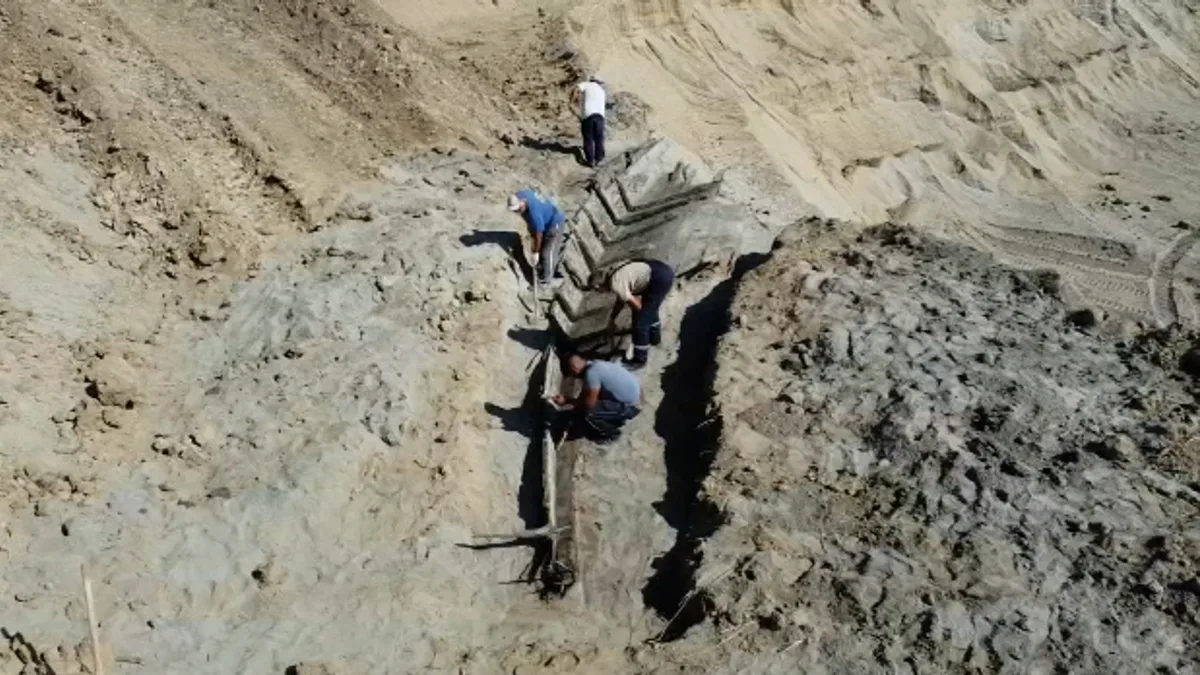
Archaeologists at Viminacijum have found another wooden barge in the former Danube riverbed near Kostolac, according to a report by RTS. The vessel was uncovered a few weeks ago. It is the third barge and the sixth vessel in total from the site. The preserved section is about 13.7 meters long, but the bow and stern were not found, so the full length is unknown.
The site is a Danube channel that was closed more than 50 years ago, when a surface coal mine expanded. Layers of earth, sand and silt kept the wood intact, and analysis of the newest barge’s timber has not yet been done. RTS does not give the exact date of the discovery.
According to doctoral student Petar Kojadinovic, it is a cargo barge with a flat bottom and sharp side edges. Part of the hull was probably destroyed by an excavator, and the ship was already damaged when archaeologists reached it. Its purpose, he said, is not in doubt:
“It was certainly used to carry cargo along the Danube,” Kojadinovic told RTS.
Doctoral student Dusan Milojevic says the first impression was grim, because the damage to the ship was plain to see, but almost 14 meters of the vessel were still saved during the dig. He also described the work itself to RTS:
“In a way, we have the best job in the world, because there is no repetition. Every day is truly its own and special,” Milojevic said.
Where does the 70,000-year story come from?
A claim spread on social media that the Viminacijum ships are 70,000 years old. Professor Miomir Korac, an archaeologist and Viminacijum researcher, explained to RTS how it came about. A mammoth was found at a depth of 27 meters, while the vessels lay at seven to nine meters, and comparing those two depths, he says, led to that number.
“It’s all Vika’s fault. We found a mammoth at 27 meters. And now when you look from 27 meters and see Rome, and Rome is very small there, and it was 2,000 years ago. And then when we found these ships, they were found at seven, eight, nine meters. And so the first thought, when you compare those two elements, is that it can’t help but be 70,000 years,” Korac said.
Geomorphologists later explained the layers as river deposits, since the Danube often changed course in that area. Korac therefore stresses that the original estimate was more an internal line of thinking than a scientifically established age. For an archaeologist, he adds, the age of an object is not the only measure of its value:
“What shows you a life at one given moment is always better, because it helps you define things. The role of archaeology is exactly that, to define for you one time, one place, one way of thinking of those people,” Korac said.
How old are the vessels according to available sources?
According to RTS, the vessels date from a range running from the fifth century BC, or the turn of the era, to the 18th century. The age of the new barge has not been published.
An earlier article by the portal Sve o arheologiji describes radiocarbon dating of wood samples in a laboratory in Debrecen and says the vessels span 18 centuries. Dr. Ilija Dankovic, a researcher at the Institute of Archaeology in Belgrade, listed the dates in a comment:
“The oldest boat is from the turn of the eras. The second boat is from the 7th century AD. The first ship is from the 9th-10th century, and the second (the best preserved one in the photographs) is from the 15th-16th century.”
The same portal elsewhere states that the largest ship dates from the first century AD and the youngest vessels from the 15th to 17th centuries. The two versions do not match in detail, and RTS now gives a wider range, up to the 18th century. The scientific paper on the vessels, which Dankovic announced, has not yet been published.
The first four vessels were found in 2020 at the Drmno mine, at a depth of about seven meters. The large ship from that find is 15 meters long, 2.65 meters wide and had six pairs of oars, according to Sve o arheologiji. It is not the same vessel as the new barge.
What else do the researchers say?
Earlier analyses show that oak was most often used to build the vessels. One monoxylon, a boat hollowed out of a single trunk, was made of pine, and to a lesser extent of beech.
Korac says the Romans understood the importance of the Danube and made it navigable. The port at Viminacijum and trade records, he says, speak to the significance of the place. A museum dedicated to the ships is being prepared at Viminacijum, and some finds have already been conserved.
Twenty-two or twenty-three holders of doctorates and about ten doctoral students work at Viminacijum. So far, roughly seven to eight percent of the site has been fully explored, counting from the city core and the legionary fortress. Kojadinovic summed it up with the line “There’s work for anyone who wants to dig. And for their children too,” and Korac spoke about finds still to come:
“What we don’t know, we have a depot, so we leave it. Someone else will know, even for us,” Korac said.
What these finds do not prove
The RTS report includes no radiocarbon dating of the new barge, so its age remains unknown. The sample is a single damaged hull without bow and stern, which means its full length and carrying capacity can only be guessed. The 70,000-year figure, by Korac’s own account, was not the result of any analysis. The dates for the older vessels come from researchers who obtained them by radiocarbon methods, but the paper with the results, according to Sve o arheologiji, has yet to appear.