

Hall and Woodford win 2026 Nobel prize in economics
Two Americans are honored for models showing how monetary and fiscal policy can soften recessions and crises that ordinary measures fail to ease.
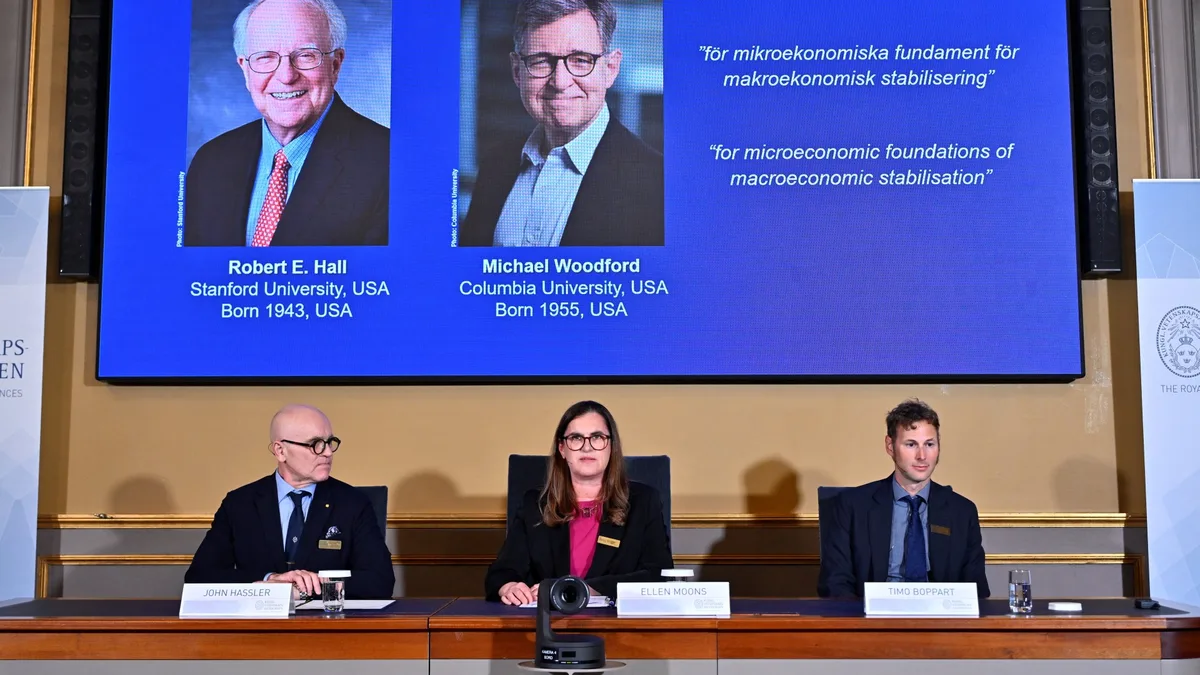
American economists Robert Hall (Robert E. Hall) and Michael Woodford (Michael Woodford) have won the 2026 Nobel prize in economics. The Royal Swedish Academy of Sciences announced the award today, Monday, October 12, in Stockholm. They were honored for macroeconomic models showing how monetary and fiscal policy can soften swings in the economy, including recessions and crises that do not respond to the usual tools.
The official name is the Sveriges Riksbank Prize in Economic Sciences in Memory of Alfred Nobel. It is the last award of this year’s Nobel season, following medicine, physics, chemistry, literature and peace.
What did Hall and Woodford offer in place of Keynesian models?
The Academy starts in the 1970s. During the oil crises, models descended from the theories of John Maynard Keynes stopped giving usable answers about when and how to respond to a recession. Hall, who is 83 and a professor at Stanford University, and Woodford, born in 1955 and a professor at Columbia University, separately began looking for a new approach.
The difference lies in the foundation. According to the Academy’s citation, instead of building models on statistical links between quantities such as inflation, output and consumption, they built them on a microeconomic base. The Academy explains it this way:
“This includes understanding how the total mass of individual households and firms, through their actions, affects the economy.”
One consequence is the assumption that households look ahead when they decide whether to spend or save. That is why the way governments and central banks communicate their policy shapes how people imagine the future, and with it their decisions.
What does the Academy say about practical use?
John Hassler, chair of the Committee for the Prize in Economic Sciences, said in the Academy’s statement:
“The laureates’ work has given us stable theoretical foundations for the models that central banks and governments around the world use today.”
Hassler added that, thanks to them, countries are better equipped for economic shocks such as energy crises or sudden shifts in how much households spend. The Academy’s citation also spelled out the condition under which the models work: “Based on these models, timely fiscal and monetary measures can reduce the peaks and troughs in the economy.”
Woodford spoke to reporters by phone during the announcement. “It’s a surprise, but I feel very good about it,” he said, and described the prize as “a great honor.” He added that his theories, although they have strongly influenced policymakers, were not “driven by a particular political agenda.” In his words, it was an attempt to improve the foundations for debate about economic policy, to contribute to managing the economy, but also to public understanding.
The prize and past winners
The prize is worth 1.2 million dollars (about 1 million euros), along with a diploma and a gold medal, and the two laureates share it. The award ceremony takes place on December 10, the anniversary of Alfred Nobel’s death in 1896. Last year the prize went to Joel Mokyr, Philippe Aghion and Peter Howitt, for research on how technology drives growth.
Economics is not among the five prizes named in Nobel’s will. It was created through a donation from Sweden’s central bank in 1968 and first awarded in 1969. The Academy selects the winners by the same procedure as the physics and chemistry prizes. According to Al Jazeera, most laureates so far come from the United States, and only three women have received it, the latest being Claudia Goldin in 2023.
The other winners were announced last week: South African judge Navi Pillay received the peace prize, Canadian-Icelandic writer Anne Carson the literature prize, Frenchman Henri Kagan and Japan’s Kenso Soai the chemistry prize, Belgian Francis Halzen the physics prize, and American Karl Deisseroth with Germans Peter Hegemann and Georg Nagel the medicine prize.
What does this not prove?
The award recognizes a theoretical framework, not the outcome of individual decisions. The Academy’s own wording is conditional: measures can soften the peaks and troughs if they are timely. It does not follow that central banks and governments pick the right moment every time.


