

Daily glacier model adds 5 to 10% to sea level contribution
A team from ETH Zurich and Vrije Universiteit Brussel ran the GloGEM model on daily weather data, and glaciers' 21st-century contribution to sea level rise grew by 5 to 10%.
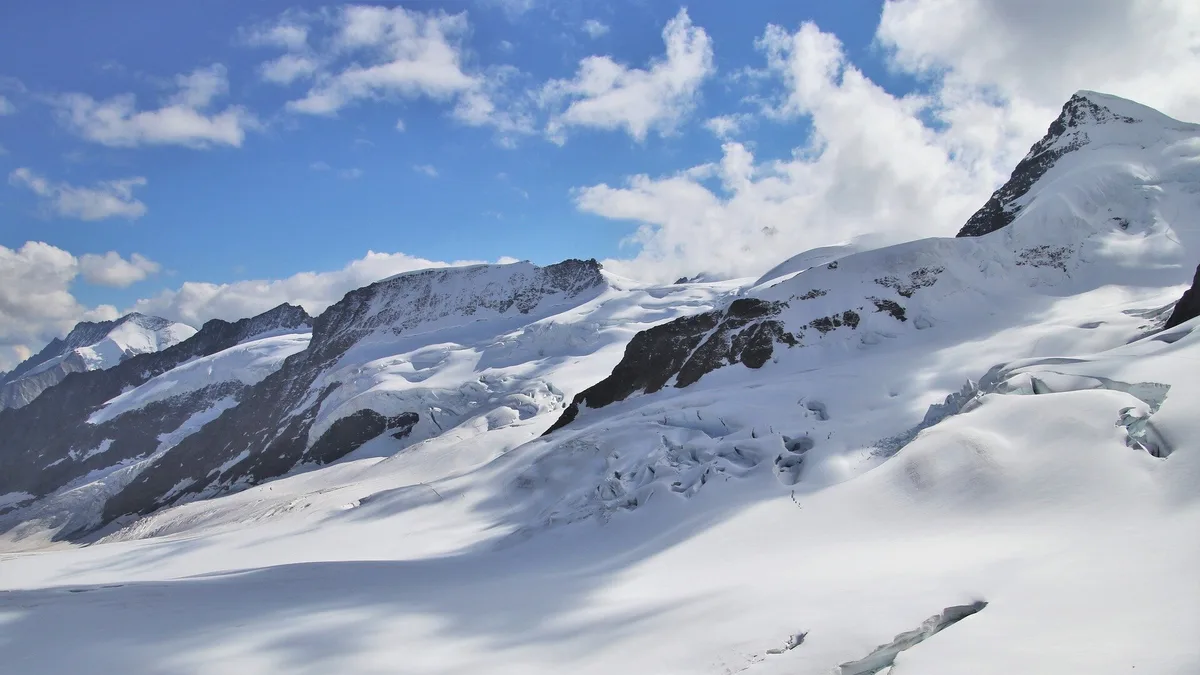
Researchers at ETH Zurich and Vrije Universiteit Brussel have published a study in Nature Communications concluding that melting glaciers will push up sea levels this century by more than current projections show. The difference comes down to time resolution: a model fed daily weather data gives a 5 to 10% larger glacier contribution to sea level than the same model run on monthly data.
The paper is titled “Resolving short-term meteorological variability amplifies projected glacier loss and sea-level rise” (DOI 10.1038/s41467-026-78260-y). The lead author is Lander Van Tricht (ETH Zurich, the Swiss institute WSL and Vrije Universiteit Brussel). Co-authors include M. Huss and Harry Zekollari, who also co-supervised the study.
What exactly changed in the model?
Most global glacier models run on monthly climate data, which smooths out short spells of weather. The team extended the GloGEM (Global Glacier Evolution Model) so that it calculates day by day, and applied it to more than 12,500 glaciers. Together they hold 94% of the world’s glacier ice by volume.
The mechanism works like this: a few extremely warm days strip away the protective snow, exposing darker ice that absorbs more sunlight and melts faster. At temperatures near zero, it also matters whether precipitation falls as rain or snow, because that decides whether a glacier gains or loses mass. A monthly average misses these transitions.
Van Tricht explains why this matters:
“Glaciers do not respond to monthly averages, but to the weather they actually experience every day. A heatwave lasting just a few days can melt enormous amounts of ice. If weather conditions are averaged over an entire month, we risk underestimating the impact of those extreme events.”
According to the authors, the daily version of the model better reproduces measured ice loss in years of exceptional melt: 2022 in the European Alps, 2023 in western North America, 2024 in Svalbard, 2025 in Central Asia and 2026 in the Alps again. The effects of short events add up over decades, so in projections the daily model shows faster glacier decline, especially in regions where sudden temperature swings drive melting.
What does it mean for water and projections?
The study does not touch only sea level. It also shows that the timing and intensity of meltwater runoff change, which has consequences for downstream water resources. Zekollari sees this as a practical question:
“Glaciers are an important source of fresh water for millions of people. Understanding not only how much ice will disappear, but also when the meltwater will be available, is essential for predicting changes in water availability. Our study shows that resolving daily weather variability can significantly improve our understanding of these changes.”
Van Tricht is cautious in his conclusion about existing projections:
“Our findings suggest that existing global projections, which mostly rely on monthly climate inputs, may underestimate how quickly glaciers will lose ice in a warmer world. It is not only the gradual rise in temperature that matters. Extreme melt events, like those we have recently seen in the European Alps and other regions, can have long-lasting consequences for glaciers. Capturing them is therefore essential to better understand the future of glaciers.”
What this result does not show
The 5 to 10% figure compares two models of the same family, daily and monthly, and not a model against measurements of the future. It is a projection, not an observation. The university’s announcement gives no figure for how many millimeters of sea level this translates to, nor which emission scenarios it applies to, so the difference cannot be converted into an absolute number without seeing the paper itself. Also, 5 to 10% is a larger glacier contribution, not a 5 to 10% larger total sea level rise, to which other sources contribute as well.


