

Euclid discovers comet C/2026 S1, its first new one
The European Space Agency telescope, built to image distant galaxies, has for the first time spotted a comet nobody knew about. The find was confirmed on October 8.
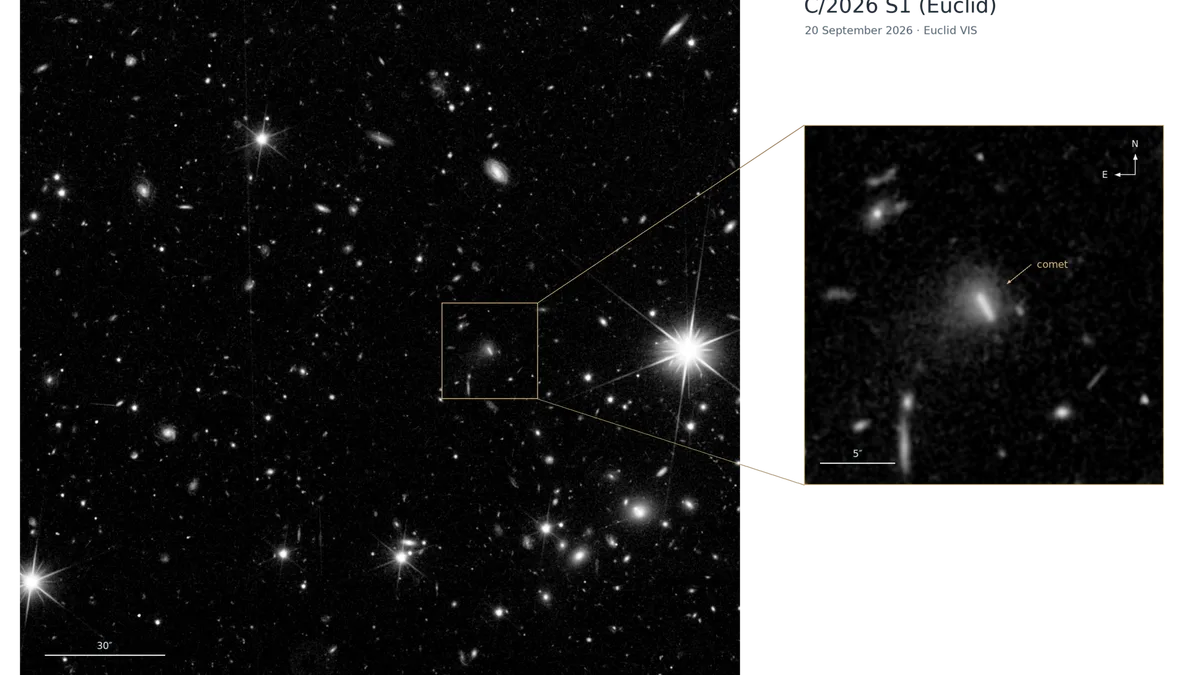
The European Space Agency’s (ESA) Euclid telescope has discovered its first previously unknown comet. The object is designated C/2026 S1 (Euclid) and sits about 1.3 billion kilometers from Earth, roughly the distance from the Sun to a point somewhere between the orbits of Jupiter and Saturn. The comet appeared in images taken from September 16 to 24, 2026, and the International Astronomical Union’s Minor Planet Center confirmed it as a comet on October 8.
Euclid was not built for this kind of work. The mission is meant to spend six years observing the shapes and motion of billions of galaxies up to ten billion light-years away, to reveal the hidden influence of dark matter and dark energy on the visible universe. Fast-moving objects from our own Solar System are a nuisance for it, not a target. Euclid has recorded comets before, but all of them were already known; C/2026 S1 is the first one it found itself.
How was the comet spotted in the images?
The find is the work of Mikko Pontinen, a doctoral student at the University of Helsinki, and the Solar System Objects Working Group within the Euclid Consortium. Pontinen used moving-object detection software he developed himself to track small Solar System bodies in Euclid’s images. In an ESA statement he described the moment the program flagged it:
“I was excited when I saw that my software had flagged a ‘streak’ stretched across several images, the result of a fast-moving object. By predicting its position, I was able to identify it in other images too, in a total of five sets of images. Further inspection showed a hazy cloud around it, a sign of an active object like a comet shedding dust and gas.”
The comet was captured in the Euclid Deep Field North in five different frames, with two to four exposures in each, for a total of 16 exposures. One of them, taken on September 20, lasted 560.52 seconds, a little over nine minutes. In that time the comet crossed the sky, so it shows up as an elongated streak, and around its nucleus a so-called coma can be made out, a cloud of dust and gas that forms when ice on a comet turns to vapor.
A check against catalogs of known comets and asteroids turned up no match, so Pontinen reported the observations to the Minor Planet Center as a new comet. The center is the world’s clearinghouse for data on comets and asteroids: it collects reports from observers, confirms new discoveries, computes orbits and assigns official designations. The report also alerted astronomers on the ground, who could add their own observations.
Why is a find like this rare for Euclid?
Euclid deliberately avoids the band of sky along the plane of the Solar System, which is rich in asteroids and comets, because the dust there creates a glow that interferes with sensitive deep-sky imaging. On top of that, it normally visits each patch of sky only once, so a comet cannot be photographed again when needed. C/2026 S1 landed in the frame because it is not in the plane of the planets: seen from the Sun, it is currently steeply above it, on an arc across the Solar System along an orbit it completes in several thousand years.
Bruno Altieri, the scientist in charge of the Euclid mission archive and a member of the team behind the discovery, said in the ESA statement:
“Very few comets should be discovered by Euclid, so it was a lucky coincidence that the comet’s trajectory and Euclid’s scanning in those days together captured the object in multiple images.”
Valeria Pettorino, Euclid project scientist, offered an assessment of what the find means for future missions. According to her, this comet is not a suitable target for ESA’s upcoming Comet Interceptor mission, but the case is useful all the same:
“Although this comet is not a suitable candidate for Comet Interceptor, the process of discovery and alert gives us a real test case for how our two mission teams will coordinate in the future. And of course, we are happy to have discovered a previously unknown comet that the Solar System community can follow up on.”
Euclid needs to track Solar System objects even without discoveries like this one: that is how every object in a frame is identified and noise is removed, such as comet trails or excess light unrelated to its main task, the precise mapping of galaxies. The short gap between recognition and confirmation, according to ESA, shows that Euclid can discover new comets while they are still relatively far from the Sun.
What does this discovery not tell us?
The limits of the find are clear. The comet’s orbital period will become more precise only once more data is collected, and ESA’s statement does not say when the comet passes closest to the Sun or whether it will ever be visible to the naked eye. A single find also says nothing about how many new comets Euclid will turn up in the future: Altieri himself says very few such discoveries are expected from the telescope, and C/2026 S1 is not suitable for Comet Interceptor either, so its main value for now lies in testing cooperation between the two mission teams.


