

Zhuque-2E Rocket Debris Falls on Borneo Palm Plantation
Two pieces of metal marked 2ZQE31-20-15 were found on an oil palm plantation in Borneo. Indonesia's BRIN agency links them to a Chinese rocket. No one was hurt.
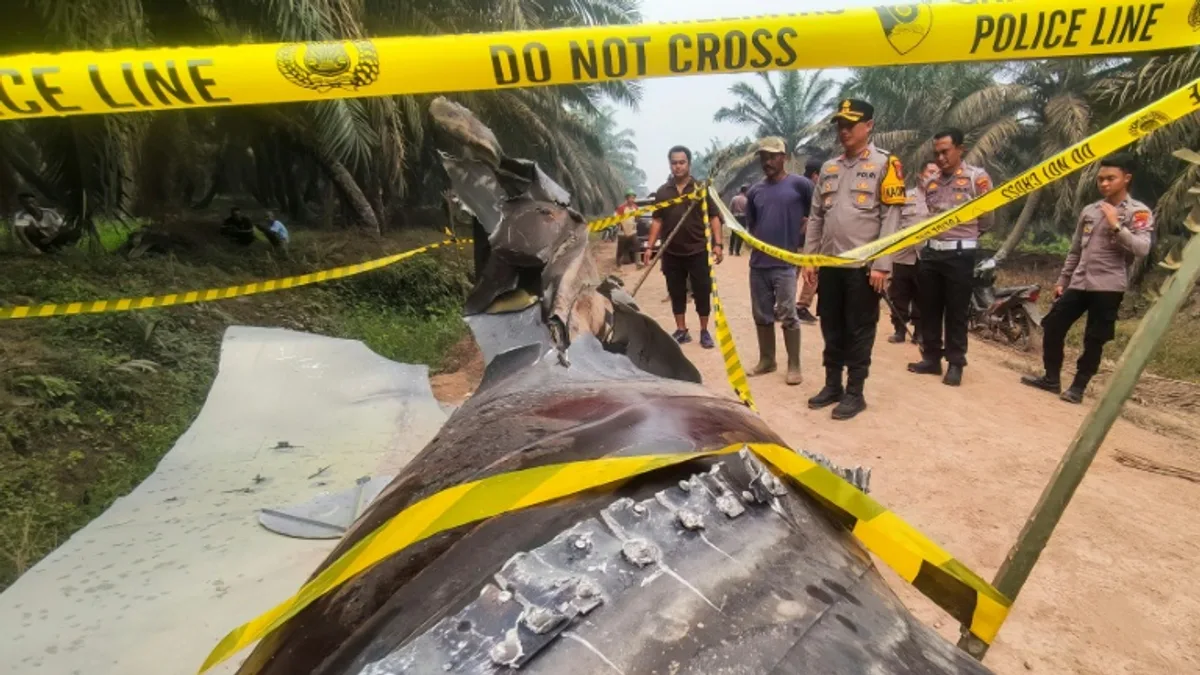
Two pieces of metal that Indonesia’s state agency BRIN says came from the Chinese rocket Zhuque-2E were found on Monday, October 19, and Tuesday, October 20, on an oil palm plantation near the town of Sampit on the Indonesian side of Borneo. No one was killed or injured, and the origin of the objects has not yet been confirmed.
What was found, and where?
The site is a plantation owned by PT Agro Bukit, block G38-39 of the Sungai Lenggana estate in Kotawaringin Timur regency, Central Kalimantan province. The plantation lies along the Sampit-Pangkalan Bun road. According to AFP, it is about three kilometers from the company’s workers’ housing.
Workers and local residents reported a loud bang on the evening of Sunday, October 18. A worker spotted the first piece on a plantation collector road at around 7 a.m. on Monday and alerted the foreman. AFP says the worker was Wardi Tamroni, 51.
“It was there. At first I thought it might be the remains of some aircraft.”
That is how Tamroni described the find to AFP. He added that all the workers had already gone home when the object fell.
“Luckily, all the workers had already gone home, so nobody was left in the plantation.”
The marking on the metal and BRIN’s role
The piece shows burn marks and attached cables, and one section carries the marking 2ZQE31-20-15. According to the news outlet detik, the full inscription reads 2ZQE31-20-15 240256KY. The inscription was examined by the National Transportation Safety Committee (KNKT), which noted that the marking resembles the name of the Zhuque-2E rocket. The Aerospace Research Organization (ORPA) at BRIN then confirmed that the part comes from that rocket. AFP is more cautious: according to BRIN, the debris “appears” to be part of a Zhuque-2E rocket.
BRIN researcher Thomas Djamaluddin explained that not every part of a spacecraft burns up on reentry, and that sturdier components can reach the ground. In a statement from the agency, he added:
“This phenomenon is one possible explanation for the discovery of a large piece of metal on an oil palm plantation in Sampit.”
According to AFP, China said last week that the Zhuque-2E rocket launched 10 satellites from a commercial spaceport in the northwest of the country. The China National Space Administration (CNSA) was not available for comment.
Sources differ on the time and the size
There are two versions of when the debris fell. ANTARA reports that workers and residents heard the bang at around 6 p.m. local time. Detik, citing the H. Asan airport team in Sampit, says the part fell at about 5:36 p.m.
The description of the piece differs as well. ANTARA describes it as roughly round, about 4 by 3 meters. Local police chief I Kadek Dwi Yoga Sidhimantra told AFP it was an irregularly shaped aluminum plate up to nine meters long, with visible burn marks.
The second piece and the safety assessment
The second piece was found on Tuesday morning, about a kilometer from the first. Civil aviation spokesman Zachrudien told AFP that officials have yet to inspect it.
“Judging by the photos, the object is round and connected to the first one. Its material also appears to be an aluminum alloy, but we have to verify that.”
According to Zachrudien, there are no injuries and no material damage, and no risk of radiation or toxicity. BRIN, according to detik, says the debris contains no toxic substances.
The site has been cordoned off with tape, and residents have been asked not to touch, dismantle or move anything until the inspection. On the first day of the discovery, Mentaya Hilir Utara sub-district head Muhamad Huzaifah told ANTARA:
“The temporary information is that the object is still at the site and that only one has been found.”
The first piece was taken to the Lanud Iskandar air base in Pangkalan Bun, about 125 kilometers and four hours 20 minutes by road from the site. The meteorological agency BMKG declined to confirm the origin of the object. Its head for Kotawaringin Timur, Mulyono Leo Nardo, told ANTARA: “We cannot confirm it because it is not within our authority.” The Sampit airport referred questions to KNKT.
How rare is this?
Most space debris comes down in the oceans, which cover about 70 percent of the Earth’s surface. In last year’s report, the European Space Agency estimated that the risk to an individual from uncontrolled reentry is lower than from rare accidents such as lightning strikes or shark attacks, but that it is rising.
“While reentry risks remain relatively small, they have grown significantly from 2019 to 2024, mostly because of increased space activity.”
That is what the report from the ESA space debris office says. Tamroni, who found the piece, responded: “If we had to expect something like this every day, we couldn’t do our jobs. We have to leave it to fate. What else can we do?”
What this does not prove
For now, the link to the Zhuque-2E rocket rests on the marking on the metal and BRIN’s assessment, and the Chinese side has not commented. The source of the bang on Sunday has not been officially confirmed, so it cannot be said that it is connected to the fall. The composition of the second piece has yet to be checked, and official measurements of the first piece have not been published, which shows in the difference between the descriptions in the sources.


