Falcon 9 Rocket Stage to Hit the Moon Wednesday at 8:35
The Falcon 9 upper stage falls near the Einstein crater on Wednesday at 06:35:37.5 UTC. A University of Texas at Austin team predicts a dust plume rising as high as 100 kilometers.

The upper stage of a Falcon 9 rocket, listed in tracking catalogs only as 2025-010D, is set to hit the Moon on Wednesday, August 5, at 06:35:37.5 UTC, or 8:35 a.m. Central European Summer Time. The impact site is near the Einstein crater, on the sunlit edge of the near side of the Moon, the side visible from Earth. American astronomer Bill Gray calculated the trajectory, and the event is being watched closely because it is a rare chance to observe an artificial lunar impact as it happens, with the time and place known in advance.
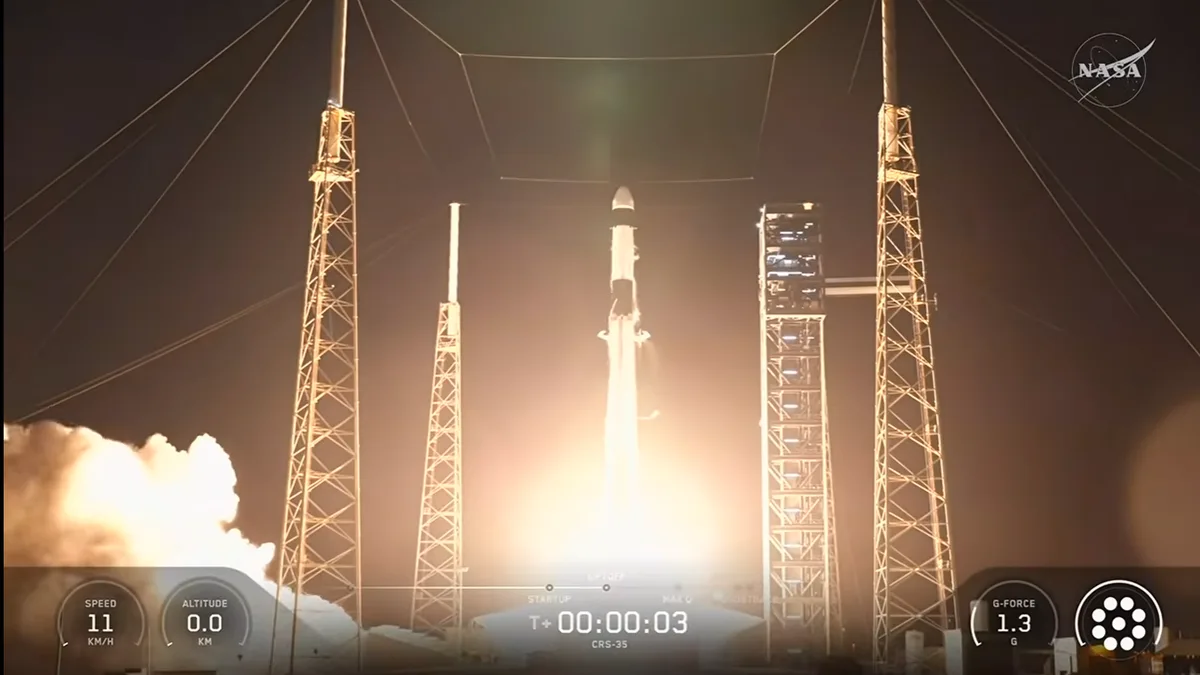
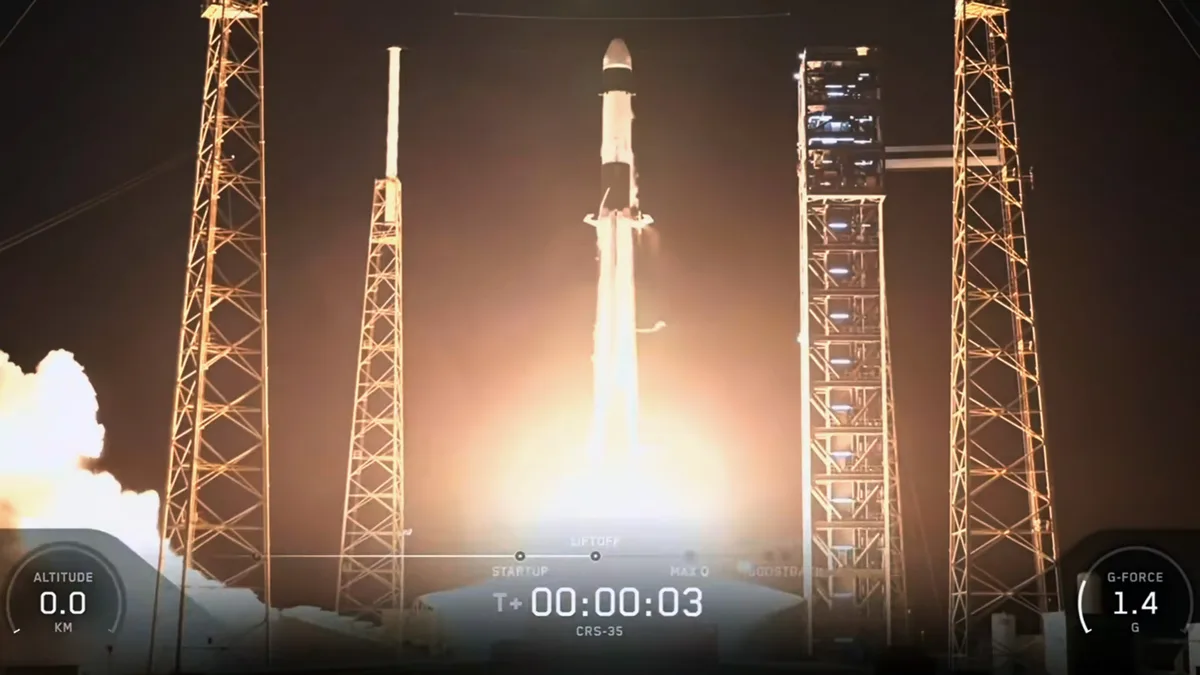
The stage launched on January 15, 2025, from the Kennedy Space Center, carrying two landers toward the Moon: Firefly’s Blue Ghost Mission 1 and Japan’s ispace RESILIENCE. Once it released them on their lunar trajectory, it ran out of fuel. It could not reenter Earth’s atmosphere and burn up, nor could it head off beyond Earth, so for more than a year and a half now it has been drifting in an elongated orbit that crosses the Moon’s path. Gray wrote on his website that this poses no danger to anyone, but that it does say something:
It poses no danger to anyone, but it is indicative of a certain carelessness in the disposal of space hardware.
How the impact was calculated
Gray calculates the orbits of objects at high altitudes, ones that military radar essentially cannot track because they are too far away, so only telescopes pick them up. His software predicted the impact back in September 2025, and the calculation has been refined with new observations ever since. By February 26, 2026, more than 1,000 observations of the object had been collected, from observatories in Mississippi, Utah, Beijing and England. Amateur astronomers have also recorded changes in brightness that show the stage is tumbling as it travels.
The tumbling is not a minor detail. Sunlight pushes on the object, weakly but constantly, and how much it gets pushed depends on which side is facing the Sun. Because of that, the impact point keeps shifting and has to be recalculated after every new measurement. For now, Gray puts it this way:
In theory, the time is accurate to about half a second, and the position to about 0.01 degrees, which is roughly a third of a kilometer.
He adds that theory does not fully capture those unpredictable parts of the motion, so in practice he works with a margin of several seconds and several kilometers.
What to expect on the lunar surface
The object is not a solid chunk of metal but a largely hollow structure, and that changes the physics of the impact. Here is what is known:
- length about 12 meters, width about 4 meters
- mass about 4,000 kilograms by one estimate, or about 4,900 kilograms by Gray’s
- impact speed of 2.43 kilometers per second, about 8,700 kilometers per hour
That gap in the mass estimate is not trivial. Impact energy scales linearly with mass, so a difference of 400 kilograms changes the calculation by roughly a fifth, and that in turn affects the estimated crater size and plume height. The crater is expected to be 20 to 30 meters wide and about five meters deep, throwing out roughly 1.2 million kilograms of lunar material. Because the structure is hollow, it will crumple on impact rather than dig in deep the way an asteroid of the same mass would.
What will be visible from Earth?
There are two possible signs, and they differ greatly in how long they last. Benjamin Fernando and colleagues, in a paper posted on arXiv, write:
The possible observable signatures of this event are a flash at the moment of impact and a plume of ejected material.
The flash lasts less than a second and is hard to catch, requiring very high speed cameras. The dust plume lingers for minutes. According to a model from William Jo of the University of Texas at Austin, the central jet of ejected material should rise to 75 to 100 kilometers, a curtain of dust to 15 to 20 kilometers, and the lateral spread should reach about 180 kilometers. Jo also worked out a brightness estimate: by his model, the plume would be several orders of magnitude brighter than the dark sky behind it during the first few minutes.
Viewing conditions are best in the eastern half of the United States and Canada, as well as most of South America. The Moon will be near its last quarter phase at that time, and it will be nighttime there.
Nothing will be visible from here
From Serbia there will be nothing to see, even though the Moon is above the horizon at the time. At 8:35 a.m. local time it is broad daylight, the Sun is high, and neither the flash, which lasts less than a second, nor the dust plume above the lunar edge can be picked out against the daytime sky. Any usable footage will come from the Americas, and the first images of the crater itself will only come later, from lunar orbit.
That job falls to the Lunar Reconnaissance Orbiter, NASA’s probe that has been imaging the Moon since 2009. The same probe photographed the aftermath of another rocket stage impact on March 4, 2022. That time, the images turned up not one crater but two, about 16 and about 18 meters wide, a result nobody expected and one that still has no confirmed explanation. That is why this time’s estimate of 20 to 30 meters is not something that will simply be confirmed as is.
The limits of this forecast
The paper on the expected consequences of the impact is a preprint on arXiv, and the paper from Austin has only just been submitted to a journal. Neither has been peer reviewed yet. The figures on plume height and brightness come from simulations, not measurements, and for hollow objects of this kind there are very few impact models that have been checked against a real case. That is exactly why researchers find the event interesting.
The model does not guarantee that anything will be visible. There is a precedent pointing the other way too: in 2010 a rocket stage was deliberately steered into the Moon, the impact was timed so major telescopes could observe it, and nothing was seen. On top of that, at a speed of 2.43 kilometers per second, a smaller share of the energy comes out as visible light than with natural meteor impacts, which hit the Moon at speeds of around ten kilometers per second.
There is also a chance that the impact point, pushed by sunlight pressure, shifts slightly past the edge, onto the far side of the Moon that cannot be seen from Earth. Gray does not expect that, but he does not rule it out either. A precise answer to both questions, where and when, will only be known in the final hours before impact, since observations keep coming in until then.