

Andromeda Red Giant Caught Swallowing Its Companion Star
Columbia University astrophysicists tracked a red giant in Andromeda from its first brightening in 2018 to an eruption in late 2025. The study appeared in Nature.
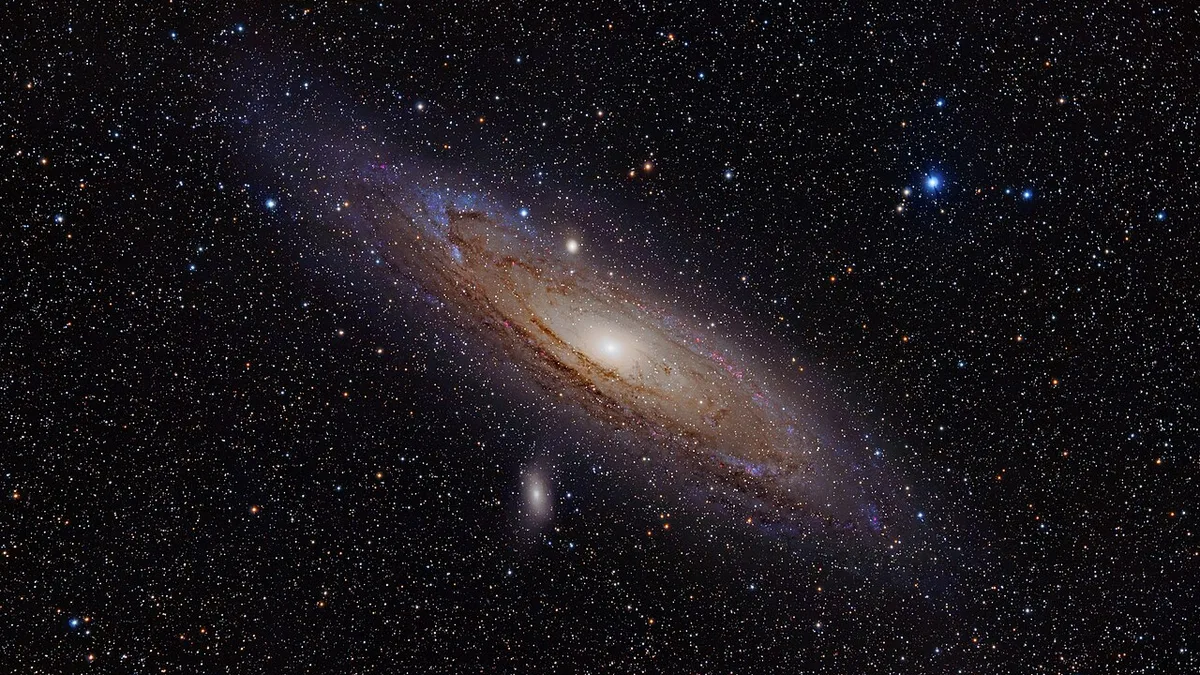
Astronomers have, for the first time, directly followed a giant star as it swallows its companion, from the earliest hints to the final eruption. The system sits in the Andromeda galaxy, about 2.5 million light-years from Earth, and the work was published on November 18, 2026 in the journal Nature. The lead author is astrophysicist Viraj Karambelkar of Columbia University in New York.
The star carries the designation WNTR23bzdiq, while ABC News lists the same system as AT2025abao. The team nicknamed the binary “Bao,” so the larger member is Big Bao and the smaller is Little Bao. Big Bao is a red giant of about seven solar masses and roughly 350 times wider than the Sun (ABC says “more than 350”). Little Bao has about 0.7 solar masses.
How did the event unfold between 2018 and 2025?
Archival data show the giant began to brighten gradually as early as 2018. Scientists noticed the unusual changes in brightness only in 2023, in observations from the NEOWISE space telescope, which is no longer operating, and from the WINTER telescope at Palomar Observatory in California. Karambelkar told ABC that the team first spotted the star in 2023 because of odd brightness shifts in the data. The Zwicky Transient Facility was also used for tracking.
The team proposed an explanation even then: if the giant is swallowing a companion that spirals toward its core, friction produces heat and light, and the star brightens. The next step was a large burst of light. Space.com dates it to late 2025, and ABC puts it in October 2025, when the brightness jumped sharply. Researchers interpret it as the moment the companion crashed into the giant’s heart.
The James Webb Space Telescope imaged the star 47 days after the eruption, and those observations let the team describe the event in detail. The estimate is that the eruption threw off material with a mass of 0.1 to 0.2 solar masses. Karambelkar said he watched it with amazement:
“I was absolutely stunned when we saw it.”
Why is an event like this so hard to catch?
In astrophysics the process is called common envelope evolution. When a star like Big Bao ages, it swells to hundreds of times its original size. If a smaller star is nearby, both end up inside the larger star’s outer plasma envelope, and the smaller one begins sinking quickly toward the core. The outcome is either the destruction of the companion, or the ejection of the envelope and a new, tight pair. Karambelkar told ABC that this process is key to forming close binary systems such as merging neutron stars and white dwarfs.
The theory of a star swallowing its companion has existed for decades, but nobody had observed it. According to Karambelkar, the reason is a faint, short-lived signal: the event lasts only a few years, while stars evolve over millions of years:
“When a star swallows its companion, the effect is very subtle, like throwing a bucket of water into a big ocean. We need sensitive telescopes that watch the sky for a long time to catch that effect.”
An independent assessment came from Sven Buder, an astrophysicist at the Australian National University who was not involved in the study. In his words, the team could reconstruct what happened with fairly high confidence, because observations were collected before, during and after the spiral and the merger. Buder described what happens inside the envelope: “It’s a star moving through a hot ocean of plasma.”
What does the study not prove, and what comes next?
The authors do not claim that a merger is the only possible explanation. Space.com writes that astronomers may have observed the event directly, and Karambelkar named a different option:
“The other possibility is that both stars survived, in a much shorter orbit.”
To settle it, the team will keep monitoring the system once the aftermath of the eruption calms down. Until then, a merger is the most likely reading, not a proven outcome. This is also just one system: the study does not say how common such mergers are.
The team expects more cases from the Vera Rubin Observatory and the Nancy Grace Roman Space Telescope. Karambelkar said: “Now that we’ve found the first star-swallowing event, we want to find more.”


