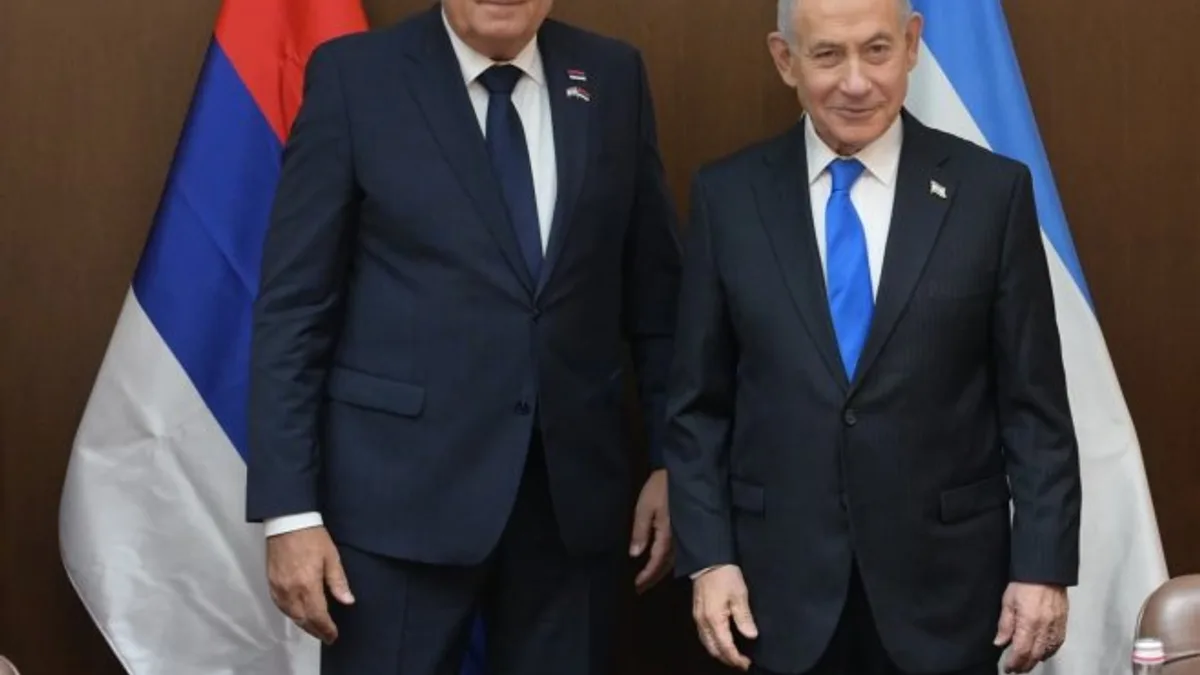
Dodik: Bosnia Must Annul High Representative Decisions
From Mostar, the SNSD leader said Republika Srpska will not consent to changing how the Serb presidency member is elected and that Bosnia must return to its constitution.

- Speaking in Mostar on July 13, SNSD leader Milorad Dodik said Republika Srpska will not consent to changing how the Serb member of Bosnia's presidency is elected.
- He demanded that Bosnia return to its constitution and that all decisions by high representatives be declared null and void.
- He announced his party will enter the coming elections expecting its best result yet.
- He described cooperation with HDZ BiH as good.
Milorad Dodik, president of the Alliance of Independent Social Democrats (SNSD), said in Mostar on July 13 that Republika Srpska will not consent to changing the way the Serb member of Bosnia and Herzegovina’s presidency is elected. The message came after a meeting with the leadership of the Croatian Democratic Union of BiH, and Dodik specified that there is nothing to discuss about the Serb member’s election except through direct elections within Srpska.
That reopens one of the most sensitive questions of constitutional matter in Bosnia. The method of electing presidency members has been disputed for years, and Dodik reduced Srpska’s position to a single line: without the entity’s consent, the rules of the game will not change. In the same address he said the state must return to the Dayton constitution and that every decision handed down by high representatives should be declared void.
Why does Dodik want the high representative’s decisions annulled?
The office of the high representative, created by the Dayton Peace Agreement, has been a source of political dispute in Bosnia for decades. Dodik sees it as a mechanism that imposed decisions against the will of the constituent peoples, and he has turned the annulment of those acts into one of the central planks of his platform. His demand is not new, but he now voices it alongside partners from HDZ BiH, giving it a broader front.
Dodik described cooperation with HDZ BiH as good, saying the two parties work without undermining one another. For the Serb and Croat political scenes in Bosnia, that signals a shared line forming around the question of the high representative’s powers, even if the two parties’ motives differ. Bosniak parties have traditionally defended broader powers for the office, so a line of conflict is already visible ahead of the next electoral cycle.
Dodik announced that his party is entering the elections expecting its strongest result to date. That announcement, paired with the call to return to the constitution, reads as an attempt to make the constitutional theme the campaign’s central issue. For voters in Srpska, it means the ballot will once again be framed around questions of jurisdiction and the entity’s relationship to state institutions.
What does this mean for relations within Bosnia?
The message from Mostar shifts the focus from day-to-day politics to the constitutional framework, and that is where its weight lies. If Republika Srpska consistently refuses consent to changing how the Serb presidency member is elected, any reform of that part of the constitution is blocked from the outset, since such changes require broad consensus. The question of the high representatives further sharpens relations with international actors who see the office as a guarantor of Dayton.
It remains open how Bosniak parties and the international community, which view the high representative differently, will respond to these messages. Some seek its abolition; others regard it as the last barrier to stability. The next electoral cycle is thus shaping up as a clash between two opposing visions of how Bosnia should be arranged.
Do you think an agreement on constitutional questions in Bosnia is possible without the consent of all three constituent peoples, or is deadlock now a permanent condition?