Dodik answers Netanyahu on X: an alliance of nations
Israel's prime minister congratulated Dodik, Cvijanovic and Minic on their election win, and the SNSD leader replied the same day. It follows Dodik's remarks on unifying with Serbia.
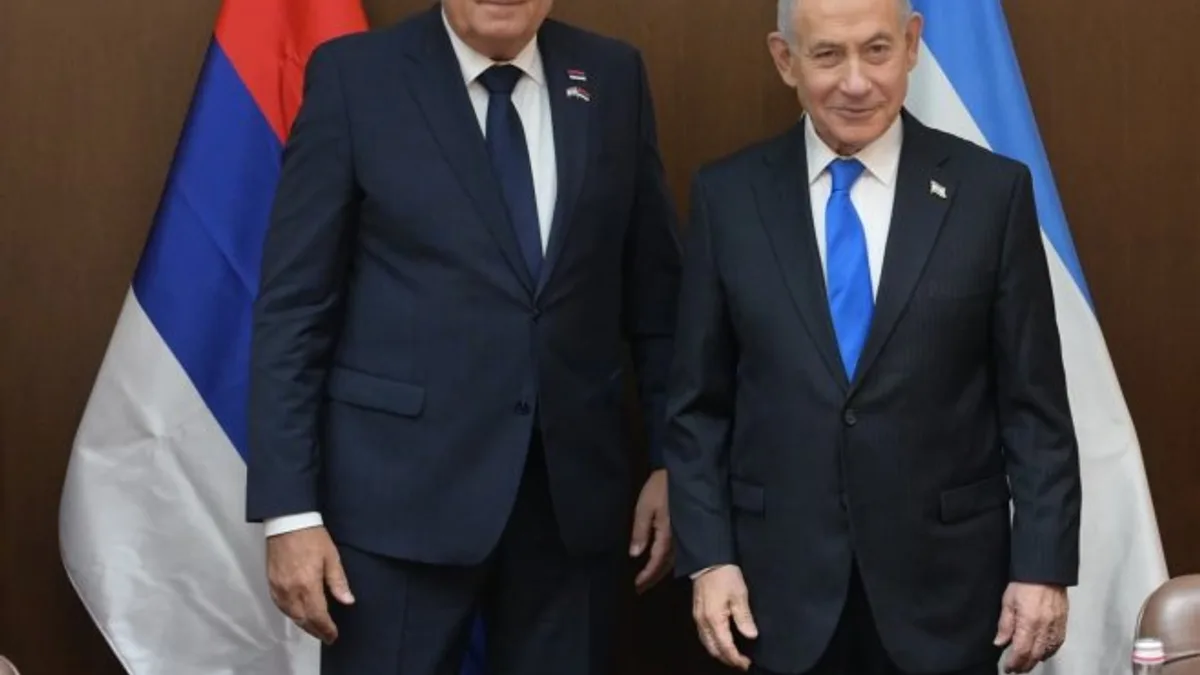
Israeli Prime Minister Benjamin Netanyahu congratulated SNSD leader Milorad Dodik, Zeljka Cvijanovic and Sava Minic on their election win in a post on X on October 8, and Dodik answered him publicly the same day. The exchange comes a few weeks after Dodik told an Israeli newspaper that he dreams of Republika Srpska leaving Bosnia and Herzegovina and unifying with Serbia. Dodik has spoken about unification with Serbia openly, while Netanyahu did not mention it in his congratulations.
This newsroom previously reported on the letters Dodik sent to Netanyahu and to Ohana on the anniversary of the attack.
What did Netanyahu write about the Republika Srpska elections?
The occasion is the general election of October 4, in which the SNSD (Alliance of Independent Social Democrats) won the most votes at every level, according to preliminary data from the Central Election Commission of Bosnia and Herzegovina. Cvijanovic is a candidate for the Serb member of the Bosnia and Herzegovina Presidency, and Minic is the SNSD candidate for president of Republika Srpska.
Netanyahu wrote in his post:
I want to congratulate my great friends President Milorad Dodik, Zeljka Cvijanovic and Sava Minic on their decisive victory in the elections in Republika Srpska
He then added that he looks forward to years of close cooperation, as the Sarajevo portal N1 translated it: “I look forward to years of close cooperation, to expanding and deepening the cooperation between our peoples in technology, energy, security and other areas”. He also congratulated the SNSD party.
What did Dodik say in reply?
Dodik thanked Netanyahu and the State of Israel, then wrote: “Serbs and Jews are two peoples who know what it means to defend their name, their faith and their right to exist on their own land”. He went on with a sentence he singled out in the post as the core of his message:
Our friendship is not a word - it is an alliance of peoples forged in the same threat and the same struggle
Finally, he said that he and Israel “see each other” in specific areas: “We see each other in technology, in energy, in security and in everything we are only now building”. He closed the post with the message: “Jews and Serbs never surrender, and that is why the future belongs to them”.
Sar’s congratulations and who was left without one
Netanyahu’s message is not the first from the Israeli leadership. Israeli Foreign Minister Gideon Sar described the SNSD result on X as early as October 5 as a strong confirmation of trust in Republika Srpska, and praised Dodik’s leadership and policies, without mentioning Bosnia and Herzegovina. The Sarajevo portal N1 reports that Sar separately congratulated Darijana Filipovic of the HDZ BiH on her election as the Croat member of the Presidency, while Denis Becirovic, who won a new term as the Bosniak member, was not mentioned, nor were the SDA or the SDP.
Neither Netanyahu nor Sar explicitly endorsed Republika Srpska’s secession in their posts.
Ties that already have an address in Banja Luka
On September 13, in an interview with the Jerusalem Post, Dodik was asked whether he is thinking about a referendum on leaving Bosnia and Herzegovina and unifying with Serbia. He answered: “I dream about it. Absolutely”.
Meanwhile, the Israeli connection is taking institutional form. An office of the Israeli Chamber of Commerce, headed by Amir Gros Kabiri, opened in Banja Luka in September. The opening was attended by Israeli Diaspora Affairs Minister Amichai Chikli, Galit Peleg, who was then finishing her term as Israel’s non-resident ambassador to Bosnia and Herzegovina, and Zeljka Cvijanovic.
In a few weeks, Israel has thus had three public contacts with the Banja Luka leadership: the chamber’s opening in September, Sar’s message of October 5 and Netanyahu’s congratulations of October 8. The election was held on October 4, and the Central Election Commission figures cited by RTRS are still preliminary.