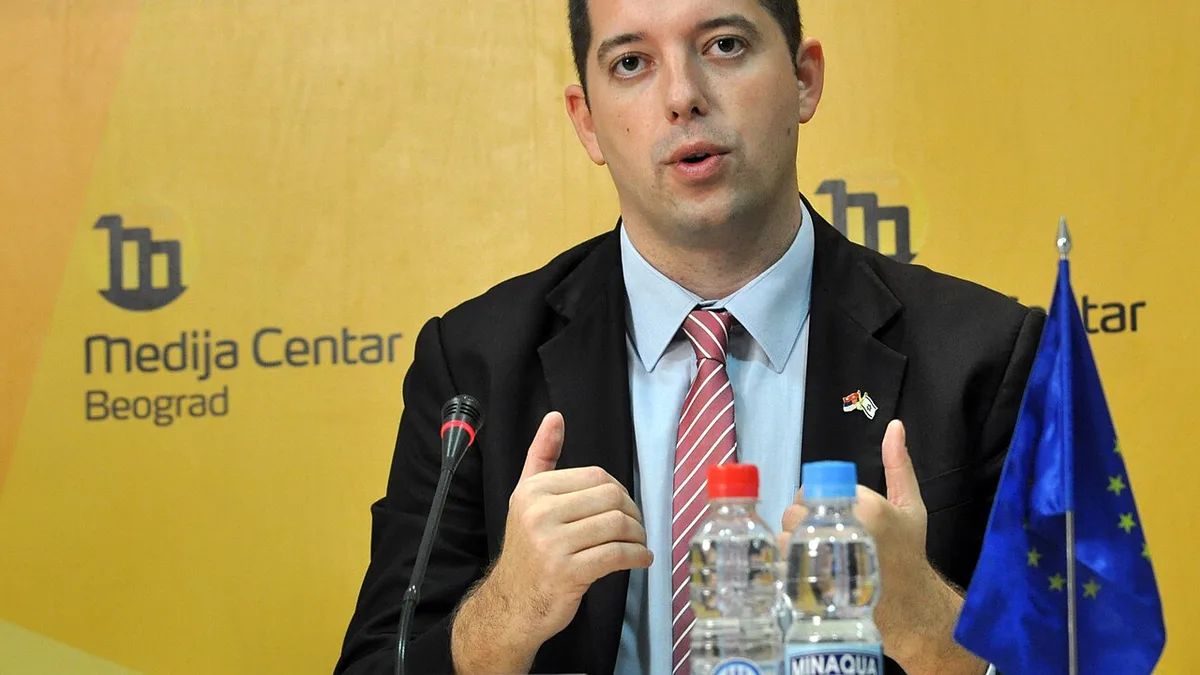
Petkovic to New Negotiator: Bajrami Must Learn Dialogue Basics
Belgrade's Kosovo office chief says talks have been frozen since April as Pristina spurns the EU envoy, while Kurti names a negotiator with no mandate on substance.

- Petar Petkovic, director of Serbia's Office for Kosovo and Metohija, says the Belgrade-Pristina dialogue has been frozen since April.
- Pristina is rejecting invitations from EU special envoy Peter Sorensen to resume talks in Brussels.
- Aljbin Kurti has appointed a new negotiator, Agron Bajrami, whom Petkovic says should first learn the basics of dialogue.
- Belgrade insists that Pristina's wishes and dreams are not, and never will be, a subject of the talks.
Petar Petkovic, director of Serbia’s Office for Kosovo and Metohija, said on Monday that the dialogue between Belgrade and Pristina has effectively been frozen since April, and that the reason, in his words, is Pristina’s refusal to answer invitations from the European Union’s special envoy, Peter Sorensen, to return to the table. The remark came days after Aljbin Kurti appointed a new negotiator, Agron Bajrami, a man Petkovic says should first learn the basics of dialogue before taking a seat in Brussels.
The line sounds like diplomatic posturing, but there is a concrete calculation behind it. Belgrade has repeated the same argument for months: it is not Serbia that is avoiding talks, but Pristina that is ignoring the mediator’s calls. Petkovic was precise about the tone, saying that Pristina’s wishes and dreams are not a subject of the dialogue and never will be. With that, he drew a red line in advance for any new interlocutor, Bajrami included.
Why send a new negotiator into an empty room?
On paper the appointment looks like movement; in practice it is closer to a gesture. From what we understand of the corridors of the Brussels process, Bajrami arrives without a mandate on substance, meaning he can conduct technical talks but cannot open the questions that would shift negotiations off dead center. If that holds, a change of name changes little. The table stays the same, and it stays empty.
Petkovic’s phrase about the basics of dialogue is therefore not merely an insult sent across the border. It is also a signal to Brussels that Belgrade will not treat the new negotiator as a serious partner until it is clear what exactly he is allowed to negotiate. Sorensen, the envoy who took over the mediation, is left in an awkward role: he calls both sides, and one of them, according to Belgrade, systematically fails to respond. When a mediator calls into an empty room, the process does not formally break down; it simply ceases to exist.
It is worth recalling that the dialogue last had real momentum more than a year ago, over the formation of the Community of Serb Municipalities, an obligation Pristina has yet to fulfill. Since that knot was left untied, every attempt to resume talks drifts back to the same point and stops there.
What remains when talk becomes a formality
With an election autumn approaching in both Belgrade and Pristina, the dialogue increasingly resembles a backdrop for domestic audiences rather than a process with an outcome. Each side speaks to its own voters, not to the other across the table. By naming a negotiator, Kurti signals activity; by refusing others’ conditions, Belgrade signals resolve; by issuing invitations, Brussels signals that it is mediating. All three messages point inward, not outward.
The opposition in Serbia reads these exchanges differently. Part of it argues that the government uses the Kosovo file to divert attention from domestic problems, while another part demands a clearer strategy instead of the repeated claim that someone else is dodging the talks. From the governing side comes the reply that principle is not measured by the number of meetings but by what is defended in them.
One question none of the actors says out loud remains: how long can the process be run without content before the European Union itself stops calling it a dialogue? Do you think new names at the same table can restart the negotiations, or has Brussels long since become a place where everyone simply waits for the electoral calendar?