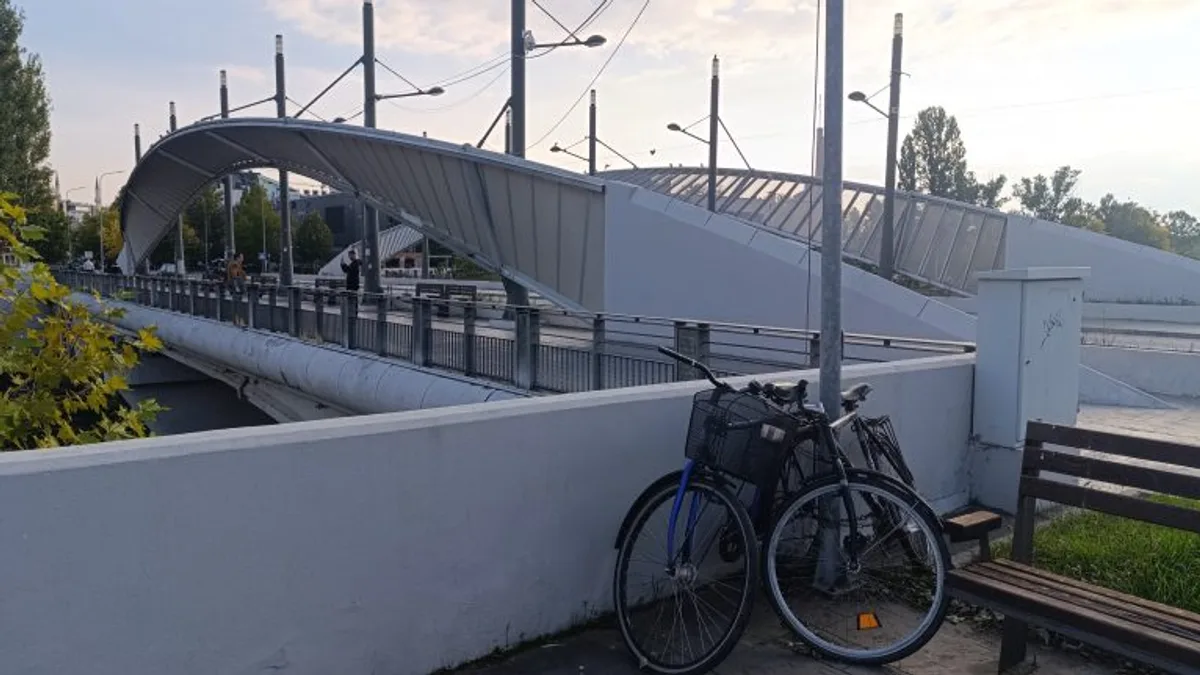
EU Says Conditions Are Met to Open Ibar Bridge
The European Union spokesperson confirmed the conditions from the 2025 report have been met, but Brussels' reply gives no date for opening the main bridge in Kosovska Mitrovica.

A European Union spokesperson told the Pristina outlet Gazeta Ekspres that the conditions for opening the main bridge over the Ibar in Kosovska Mitrovica have been met. The response from Brussels came a week after KFOR announced it had begun gradually shifting its permanent presence away from that bridge.
The conditions in question are laid out in the European Union’s annual report on Kosovo for 2025: completion of construction work on the bridge, along with further assessments and consultations with security partners. The spokesperson reaffirmed that position and said each of those conditions has now been fulfilled.
“The EU’s position on the bridge has always been clear: once the works on the Austerlitz bridge in Mitrovica are completed, along with additional assessments and consultations, the bridge should be opened. We can confirm, as already stated in last year’s annual report, that this is indeed the case.”
The reply contains no date. Brussels did not specify when the bridge might reopen to traffic, nor what steps would precede such a decision. Even so, this is the furthest the European Union has gone on the issue to date, having previously spoken only in conditional terms about what should happen once the conditions were met.
What changed at the bridge on August 10
On Monday, August 10, 2026, KFOR announced it had begun a gradual transition of its permanent presence away from the main bridge. On the northern side, the long-standing static position held by Italian carabinieri was removed, and their vehicles were subsequently seen patrolling across the bridge and on both sides of it. The mission described the move as part of an optimization of its force posture, based on an assessment that the security situation had improved.
“The process will be gradual, conditions-based, and carried out in close coordination with all relevant stakeholders.”
In the same statement, KFOR said the process is being carried out in coordination with representatives of Kosovo’s institutions, international organizations, the Kosovo Police and the EULEX mission, and that the Chief of the General Staff of the Serbian Armed Forces has been regularly briefed on its progress.
On the same day, on the southern side of the bridge, Pristina’s acting interior minister Dzeljalj Sveclja said the transfer of responsibility for the bridge’s security to the Kosovo Police had begun, and said the outcome of that process should be the bridge reopening to traffic. KFOR confirmed the transition of its own presence, but not Sveclja’s characterization of a handover of responsibility.
On the same August 10, the mission also announced that the Kosovo Police would begin taking part in the security arrangements around the Visoki Decani monastery, putting two separate developments, the bridge and the monastery, on the record within hours of each other.
Srpska Lista sought a meeting, Ulutas raised the possibility of a reversal
Srpska Lista requested an urgent meeting with KFOR commander Major General Ozkan Ulutas over the changes at the bridge. Ulutas received the party’s president, Zlatan Elek, at the Film City base, joined by deputy leader Igor Simic, lawmaker Jovana Radosavljevic and the mayor of North Mitrovica, Milan Radojevic.
At that meeting, Ulutas said the optimization of KFOR’s force posture could be reversed if developments on the ground required it, and said the mission still holds the role of first responder on the security of the Visoki Decani monastery.
Radojevic has taken a sharper tone, and done so publicly. At a public hearing on the draft local budget, asked by residents about the withdrawal from the bridge, he said:
“Opening the main bridge is something Albin Kurti has in his program. If KFOR moves its troops and allows the main bridge to open for traffic, that will mean a victory for Albin Kurti and will put KFOR on their side. KFOR has held to neutrality for 27 years, preserving peace and stability between the two divided towns.”
The mayor also rejected the assessment underpinning the mission’s move.
“We expressed our concern. We said that if this happens, there will be major security problems. We do not agree with the assessment that the security situation has improved. On the contrary, you live in this municipality, you face these problems every day, you see how Kosovo Police officers behave. We cannot say that Kosovo Police officers are neutral and professional at this time.”
Radojevic added that municipal leadership will keep talking to the KFOR commander to try to prevent such a decision from taking effect in practice, noting that carabinieri remain on the ground and that traffic between the two parts of the city already runs over several other bridges.
What has not come out of Brussels is a timeline. The decision on force posture rests with NATO, and EULEX, according to the spokesperson, has been duly informed of the change and continues its cooperation with the Kosovo Police and KFOR. The political assessment that the conditions have been met is now on the record. The next step belongs to whoever sets the date.