Brnabic Clashes With Opposition on Day Two of Budget Debate
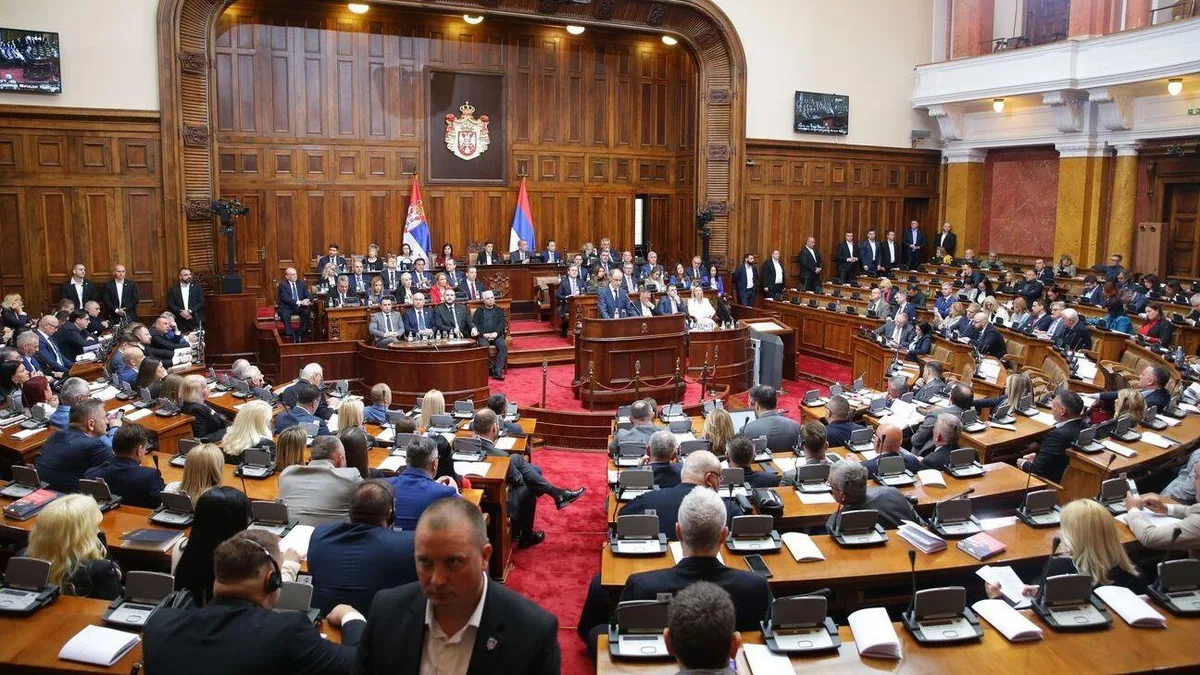
Serbia's parliament entered a second day of debate on the 2026 budget revision and 58 other items, marked by a sharp clash between Speaker Ana Brnabic and the opposition over national minorities.

Serbia’s National Assembly continued today, August 25, into the second day of an extraordinary session called at the request of 109 lawmakers, holding a joint general debate on all 59 items on its agenda. The session, convened by Speaker Ana Brnabic, was attended by 94 lawmakers. Srpske vesti reported yesterday on the opening of the debate and the boycott by the NADA parliamentary group; today brought the first open clash between the speaker and the opposition.
The first item on the agenda remains the proposed revision of the 2026 budget, which increases spending by 112.45 billion dinars, bringing the total to 2,527.15 billion. Capital investment is set at 779.9 billion dinars, about 7 percent of gross domestic product. Health care receives nearly 30 billion dinars, and social welfare 25 billion. The full package of aid to citizens is estimated at 980.6 million euros, including a one-time payment of 6,000 dinars for every adult citizen. As previously presented, the revision is built on projected economic growth of 3.3 percent, inflation brought down to a projected 3.4 percent, and public debt of 43.8 percent of GDP at the central level, or 44.2 percent at the general government level.
Lawmaker questions: Kosovo, fuel oil, social welfare centers
As on every Tuesday while the session runs, part of the morning debate was set aside for lawmakers’ questions to the executive branch. Movement of Socialists lawmaker Bojan Torbica demanded that the bridge over the Ibar River remain closed and that the Decani Monastery continue to be secured by KFOR rather than Kosovo police, warning that a reduced KFOR presence at such sites could trigger a new exodus of Serbs from Kosovo and Metohija.
“Our state must do everything to prevent a conflict from happening, by not opening the bridge and by having Decani Monastery secured by KFOR, as it has been until now, rather than by Albanian police,” Torbica said, adding that opening the bridge and KFOR’s withdrawal from the monastery would send the message that Kosovo is a “successful state” guaranteeing security to all its citizens, which, in his words, is not true.
Ecological Uprising lawmaker Dragan Jonic raised the spill of fuel oil from the site of the former rubber industry near Dimitrovgrad into the Nisava River, and asked Minister Sara Pavkov whether she had been informed of the problem during her visit to that town.
“I was personally there about ten days ago, and the situation looks like this: the fuel oil is still sitting in the bed of the Nisava River, everyone is denying responsibility, no one is held accountable, yet we are all being poisoned, both the residents of Dimitrovgrad and those in towns downstream,” Jonic said.
Workers’ Party lawmaker Irena Zivkovic warned that social welfare centers have more than a thousand cases per professional staff member, alongside the lowest salaries in Serbia. “The salaries of social welfare center workers are the lowest wages in Serbia, they work for the lowest pay. But that is not the only problem, an even bigger problem is staffing, where one professional worker handles over 1,000 cases, and new staff coming in simply do not want to work in such a system,” Zivkovic said. Borislav Antonijevic, a lawmaker from the We, Power of the People parliamentary group, asked why the leadership of the Narodni Front Clinic for Gynecology and Obstetrics consists exclusively of retired professors, and whether their fitness for work and the conditions under which they perform their duties have been verified.
Brnabic to opposition: “countries in the region that are ethnically pure”
Over the course of the day the debate escalated into a direct clash between the Speaker and part of the opposition over the treatment of national minorities. Brnabic responded that ethnicity has nothing to do with one’s political stance toward Serbia, pointing out that representatives of Bosniaks, Hungarians, Croats and Albanians sit in both the Assembly and the Government.
“No one in this chamber has criticized them over their conduct or their nationality. On the contrary, they are welcome in this Assembly and in the Government of Serbia, because unlike other countries in the region, Serbia is open. It is the country with the largest number of national minorities in Europe, while we have countries in the region that are ethnically pure, and you have never once criticized them,” Brnabic said, adding that a political stance on Serbia’s territorial integrity has nothing to do with ethnicity.
After the lawmakers’ questions, the session moved to the joint debate on all 59 items. Alongside the budget revision, the agenda includes a draft law on the Judicial Academy, amendments to the Anti-Corruption Law, amendments to the lex specialis on expropriation for the Belgrade Waterfront project, and amendments to the Law on Public Media Services. The Assembly has not yet specified when the session will conclude.