Belgrade Pride March 2026: 25 Years After the Bloody First
The march called There Is Room for All of Us passed the Government, Presidency and Assembly, 25 years after the first 2001 Pride. Near the Church of the Ascension, a photo of Ratko Mladic was shown.

A march called “There Is Room for All of Us” passed through central Belgrade today, by the buildings of the Government of Serbia, the Presidency and the National Assembly, exactly 25 years after the first attempt to hold a Pride parade in Serbia under the same slogan. That gathering, in June 2001, is remembered as the “bloody Pride,” after participants were attacked by right wing and football hooligan groups on the streets of central Belgrade.
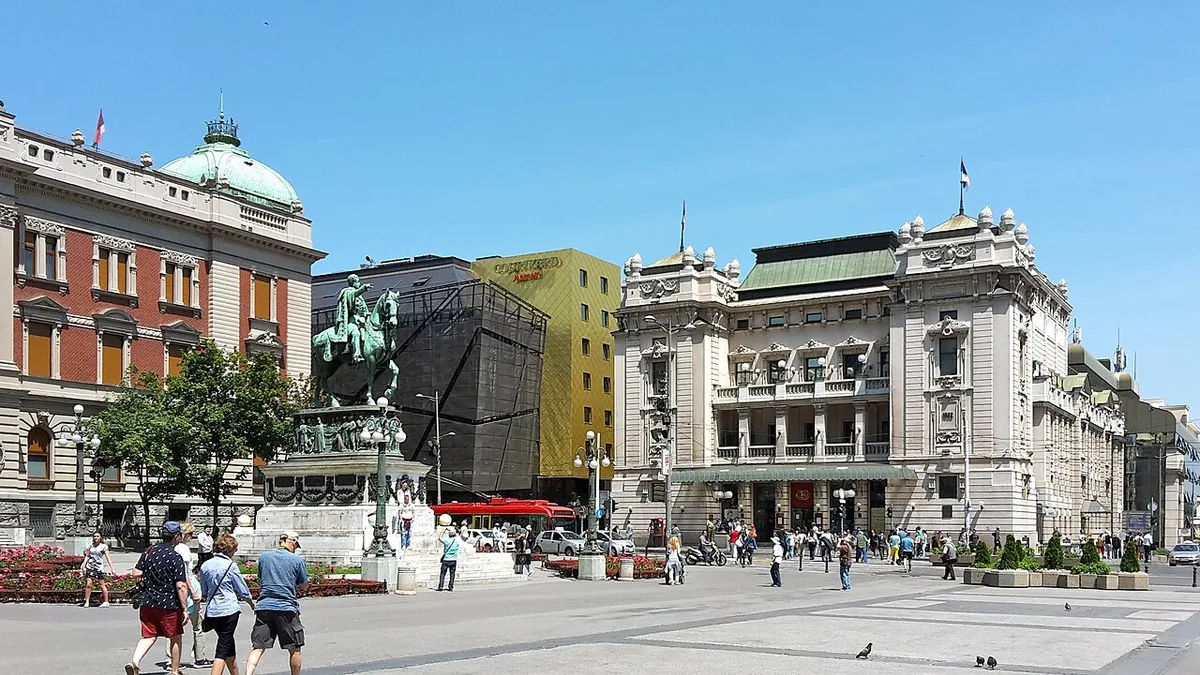
The gathering began at 4 p.m. in Manjez Park, and the procession set out an hour later. The route led down Nemanjina Street, then Kneza Milosa and Kralja Milana streets, across Nikola Pasic Square to the National Assembly building, from where participants returned to Manjez Park along the same streets. The march is part of Pride Week, running from September 1 to 7.
Which streets were closed to traffic
Police closed traffic in several central city streets for the march. The closures covered part of Nemanjina Street, with cordons near the Hilton hotel and the National Bank of Serbia, as well as part of Kneza Milosa Street. Manjez Park was fenced off with metal barriers, and members of the Police Intervention Unit were stationed inside it, without riot gear. A large number of police officers in full equipment were present along the entire route and at nearby intersections.
Tension flared near the National Assembly building when a small group of people, led by a person in a cassock, tried to approach the parliament building. Police Intervention Unit members pushed them back. Tanjug, citing police, reported that no incident was officially registered during the march, while other outlets covering the event on the ground recorded this very confrontation near the Assembly as a minor clash.
In the churchyard of the Church of the Ascension, along the march’s route, a separate group gathered and displayed offensive messages along with a photo of Ratko Mladic, whose commemoration had been announced for the same day. The overlap of the two events in the same part of the city has not previously been reported on, even though the symbolism is difficult to read as coincidental: the 25th anniversary of the first, attacked Pride parade, and the public display of a convicted general’s image, a few hundred meters from the route Pride participants walked.
The sash: a third hand in 25 years
Before the march began, last year’s Pride godmother, Olivera Kovacevic, handed the sash to this year’s godmother, N1 television journalist Danica Vucenic. Kovacevic said that since she wore the sash last year, “a lot has gotten worse,” adding that what the Pride community is going through today is shared by a large number of other citizens as well. On society’s attitude toward minorities, she said:
“When they beat members of the LGBT community, most people didn’t care, because they were being portrayed, as they put it, as a social deviation.”
Vucenic told the crowd that Pride is still being held in an atmosphere of threatened human rights, on the anniversary of the police operation on the University of Novi Sad campus, and without a single one of the community’s eight demands from this year’s Pride Week having been met. She said:
“We are more or less in the same place we were on June 30, 2001.”
Mirjana Karanovic, who carried the sash 11 years ago, addressed the crowd with these words:
“I was the godmother of Pride 11 years ago. Congratulations on 25 years of Pride. I want to tell you, life is magnificent and it belongs to us. There is no one and nothing that can stop us from enjoying life and living it exactly the way we want to.”
Agata Milan Djuric, founder of the organization Geten and herself a participant in the attacked 2001 parade, pointed to the gap between city and countryside:
“Violence is widespread, especially in rural areas.”
Njuz.net journalist Jelisaveta Miletic made an unusual request of those gathered:
“I ask you for tenderness, even though I know we live in a country not known for tenderness toward its citizens.”
Drag performer Aleksis Plastik spoke about the point of the gathering itself:
“There is a lot that’s ugly in this society. Today we gathered to fight for it to become more beautiful, better, more colorful, a society of more equal people.”
Two laws, the same demands for years
Pride Week organizers again singled out the adoption of the Law on Same-Sex Unions and the Law on Gender Identity and the Rights of Intersex Persons as their key demands this year. Neither law has been passed by the National Assembly to date, so the demand carries over from year to year with no movement in the parliamentary procedure.
After the march, an accompanying concert began in Manjez Park, with entrances at the intersection of Resavska and Masarikova streets and at the intersection of Nemanjina and Kralja Milutina streets. The march wrapped up before 9 p.m., after which traffic in the city center was fully restored.
Pride has been held regularly in Serbia for more than a decade, always under a heavy police presence on the streets. The slogan “There Is Room for All of Us,” used again for this year’s march, was first used exactly a quarter century ago, on the day an attempted gathering ended in violence. Whether the 26th anniversary will arrive with both laws the community is demanding from the institutions finally passed remains a question whose answer depends on the next convocation of the National Assembly.