CRTA campaign report: booths introduced, RIK yet to decide
CRTA observers presented campaign findings for the October 25 elections: booths and a new minutes column are in place, a draft registry of off-site voting requests awaits RIK.
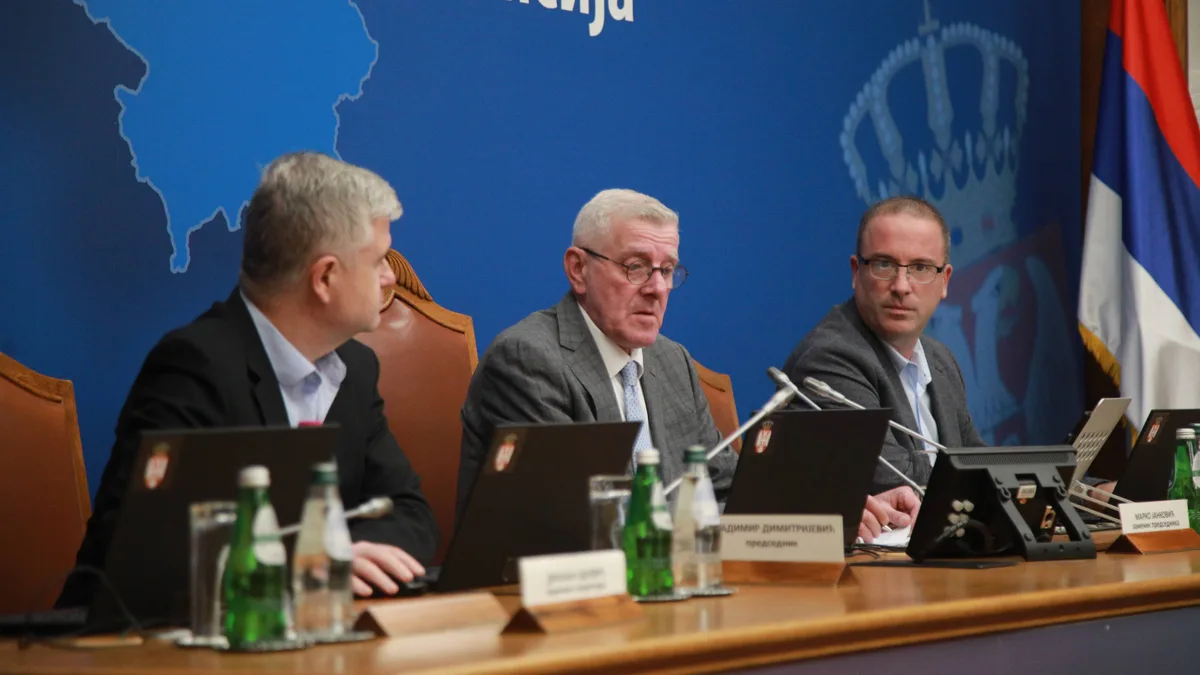
The CRTA observer mission presented on October 8 its report on the first part of the campaign for the parliamentary elections scheduled for October 25. The report was explained by mission head Rasa Nedeljkov, Tamara Brankovic and head of the legal team Pavle Dimitrijevic. Besides assessments of the media and of institutions, the findings record two changes in the voting procedure itself: voting booths and a new column in the polling board’s minutes.
Nedeljkov said that in recent weeks voters have been intimidated to discourage them from taking part in the elections. He described the decisions of the Republic Electoral Commission (RIK) and the Foreign Ministry on voting abroad as unprecedented and as a continuation of what CRTA calls systemic election engineering. He also pointed to the wiretapping affair involving activists and lawmakers, and to the conduct of the Criminal Police Directorate toward activists of the student movement, in which he sees political pressure.
What is new in the voting procedure?
According to Dimitrijevic, voting booths have been introduced, and the minutes of the polling board now include a column for entering the number of unused ballots. That is happening for the first time in several election cycles, he said.
A third change is not finished yet. At the initiative of some RIK members, a draft registry of requests to vote outside the polling station has been prepared, and the commission has yet to take its final position. Dimitrijevic described it this way:
“I have to stress the significance of an initiative that is under way: at the initiative of a number of members of the Republic Electoral Commission, a draft and a form for keeping a registry of requests to vote outside the polling station have been prepared, with the aim of regulating how voters who want to vote outside the polling station submit their requests, and at some of the next sessions the Republic Electoral Commission will take its final position on this draft. The idea of the draft was to regulate the way requests are submitted more precisely and, in that way, simply to prevent possible abuses of this right.”
The sources from the presentation do not say how requests are handled today, only that the draft form is ready and that RIK is deciding on it.
Why does CRTA criticize voting in the diaspora?
Dimitrijevic argued that the decision to hold voting at all polling stations in the diaspora on Serbian time endangers the voting rights of a large number of voters. He singled out New Zealand as the hardest case, where people will vote during the night.
Nedeljkov addressed the topic in an interview with N1. He said that more than 30 Foreign Ministry diplomats have publicly criticized the way voting abroad is organized, which he finds encouraging. On the night voting itself he said:
“What is happening with the polling stations abroad, voting at night, there is no recorded example of anything like it anywhere in the world, and it tells us that we do not know what illegal, semi-legal or borderline mechanisms the ruling parties will resort to in order to keep their position.”
In the same interview Nedeljkov said that the Parliamentary Assembly of the Council of Europe was, until recently, not invited to observe the elections, which is a precondition for accreditation. The statements relayed from the presentation contain no response from the institutions to which these assessments refer.
What does CRTA say about the Anti-Corruption Agency and REM?
Dimitrijevic recalled that the amendments to the Law on the Prevention of Corruption introduced two mechanisms: monitoring of a random sample of at least 60 officials, and mandatory monitoring of the president and the members of the government regardless of the sample. Of the Anti-Corruption Agency he said:
“The Agency did establish that mechanism, but for now its implementation is mostly formal. Findings for the officials in the random sample have been published, and they mostly boil down to a list of monitored officials and the number of proceedings launched, without any details about the monitored activities, while for the president and the members of the government not a single weekly finding has been published.”
In his words, the observer mission has not established that the Regulatory Authority for Electronic Media (REM) has fulfilled its responsibilities so far. The REM Council was constituted 13 days after the elections were called, and after 15 days of campaigning it had not adopted its first media monitoring report. Dimitrijevic added:
“I should stress that the Council did not reach agreement on extending the sample to new influential cable channels, including Informer television, which was one of the proposals, so monitoring in fact relies on the 2023 methodology, which is now being applied on a highly questionable legal basis.”
Media space, lists and certification
Brankovic presented measurements of airtime on national-frequency television channels. Aleksandar Vucic took up more than 50 percent of prime-time airtime, the authorities hold two thirds of the total time and the opposition one third, mostly in a negative context. The student list, the most visible among the opposition lists, was portrayed negatively in 88 percent of cases. She named TV Informer and TV Kurir as the stations where the opposition is shown exclusively in a negative light.
The number of declared electoral lists is the same as in the 2023 elections, and half of them are lists of national minority parties. Brankovic sees this as the manufacturing of political pluralism.
One of her claims was left without further explanation in the sources: “CRTA has recorded that some representatives of the authorities in municipal administrations certified votes without voters being present and on the basis of already scanned ID cards.” What exactly is being certified, and in which procedure, was not specified at the presentation.
Nedeljkov said the opposition is far less present on nationally broadcast television and is mentioned almost exclusively in a negative context. Fewer than three weeks remain until the October 25 elections, and RIK has not yet said when it will decide on the draft registry of requests.