Administrative Court Rules Tonight on Student List Appeals
The 72-hour deadline for a ruling on appeals over polling stations and voting hours abroad expires tonight, nine days before the October 25 election.
The Administrative Court in Belgrade must rule tonight, October 16, on appeals by the Student List against decisions of the Republic Electoral Commission (RIK) on voting abroad, because the 72-hour deadline expires then. The list filed the appeals on the evening of October 13, and they cover two groups of decisions: where polling stations abroad will be, and when voting takes place in each time zone. The court had not announced a decision at the time of publication.
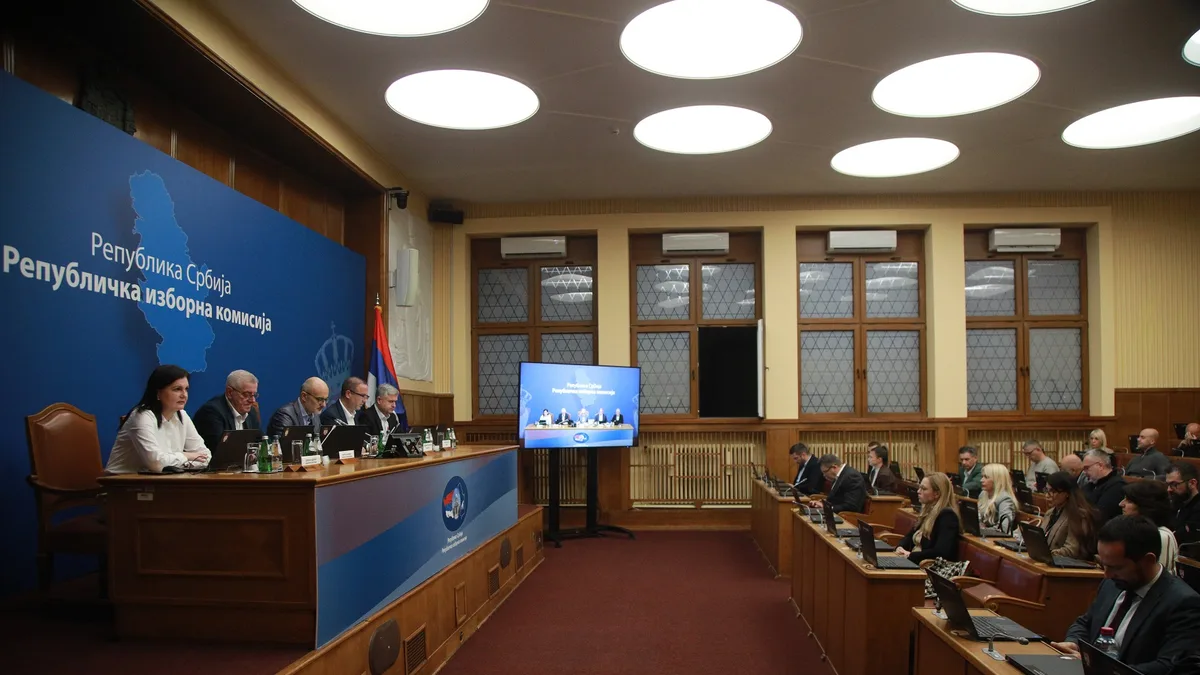
We previously reported on the RIK session at which objections from European Serbia and the Student List were rejected. The list says RIK failed to decide on its objection within the legal 72-hour deadline and then rejected it, so it turned to the court.
Who decides where polling stations abroad go?
The first part of the appeals concerns jurisdiction. The list says RIK maintains that the Ministry of Foreign Affairs (MFA) is “solely responsible” for the list of polling stations abroad, and that RIK accepted the ministry’s proposal without checking it. The Student List disputes this, and its statement reads:
“However, under the Law on the Election of Members of Parliament, polling stations are determined by RIK. The Commission was obliged to ask the Ministry for data on the number of registered voters by city, so that polling stations would be opened everywhere the legal conditions for it exist.”
As an example of an uneven distribution, the list points to Germany and Bosnia and Herzegovina. The students state:
“For the first time in history, there are more registered voters in Germany than in Bosnia and Herzegovina, yet only 8 polling stations have been opened in Germany, compared to as many as 28 in Bosnia and Herzegovina, where polling stations are opened even in places with just 117 voters (such as Branjevo).”
The list also put “three key questions” to RIK, the MFA and the Ministry of Public Administration and Local Self-Government (MDULS):
“Why is MDULS blocking the processing of applications received by 11:59 p.m. on October 3? The work of diplomatic and consular missions is being deliberately obstructed so that the applications of thousands of citizens are not entered into the system, which is a direct violation of the law. Why are you deliberately creating a collapse at locations with more than 2,500 voters? At as many as seven polling stations, the number of people is brazenly pushed above the legal limit, deliberately creating queues that last for hours so that people physically cannot make it to vote. Why are you deliberately reducing the number of registered voters and discriminating against voters by country,” the students asked.
All of this comes from the list’s own claims. Neither the statement nor reports about it contain any reply from RIK, the MFA or MDULS to those questions.
Why would voters in the US and Australia vote in the middle of the night?
The second part of the appeals concerns the schedule. All polling stations abroad operate on Central European time, as in Serbia, so under the RIK decision voting in the US, Australia and New Zealand would run from 1 or 2 a.m. until 6 a.m. local time. The list notes that at previous elections voting ran from 7 a.m. to 8 p.m. local time and asks for a return to that schedule. The statement says:
“RIK abused the provision on time zones and decided that voting in the US, Australia and New Zealand will take place at night (from 1 or 2 a.m. until 6 a.m.). The law requires uninterrupted voting for 13 hours, in normal, humane conditions. We are asking the Administrative Court to annul these decisions and restore voting from 7:00 a.m. to 8:00 p.m. local time.”
What RIK decided for the October 25 election
For the early parliamentary election, RIK opened 93 polling stations in 37 countries. Most are at Serbian diplomatic and consular missions. RIK member Dusan Dincic told the Beta news agency earlier that more than 130 polling stations had been expected, because more than 130,000 Serbian citizens registered to vote. A few figures from the decision:
- Germany: eight stations in four cities (Munich, Stuttgart, Frankfurt, Hamburg)
- Bosnia and Herzegovina: 28 stations
- Austria: six stations, four in Vienna and one each in Salzburg and Linz
- US: four stations (New York, Los Angeles, Chicago, Washington)
- Australia: two stations (Sydney, Melbourne)
Request for documents on voting abroad
The Student List also sent a freedom of information request to the Ministry of Foreign Affairs and, according to some reports, to the Ministry of Public Administration and Local Self-Government. It asks for the complete documentation, correspondence and diplomatic notes on how voting abroad is organized. The main item is a question for which it expects a written answer:
“We are asking for a written answer to a clear question: Has Serbia sent an official request to open additional polling stations outside diplomatic and consular missions, and if so, when and to which countries?”
The list also said it has formally approached the relevant ministries of the countries where Serbian citizens are due to vote, to check whether authorities in Belgrade asked for permission to open additional polling stations and what replies they received. “We will not accept bureaucratic explanations without insight into the documentation that backs them up. The facts must be verifiable, and responsibility for the decisions made must be clearly established,” the Student List stated.
Nine days remain until the election, and the list is asking the court to annul the disputed decisions and restore voting to the usual hours in local time.