Court Rejects Student List Appeals on Diaspora Voting
The Administrative Court on October 15 and 16 dismissed the list's appeals against electoral commission decisions on polling places and voting hours abroad.
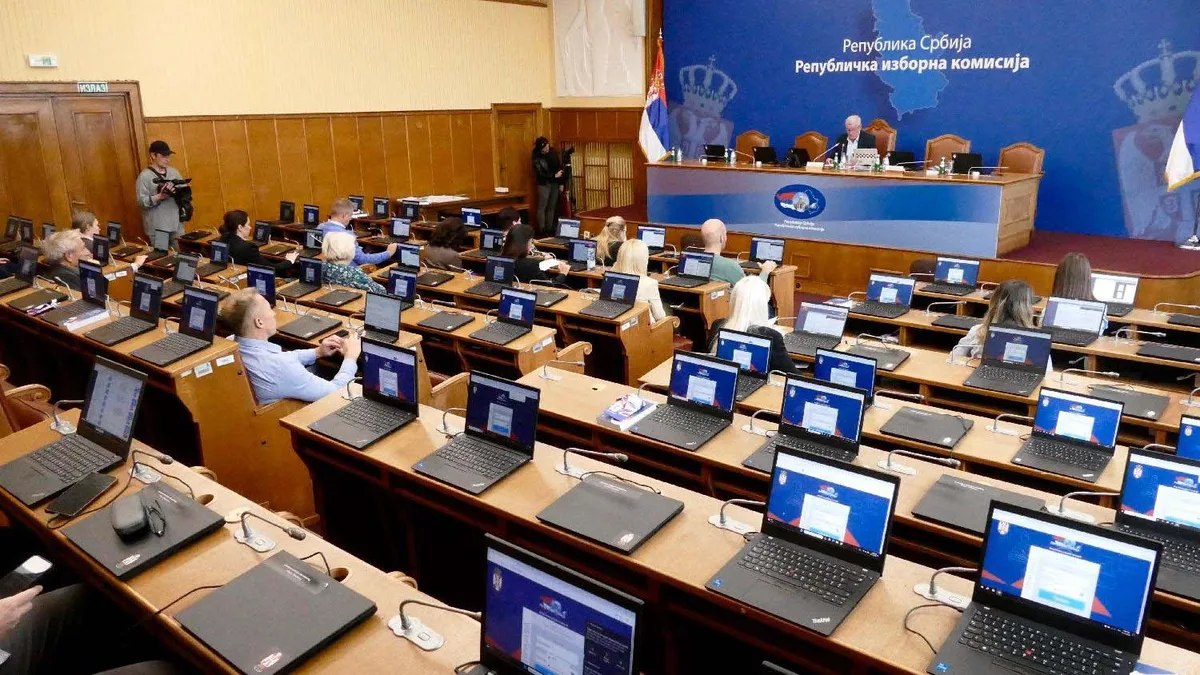
The Republic Electoral Commission (RIK) does not have to change the rules for voting abroad: in rulings of October 15 and 16, the Administrative Court dismissed both appeals by the “Student List (Students Win)” electoral list against the commission’s decisions on voting hours and polling places for the October 25 parliamentary election.
We reported earlier that the court was considering these appeals. Both decisions have now been published on the court’s website, and they leave in place what RIK set for voters in the diaspora.
Why does voting abroad last 13 hours?
The first ruling, issued on October 16, concerns the length of voting. RIK decided that all polling places abroad would be open for 13 hours, closing no later than 8 p.m. Serbian time. The Student List wanted voting to run from 7 a.m. to 8 p.m. local time in the host country. It named Australia, New Zealand, Chicago and New York as examples, where RIK’s decision schedules voting overnight. It asked the court to annul RIK’s decision or send the case back to the commission for a new ruling.
The court found that the statutory provision on uninterrupted voting from 7 a.m. to 8 p.m. cannot be read in isolation from the provision that authorizes RIK to set voting hours abroad according to time zones. The ruling states that voting outside the country follows a separate regime.
The list also pointed to the commission’s earlier practice. The court said RIK decisions from 2016, 2017, 2020 and January 2022, which set voting by local time, were not made on the basis of the provisions now in force. As for the decisions of March 2022 and November 2023, it said they do not amount to an established practice that would oblige the commission to explain a departure from it.
Why were no new polling places opened?
The second ruling, issued on October 15, concerns an objection about cities where no polling places were designated. The Student List named twelve cities:
- Manama
- Sofia
- Santiago
- Havana
- Doha
- Bucharest
- Timisoara
- Bratislava
- Istanbul
- Ankara
- Abu Dhabi
- Dubai
The objection also argued that in some cities no polling place was opened even though other polling places exist in the same countries, and that the criteria used to assign voters to distant locations were never explained. As a result, the objection said, exercising the right to vote became harder and voters faced extra costs. The list asked RIK to obtain from the Ministry of Foreign Affairs the number of registered voters per city and to open additional polling places wherever the legal conditions are met.
The court accepted that the Ministry of Foreign Affairs is the body authorized by law to propose polling places abroad, and that RIK made its decision on the basis of that proposal. The regulations, it found, do not require voting at every Serbian diplomatic or consular mission. The main criterion is the number of registered voters: at least 100 and at most 2,500 per polling place. The exception for fewer than 100 voters, with RIK’s consent, applies only to polling places in Serbia, not abroad.
The court added that, under the Law on the Election of Members of Parliament, upholding the objection would mean annulling the decision on polling places, not amending it or opening additional ones, which is what the list demanded. RIK, it concluded, rightly rejected the objection.
The election is set for October 25, eight days away, and RIK’s decisions on voting abroad remain as they were before the appeals.