Kosovo Voters on Serbia's Roll: 115,856, Up 21,695
An analysis of the public database finds names entered more than once, while Ognjen Rasuo of the Revision Commission says the rise does not mean more people in Kosovo.
Serbia’s voter roll for the October 25 election lists 115,856 voters with a Kosovo address, according to an analysis of the publicly available database of the Ministry of Public Administration and Local Self-Government carried out by Radio Free Europe. At the parliamentary election in December 2023 there were 94,161, which is 21,695 fewer. In the same database, the newsroom also found hundreds of names that appear more than once, as well as incomplete records.
The Interior Ministry and the Ministry of Public Administration and Local Self-Government did not answer Radio Free Europe’s questions about the reasons for the increase or about the irregularities it found. Serbian authorities maintain that the voter roll is “accurate” and “the most up to date so far.”
How does the Revision Commission explain it?
Ognjen Rasuo, an opposition member of the commission that audits the voter roll, says the difference does not mean that more people holding Serbian documents actually live in Kosovo. In his account, the way these voters are recorded has changed. Until now they were registered at polling stations in Serbia, under temporary residence addresses.
“However, temporary residence is limited to two years. And the moment those two years passed, for anyone who had not extended their residence, they decided (the ministry) to delete them by place of temporary residence and return them to the roll by place of permanent residence, which was in Kosovo,” Rasuo told Radio Free Europe.
The authorities have not explained why this was done now. The 21,695 comparison refers to the figure that applied at the December 2023 election, not to every snapshot of the roll since. Within the last three weeks, however, the number did keep rising: from 114,492 voters on September 22 to 115,856 on October 12, an increase of more than 1,000.
Rasuo described the voter roll as untidy and did not limit that to Kosovo.
“It is not only the data from Kosovo, the entire voter roll is like that. That is why there is a risk of abuse, because manipulation can hide in all of those irregularities,” Rasuo said.
The audit commission, he added, has not received extracts from the roll in the form in which they will be printed for the election, even though it asked to check whether anyone is registered twice and whether the data is complete. We reported earlier that Rasuo had warned about 236,280 more valid ID cards and asked the Interior Ministry to explain it.
What was found in the database?
By processing the database, Radio Free Europe established the following:
- at the same polling station, 349 names are entered more than once, with the same first name, surname and parent’s name: 329 twice, 11 three times, seven four times and two names five times
- more than 700 names appear at two different polling stations, 32 at three, and one name at five
- in more than 3,800 entries the parent’s name is missing
- more than 2,500 names are entered in a mix of Cyrillic and Latin script, along with hundreds of spelling errors
The website of the Ministry of Public Administration and Local Self-Government says that “up-to-date data from the voter roll” is displayed for each polling station. The OSCE Office for Democratic Institutions and Human Rights (ODIHR), in its preliminary report ahead of the vote, says the accuracy of the roll remains a concern, because of an unusually large number of people registered in some municipalities and at certain addresses. The ruling Serbian Progressive Party rejects accusations that the roll is being manipulated.
What do people on the ground say?
In the village of Rabovce near Lipljan, 527 voters are registered. Farmer Zoran Spasic estimates that the real number is lower.
“There are people who moved away. There were also quite a few deaths. The roll probably has not been updated,” Spasic said.
His own address is listed in the Serbian records as “no street, zero,” even though the street was given a name and the house a number five years ago. In the municipality of Klina, about 120 members of the Serb community live, while the Serbian roll holds more than 1,800 voters. Silvija Raskovic of the local community office says: “We have empty villages, empty houses.” She claims to know at least 80 people who obtained a death certificate in Kosovo and are still on the roll in Serbia.
Zoran Savic of the Kosovo non-governmental organization “Aktiv” describes the database as contradictory.
“I am not claiming that these are phantom voters, I have no proof of that. But I can say responsibly that the public does not have enough data to understand who makes up this electorate and what produces such large swings,” Savic said.
Where will Kosovo voters cast their ballots?
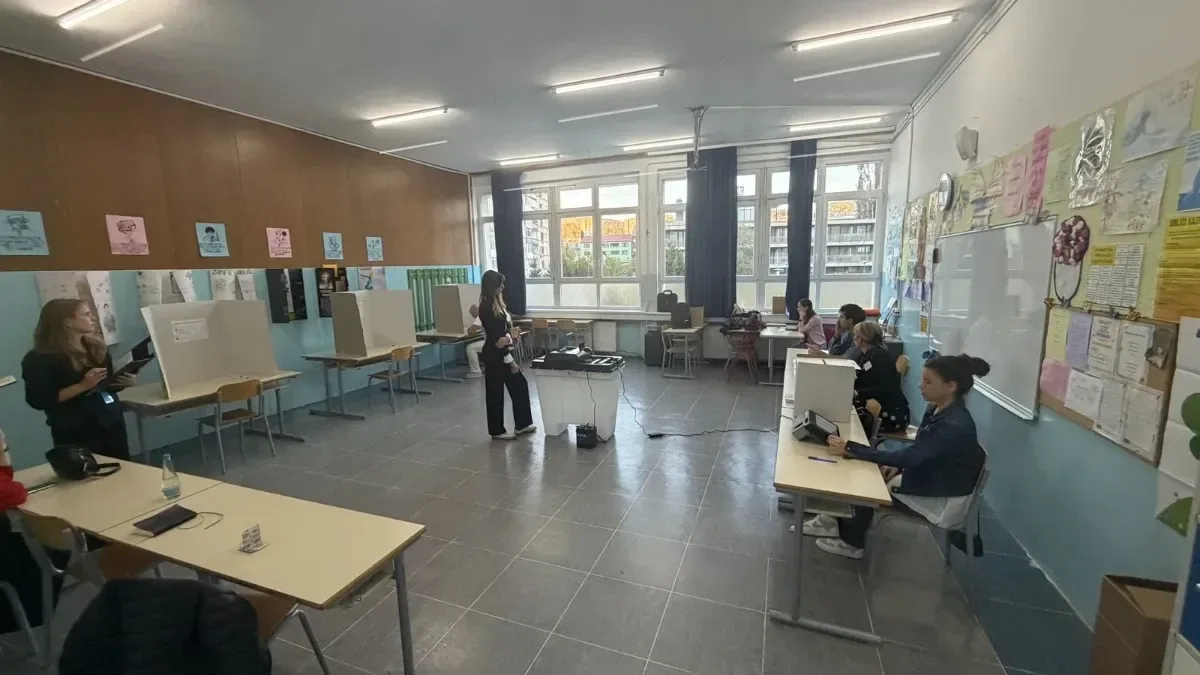
60 polling stations have been opened for them, compared with 51 at the 2023 election. Voting takes place in four border municipalities in Serbia: Tutin, Raska, Kursumlija and Vranje. The practice was introduced in 2022, after Pristina did not allow polling stations in Kosovo. Serbia keeps voters from Kosovo registered in 23 Kosovo towns and municipalities.
At the 2023 election, turnout among these voters was about 25 percent: 23,878 voted, and more than 19,000, about 80 percent, backed the ruling coalition. Rasuo notes that control at the polling stations is what counts, because a voter must present a valid identity document and has a finger sprayed with a marker visible under UV light.