

Serbian Church says it was not consulted on Kosovo law
After the Kosovo Assembly passed the bill in first reading, the Eparchy of Raska-Prizren wants more consultations or an explicit safeguard for its holy sites, while Srpska Lista plans amendments.
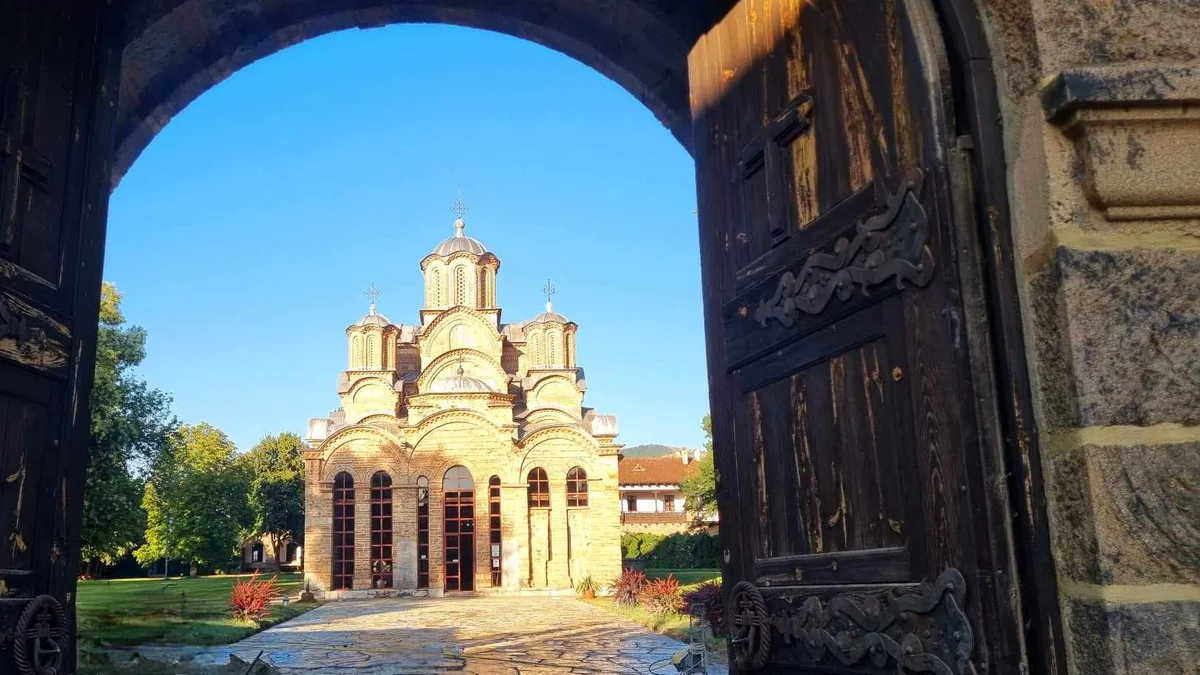
The Eparchy of Raska-Prizren of the Serbian Orthodox Church (SPC) said on November 21 that it was not consulted when the draft law on the Central Inspectorate for Cultural Heritage was prepared. The Assembly of Kosovo passed the draft in first reading on November 20. The Eparchy wants the draft sent back for further consultations and, failing that, a clear protective provision for its holy sites written into the text.
What the Eparchy says in its statement
The Eparchy does not dispute oversight of cultural property. Its objection is to how the new powers could be applied. The statement of November 21 reads:
“Our Eparchy supports expert oversight that protects all cultural property, including our holy sites, from damage and illegal construction. We are concerned, however, that the new powers could in practice be used to circumvent the protection the Church already enjoys under the Law on Special Protective Zones, the Law on Religious Freedoms and other regulations in force.”
The Law on Special Protective Zones provides for the Church’s consent to certain works and for a special dispute procedure through the Implementation and Monitoring Council. The council includes the EU, the OSCE, two Kosovo ministries and the SPC. According to the statement, this is exactly where the problem lies:
“The draft of the new law mentions neither that law nor the Council. This leaves room for questions that directly affect the life of our holy sites to be decided by an institution with enormous powers, one that the special law does not give direct jurisdiction inside the special protective zones, just as the Law on Religious Freedoms bars it from access to and intervention in religious buildings except with the consent of the religious community.”
The Eparchy also cites the European Commission’s report on Kosovo of November 4, 2026. The statement says: “The European Commission, in its Kosovo Report of November 4, 2026 (pp. 38 and 45), also states that inconsistent interpretation of regulations has already led to violations of the Law on Special Protective Zones.”
It voices particular concern about monastic communities, since the monasteries are also the homes of monks and nuns, as the statement puts it: “For a sisterhood or brotherhood, a possible unilateral suspension of necessary repairs or a ban on works can have serious consequences.” The Eparchy concedes that the draft does not provide for any change of ownership.
The demand is summed up in the closing section of the statement:
“Any law that protects our holy sites must also respect the Church’s right to care for them, as well as the freedom and undisturbed life of those who live, serve and pray to God in them.”
How the draft passed first reading
According to KoSSev, the vote was held at 2.09 a.m. on November 20, at the end of a session that began on November 19. Srpska Lista deputy Jovana Radosavljevic said in a Facebook post, carried by Tanjug, that it happened around two in the morning, when, as she claims, there were no longer any media or observers in the chamber.
62 deputies voted for the draft, eight voted against, and one deputy from the Bosniak community abstained. All eight Srpska Lista deputies voted against. Lazar Radulovic, a deputy from the party For Freedom, Justice and Survival, did not take part in the vote. Earlier, a Srpska Lista request to remove the draft from the agenda was rejected.
Culture Minister Saranda Bogujevci rejected claims during the session that the law endangers SPC rights. “It does not interfere with the substance and normative aspect of cultural heritage protection, which remains governed by the basic legislation and the special laws in force,” Bogujevci said. Asked by Radosavljevic whether the Eparchy had been consulted on the version of the draft sent to the Assembly, she replied that consultations with religious entities had taken place and could continue between the two readings. Radosavljevic, according to KoSSev, repeated that she had not received an answer on the Eparchy’s position.
What does the draft provide?
The inspectorate is not a new institution. It was established in 2018 within the ministry and, according to the daily Koha, had only two inspectors. The draft would turn it into a central executive agency of the Ministry of Culture, based in Pristina with jurisdiction across Kosovo.
Article 5 provides for independent inspection of cultural heritage assets, urgent suspension of unauthorized works and a ban on conservation work when irregularities are found. Under Article 6, the inspectorate can order the competent official to suspend or annul, within 15 days, a permit issued contrary to the law. In other words, it does not revoke a permit itself but asks the competent authority to do so.
Srpska Lista: a disputed majority and announced amendments
Srpska Lista parliamentary group leader Igor Simic told the portal KoSSev in written answers that the party does not claim the law takes property from the Church: “We do not claim that the proposed law directly takes ownership from the Serbian Orthodox Church.” He added: “We are not asking for anyone to be above the law, or for church buildings to be exempt from justified measures to protect cultural heritage.”
Srpska Lista also contests the procedure. Under Article 81 of the Kosovo Constitution, the party argues, the draft needed at least 61 votes out of 120 and at least 11 of the 20 votes of deputies from non-majority communities. According to Simic, only seven such deputies voted for it. Koha, however, says Article 81 does not apply to this law, and KoSSev reports that there is no final legal conclusion on the matter.
Rasic told Radio Kim why his deputy did not vote: “That is our method, because we did not have enough information about the law itself and that is why we did not vote.” Srpska Lista criticized that move in a statement, and Rasic replied that the party was trying to portray him as a supporter.
Srpska Lista is preparing amendments together with the Eparchy. If the law passes second reading unchanged, it is considering an appeal to the Constitutional Court under Article 113, paragraph 5. That requires at least ten deputies within eight days, and the party has eight.
Self-Determination deputy Arber Rexhaj also spoke in the debate, saying: “The problem is the Ahtisaari package system, under which they took all of our Albanian Orthodox heritage and made it Serbian, when in Kosovo it has never been Serbian.” Simic rejected those accusations and stayed with the legal questions.
Gracanica as an example
In the debate, Radosavljevic recalled February 2026, when the inspectorate ordered a halt to works on the lodgings at Gracanica Monastery. According to Koha, the works resumed in April, after questions of consent were settled. The case shows that inspections of church buildings are possible under the rules already in force, and Srpska Lista wants the new law to state explicitly how those powers relate to the SPC’s special guarantees.
The draft has not been finally adopted. Review by parliamentary committees, amendments and a second reading are next.


