Evian: Europe's four clear mines, Iran sanctions stay
On day one of the G7 summit in Evian, Germany, France, Britain and Italy pledged to clear mines in Hormuz, while von der Leyen tied any lifting of Iran sanctions to real change on the ground.

- Europe's four (Germany, France, Britain and Italy) pledged to clear mines to secure unconditional and unrestricted navigation through Hormuz.
- Ursula von der Leyen said EU sanctions on Iran stay in force until there is real, verifiable change on the ground.
- For the second year running, the G7 will not issue a joint communique.
- The official signing of the US-Iran agreement is set for Friday, June 19, in Switzerland.
For a country that routes its energy imports and part of its exports through corridors sensitive to any crisis in the Persian Gulf, what was decided in Evian is not a distant headline. The Strait of Hormuz is the chokepoint through which a fifth of the world’s oil passes, and the stability of pump prices in Serbia depends directly on whether that channel stays open. On the opening day of the G7 summit at the Alpine resort on the shore of Lake Geneva, Europe’s leading members delivered the first concrete answer to that question.
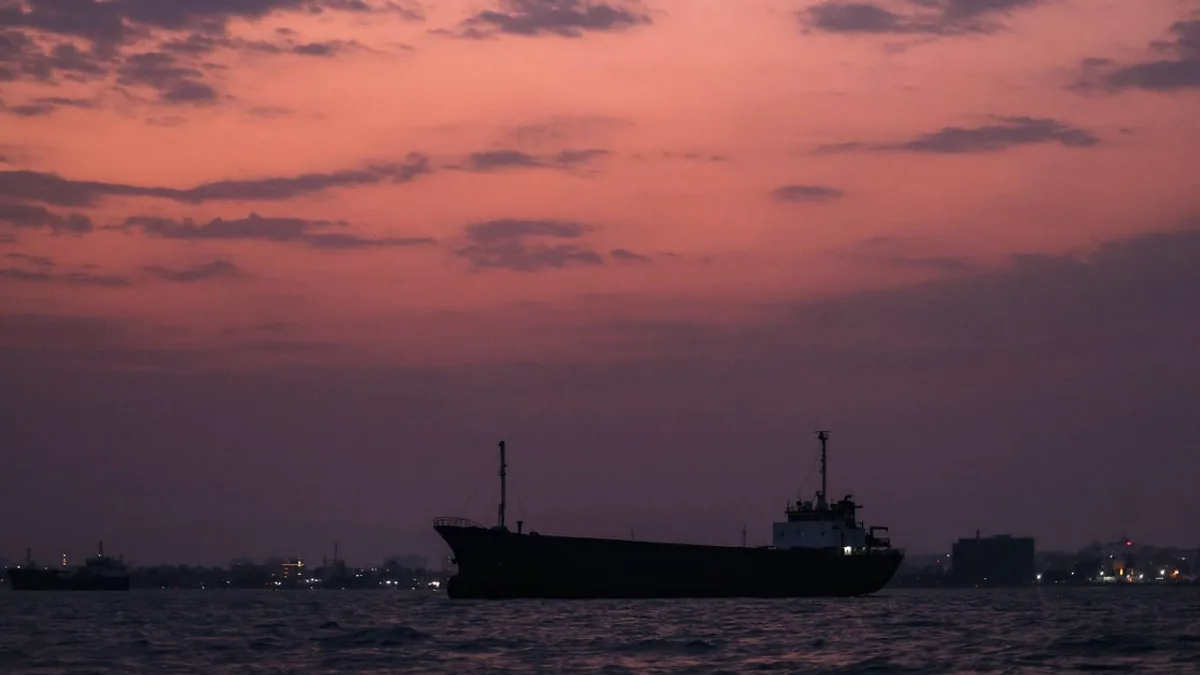
Germany, France, Britain and Italy committed to taking on the removal of mines in Hormuz in order to secure what they described as unconditional and unrestricted navigation. This is a technically demanding job that the four Europeans are assuming themselves rather than leaving it to naval fleets from outside the region, a move with a clear message: Europe wants a seat where the security of trade routes is shaped, not merely to react to the consequences.
Why do sanctions stay if a truce is on the table?
Alongside the mine-clearing pledge, European Commission President Ursula von der Leyen drew a line that Brussels is not moving for now. The sanctions regime against Iran, she said, stays in force until there is real and verifiable change in Tehran’s behaviour.
“Sanctions exist to change behaviour. If behaviour changes credibly and verifiably, then you can lift sanctions,” von der Leyen said, tying every future step toward easing to concrete proof on the ground rather than to political announcements.
French President Emmanuel Macron added a dimension that touches the heart of the dispute, Iran’s nuclear programme. He underlined the key oversight role of the International Atomic Energy Agency over Iranian uranium enrichment, signalling that for the European side there is no durable deal without the return of inspectors and full transparency of nuclear capacity. This is the point where the diplomatic channel of Brussels and Paris diverges from Washington’s approach, which has already brought its truce arrangement with Iran near to a close.
For southeastern Europe, this division of responsibility is not merely technical. If the four Europeans take on the physical security of the strait while the Commission holds the levers of sanctions, Brussels builds itself a position as an unavoidable actor in every future round of talks. The geopolitical reality is that the European perspective here is measured by the ability to guard a trade route and keep pressure on Tehran at the same time.
What comes after Evian?
This year again, the G7 summit is marked by the absence of the one document that would usually crown such a gathering. The group will not issue a joint communique, the second year in a row, which says a great deal about how hard it is to reduce the seven most developed economies to a common denominator when their approaches to crises diverge. Instead of a single text, Evian produces individual commitments, such as the one on mines, and individual conditions, such as the one von der Leyen set.
The real test arrives very soon. The official signing of the agreement between the United States and Iran is scheduled for Friday, June 19, in Switzerland. Only then will it become clear whether the pledges spoken on the shore of Lake Geneva translate into a binding document, and whether the European condition on sanctions stays isolated or becomes part of a wider arrangement. Until then, the four Europeans work on the strait, and the Commission keeps its lever.
Do you think Europe can sustain the pressure of sanctions while guaranteeing free navigation through Hormuz, or are these two goals that sooner or later collide?