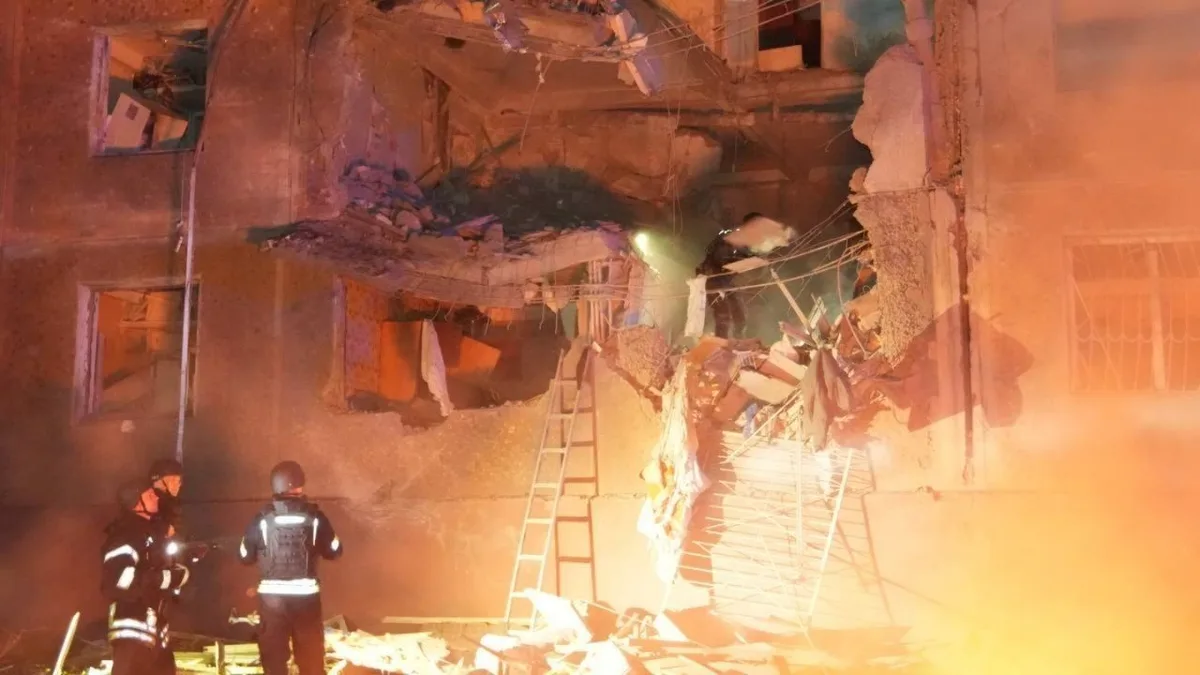
Russia's Biggest Missile Attack on Kyiv Kills at Least One
Russia launched its largest ballistic strike on Kyiv since the war began. Short of Patriot interceptors, Ukraine hit back at Moscow's shadow fleet in the Black Sea.

- Russia carried out its largest ballistic missile attack on Kyiv since the war began, killing at least one person and wounding about 16.
- Kyiv is critically short of ammunition for its Patriot systems, the only weapon that reliably intercepts ballistic missiles.
- Ukraine struck back at Russia's shadow fleet, hitting three tankers in the Black Sea and oil depots in southwestern Russia.
- A third day of protests in Kyiv, with demonstrators demanding the return of a dismissed defense minister and the removal of commander Syrskyi.
Russia carried out its heaviest ballistic missile attack on Kyiv since the start of the war overnight into Sunday, an escalation that Belgrade cannot treat as distant news. Serbia remains the only country in its European neighbourhood that has not imposed a sanctions regime on Moscow, so every escalation on the Ukrainian front sharpens the question Brussels raises at every step of the European path. At least one person was killed and roughly 16 wounded across several districts of the capital, according to first reports.
The shift is not only the scale of the barrage but the tactic behind it. Instead of the swarms of cheap drones seen until now, the Kremlin leaned this time on ballistic missiles, projectiles that fly high and strike within minutes. That is where the balance of power turns: Ukrainian air defence downs drones with relative ease, but a ballistic missile can be intercepted almost only by the American Patriot system, and Kyiv is running out of it.
Why is Kyiv left without a shield?
Ukraine’s air defence still brings down large numbers of drones and cruise missiles, yet it lacks interceptors for ballistic threats. Stocks of Patriot rounds are thinning faster than new deliveries arrive, and without them the capital stays exposed to exactly the class of weapon Moscow has now pushed to the fore. President Volodymyr Zelensky repeated that protection against ballistic missiles is the absolute priority right now, saying that interceptors “literally save lives” every single day.
For Serbia and the wider region, this shortage is not abstract. Ukraine’s vulnerability pushes the debate in Western capitals toward faster production and delivery of the systems, and every new arms transfer deepens the gulf between Washington and the Kremlin that Belgrade has spent years trying to bridge through diplomatic channels, with ever less room to manoeuvre.
Kyiv’s answer came fast and asymmetric. Ukrainian forces struck three tankers of Russia’s so-called shadow fleet in the Black Sea, the network of ageing vessels Moscow uses to dodge oil sanctions, along with oil depots in southwestern Russia. Zelensky said Ukrainian drones also hit logistics centres near Moscow that, in his words, store navigation equipment and components for drone production. The message is unambiguous: the war is moving from Ukraine’s skies to Russia’s logistics and export routes.
Protests behind the front line
While missiles fall on the capital, an internal political drama is unfolding in Kyiv itself. For a third straight day, residents are taking to the streets, with demonstrators demanding the reinstatement of a dismissed defense minister and the removal of the armed forces’ commander-in-chief, General Oleksandr Syrskyi. It is a rare scene of open discontent in a country under martial law, where wartime criticism of the leadership has long been pushed into the background.
The mix of external pressure and internal tension puts Ukraine’s leadership before a double test. Moscow clearly calculates that a shortage of interceptors and public fatigue will achieve what three years of war have not, while Kyiv’s response shows Ukraine has no intention of simply waiting in shelters as its opponent regroups. The open question is how long the capital can absorb ballistic waves without full Patriot stocks, and whether the West will fill that gap in time. Do you think Kyiv can defend its skies without new American interceptors?