War Reaches the Caspian: Iran Blames Ukraine
Tehran says a Ukrainian strike hit an Iranian merchant ship on the Caspian Sea, summons a Ukrainian diplomat and warns of a response, as Kyiv keeps targeting Russian cargo bound for Iran.

- Iran has accused Ukraine of a deadly strike on an Iranian merchant ship on the Caspian Sea.
- Iranian Foreign Minister Abbas Araghchi called the attack a hostile and criminal act, and Tehran summoned a Ukrainian diplomat.
- Kyiv is simultaneously targeting Russian cargo bound for Iran, pushing the conflict onto a third maritime front after Hormuz and the Red Sea.
- The Caspian Sea, until now a quiet logistics artery between Russia and Iran, is being drawn into the wider regional war for the first time.
For Serbia, whose foreign policy has for years rested on a delicate balancing act between Western partners and historic ties to Moscow, the war spilling onto the Caspian Sea is not a distant story. Belgrade builds its energy and trade security on the assumption that the main Eurasian corridors stay navigable and predictable, and that assumption was shaken this week. Tehran accused Kyiv of carrying out a deadly attack on an Iranian merchant ship on the Caspian Sea, opening a new theatre in a conflict that until now had been confined to the Middle East.
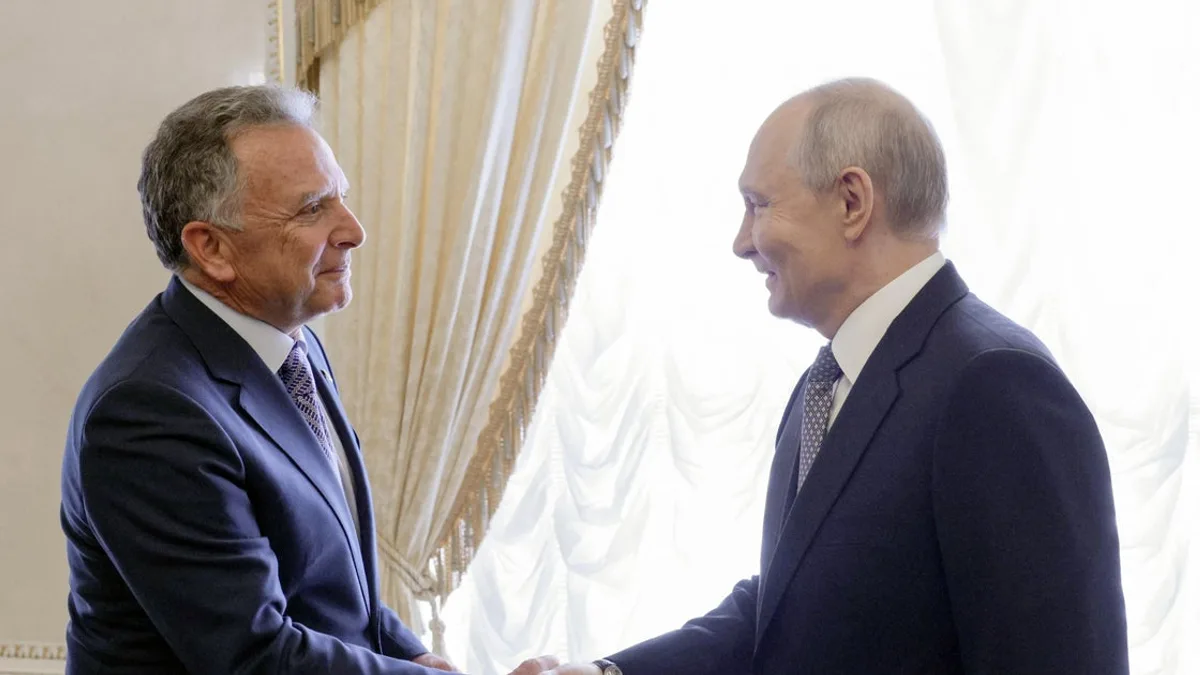
Iranian Foreign Minister Abbas Araghchi described the attack as a hostile and criminal act, saying Tehran reserves the right to respond. The Iranian ministry then summoned a Ukrainian diplomat, a standard diplomatic move by which a state signals it treats an incident as a serious rupture in bilateral relations rather than a passing security lapse. The Ukrainian side has so far not confirmed responsibility.
What makes this incident a turning point is geography. For decades the Caspian Sea functioned as a sheltered inland artery, a route along which Russia and Iran traded goods, oil and, according to Western assessments, components of military value, well beyond the reach of Western sanctions regimes and naval patrols. Carrying hostilities onto that sea means no part of the Russian-Iranian logistics chain is out of range anymore.
Why is Ukraine targeting the corridor to Iran?
Kyiv has for months systematically hit Russian cargo bound for Iran, trying to sever a military-technological exchange that supplies Moscow with drones and munitions and Tehran with parts for its own defence industry. Seen from that angle, the Caspian Sea is not so much a new target as the last link that had until now slipped through. Ukraine’s logic is simple: if Moscow’s war effort relies on Iranian supply, then that supply is a legitimate target, however far it sits from the front in the Donbas.
Tehran, for its part, sees such an attack as an overreach. Iranian officials have spent months warning that the war against their country, above all Israeli and American action around the Strait of Hormuz and the Saudi-Yemeni dynamic in the Red Sea, is gaining ever more hands. For Tehran, the Caspian strike is proof that its adversaries are now coordinating, even without a formal alliance. For readers in Serbia who watch how global crises feed into energy prices, the message is uncomfortable: the more maritime chokepoints are in play, the greater the risk to routes the European market itself depends on.
What this means for Europe’s security equation
Brussels has spent recent months trying to treat the war in Ukraine and the escalation in the Middle East as two separate files, with two different sets of levers. The Caspian incident makes that separation untenable, because it shows the two theatres are more connected than European capitals find convenient. The EU High Representative and the foreign ministers of leading member states now face a scenario in which every new front pushes the prospect of any comprehensive negotiating framework further away.
For the region and for Serbia, which reads every shift in relations between Moscow, Tehran and Kyiv closely, the key question is not only who fired the projectile, but how far each actor is willing to go before someone looks for a way out. Until this week the Caspian Sea was a symbol of what the war had not touched. Is its entry into the conflict a sign that we are nearing a point where there are no neutral waters left, or the last signal that will force the great powers to the table?