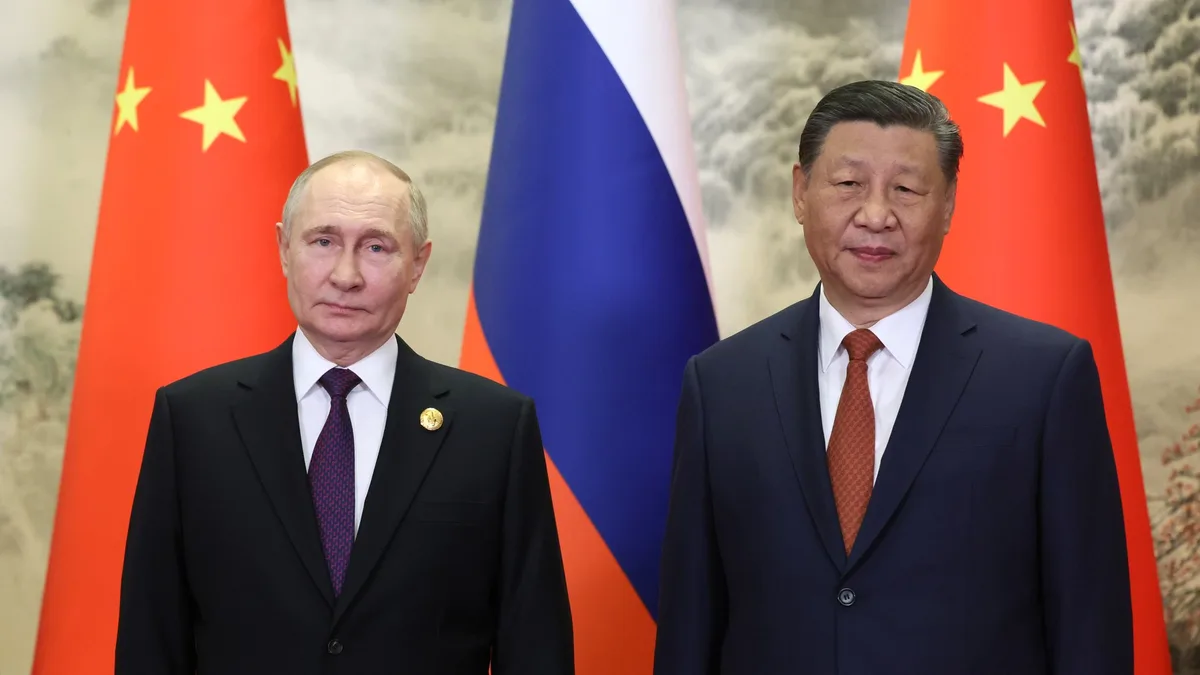
Putin Lands in New Delhi for BRICS Summit
Russian President Vladimir Putin landed in New Delhi for the two day BRICS summit, where a divided agenda over the wars in Iran and Ukraine awaits him alongside Xi Jinping and Masoud Pezeshkian.

Russian President Vladimir Putin landed today at the Palam military airport in New Delhi for a two day BRICS summit bringing together the 11 nations of the group’s expanded lineup. For Belgrade, which still steers its foreign policy along a line of military neutrality while simultaneously moving closer to the European Union, this gathering is a test of how much BRICS itself, home to both Russia and member states partnered with the West through their ties to India, can still hold together as a unified front while the war in Ukraine and the war over Iran both continue.
Putin was greeted on the tarmac by Indian Foreign Secretary Kirti Vardhan Singh, according to a report from Russia’s Ria Novosti news agency. On the same day, Friday afternoon, Modi has scheduled a bilateral meeting with Putin, followed in the evening by a meeting with Iranian President Masoud Pezeshkian, who arrived in India on his first visit since taking office and the first Iranian presidential visit to India in eight years. Chinese President Xi Jinping is set to meet with Modi on Saturday, his first visit to India since 2019.
The Gulf as the Dividing Line
BRICS was founded in 2009 as a forum for major emerging economies, Brazil, Russia, India, China and South Africa, seeking greater influence within institutions dominated by the West. Expansion later brought in Iran, Saudi Arabia and the United Arab Emirates, three countries that now stand on opposite sides of the war the United States and Israel launched against Iran in February. BRICS foreign ministers failed even to agree on a joint statement on the Middle East when they met back in May, in New Delhi itself.
“The Gulf conflict will be the central dividing line this time around, during the BRICS summit,” said foreign policy analyst Harsh V. Pant of India’s Observer Research Foundation. In his view, the expansion celebrated as a success for the group as recently as last year now looks like its biggest constraint. A similar warning came from economist Shilan Shah of London based Capital Economics, who told the AFP news agency that the war in Iran would be a sharp test of the expanded group’s cohesion, pointing to the same failed attempt by foreign ministers in May to reach a common position.
India is trying to hold its balance in this dispute. New Delhi maintains workable relations with both Tehran and Tel Aviv, while taking care not to damage its cooperation with Washington. It has partly addressed the energy crisis triggered by the war over Iran by turning to Russia, one of its most important strategic partners and, despite years of criticism, still its most contentious oil supplier. Putin last visited India in December 2025, and met with Modi again this month in Bishkek, the capital of Kyrgyzstan.
A Thaw Between Beijing and New Delhi
The meeting between Xi Jinping and Narendra Modi comes six years after the deadly border clash in the Galwan Valley in 2020 and years of strained relations that followed it. Flights, visas and high level contacts between the two nuclear powers have been gradually resuming in recent months, and Saturday’s meeting will be the biggest step yet in that cautious thaw. Deep mistrust still lingers, with a disputed border, India’s growing trade deficit with China and ongoing strategic rivalry continuing to complicate relations between the two countries.
The war in Ukraine is also on the agenda, if only indirectly. Indian Foreign Minister Subrahmanyam Jaishankar visited Kyiv this month, where Ukrainian President Volodymyr Zelensky said he was “grateful to India for its commitment to ending this unjust war.” That visit, coming just days before Putin’s arrival in New Delhi, shows how hard Indian diplomacy is working to engage both sides of the conflict, while the host country is left to reconcile the competing interests of Moscow, Beijing, Tehran and Washington all under one roof.
Security has been stepped up across central New Delhi, with wider traffic restrictions in place, and police have urged residents to be patient. The streets are lined with posters of a smiling Modi welcoming foreign leaders. Once the BRICS summit officially wraps up on Saturday, after the talks between Xi and Modi, it will finally become clear whether the expanded group managed to emerge with a common position on the Middle East, or whether, as analysts in New Delhi have predicted, it remains stuck on the same divide that weighed down its last ministerial gathering.