ZET Strike in Zagreb: Court Hearings on Ban, Pay Dispute
ZET and Zagreb Holding workers are on strike for a second day. A court is ruling on a ban, while the city and unions remain split on essential staffing and pay.

Zagreb woke up on Tuesday to another day with almost no public transport. The ZET strike, which also covers Zagreb Holding and began at 3:30 a.m. on Monday, is now in its second day. Today the County Court hears the lawsuits filed by the ZET and Holding managements, who want the strike declared illegal and banned. The Holding hearing starts at 11:30 a.m. and the ZET hearing at 1 p.m., with rulings expected during the day. Zagreb Mayor Tomislav Tomasevic says the city has not seen a public transport strike like this in the past 90 years.
What is running in Zagreb today?
Trams are operating on lines 11 and 17, but far below the usual level of service. On the first day, during the first shift, only two trams and one bus were on the road, instead of the roughly 200 trams and 300 buses that normally run. ZET records about 400,000 trips a day, so residents got around on foot, by bike, in shared rides and by working from home. At the busiest point of the day there were about 15 percent more cars than last Monday.
Bus 228 is running again on the Borongaj - Rebro - Borongaj route, introduced under an agreement between the ZET management and the unions so that patients and staff of the Zagreb University Hospital Centre (KBC Zagreb) can reach the hospital. The private agency Kaspret travel is again running a free service on the same line from 7 to 10 a.m. The Sljeme cable car runs from 10 a.m. and the funicular from 6 a.m. Ban Jelacic Square was almost empty at 7 a.m., while crowds built up on Dubrovnik Avenue.
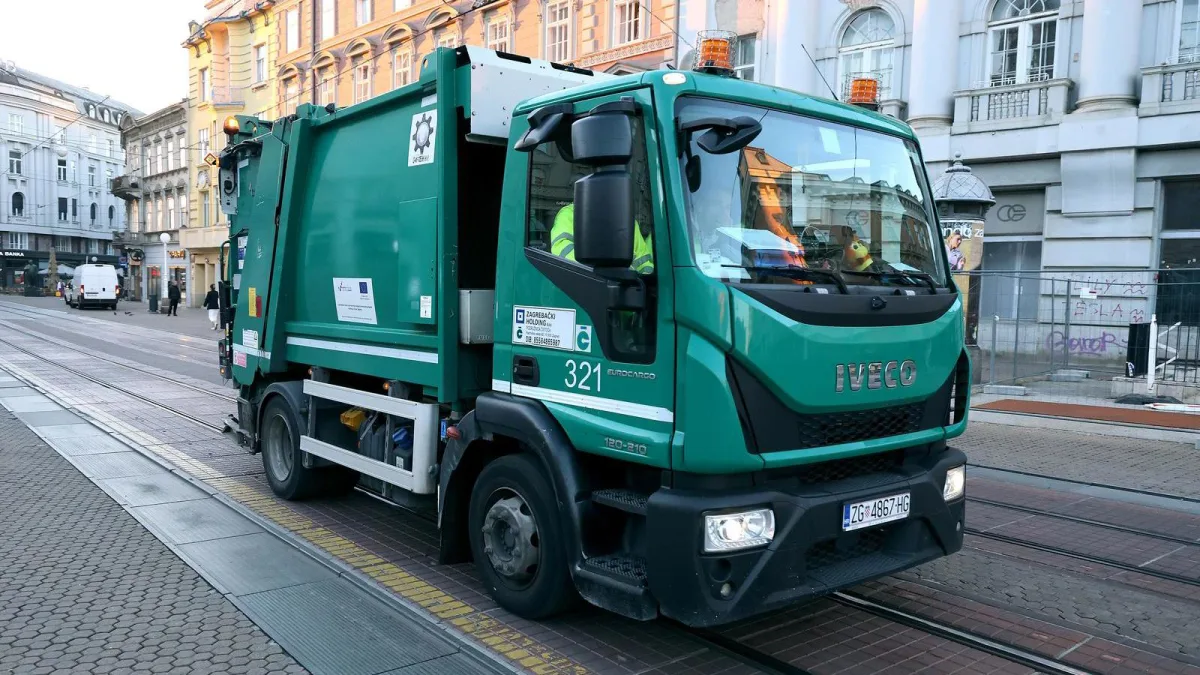
The city sanitation company Cistoca put 20 trucks on the road this morning to collect waste from hospitals, schools, kindergartens and barracks. Cistoca union chief Mumin Hodzic said the union offered 22 trucks yesterday, the employer replied that 11 were enough, and this morning all 20 are out.
Where arbitration and essential services stand
Arbitration on the minimum services that must be maintained during the strike is unfinished and continues tomorrow. The gap is wide: ZET wants 41 percent of employees working, while the union offers 1.5 percent. ZET Management Board President Marko Bogdanovic repeated the management’s position:
ZET still stands by its proposal that 41 percent of employees must be secured for essential services, while the union side, according to the proposal made so far, asks for 1.5 percent of employees to be included. No new arbitration activities are planned for today, and I expect the procedure to continue tomorrow.
Speaking to RTL Danas, Tomasevic cited Barcelona as a benchmark: there, 40 percent of public transport is guaranteed at peak hours during a strike and 20 percent outside them, which he says is roughly what the city asked for in arbitration. Vladimir Jozic, president of the ZET Drivers and Traffic Workers Union, told HRT that the union considers the strike lawful and wants to resume negotiations after the hearing:
Together with our legal team, we have concluded that we are in the right, that the strike is legal, and after that there is another conversation with the employer about continuing the negotiations. We expect to resolve this tangle as soon as possible and for our vehicles to get back onto the city streets as soon as they can.
The union said last night that the strike would go on because no invitation to a meeting came from the employer during the day. Its message to workers read: “Tomorrow we continue again - the same, but even more determined and even stronger.”
How much do the wages actually come to?
The wage figures are the first thing the two sides cannot agree on. ZET published that the net median salary in July 2026 was 1,942.42 euros. A figure of 1,992 euros for the average ZET driver’s pay has also been made public, and according to the same data a Cistoca driver earns 1,851 euros on average and a gravedigger 1,586 euros. On the RTL Direkt show, ZET union chief Goran Vucemilovic explained that a sum close to 2,000 euros cannot be viewed without the work behind it: that driver worked 26 days in the month, and one garage logged 12,400 overtime hours that month. Asked whether that is pay for a six-day week, he said yes:
That’s right, six working days a week, that’s almost 200 hours. And now you tell me, is that a small or a big salary for such a man?
Vucemilovic, who until recently drove for ZET himself, added that his own average driver’s pay over the past year was 1,800 euros, with 26 years of service and two children. He also suggested that figures like these could weaken public support for the workers.
The numbers on past wage growth also differ. Tomasevic told RTL Danas that ZET wages rose between 60 and 85 percent in three years, and in the same interview, as reported by Novi list, that ZET drivers’ pay rose by more than 60 percent and Cistoca workers’ pay by 87 percent. Holding said earlier that wages had risen by up to 87 percent over five years.
What the city offers and what it would cost
The city is offering a 4.5 percent raise in effect since January 1, another 4.5 percent now and another 4.5 percent later, about 14 percent in total over a year. According to the mayor, the government offered 1+1+1 percent. Tomasevic laid out the city’s limits:
The government offered one plus one plus one percent, that is, three percent. We offered 4.5 percent, which already took effect on January 1 this year, another 4.5 percent right now and then another 4.5 percent after that, roughly what we believe inflation will be. Over a year that is cumulatively about a 14 percent increase. That is what we can offer while city finances can still bear it. I have to be fiscally responsible. That is how the citizens elected me. You know what kind of debts the City was in when I became mayor, and I will certainly not allow it to end up in such a situation again.
By his calculation, the union demands at Holding would cost about 35 million euros, and next year the city will collect 85 million euros less in tax revenue because of the tax reform, which is more than a third of the budget of the City of Osijek. Asked whether meeting the union demands would mean higher prices for services, the mayor said it would. According to him, the unions asked for another 19 percent with indexation and larger pay supplements.
Drazen Jovic, head of the Croatian Union of Transport and Municipal Services, confirmed to RTL Danas that the work stoppage continues, and Jozic said the strike will last until the mayor meets the unions’ demands. Tomasevic called the union claims shameful and announced a new press conference today at 11 a.m.