Zagreb Transit Strike: Uber to Airport Hits 56 Euros
Day three of the ZET and Zagreb Holding strike: two tram lines run, garbage piles up in neighborhoods, and the County Court rules today on whether the strike is lawful.

The capital of a neighboring European Union member has gone a third day in a row without public transport and with its garbage uncollected, and a decision that could change the course of the dispute arrives this morning. The County Court in Zagreb hands down its ruling on the lawfulness of the strike at Zagreb Holding at 10:30, and its ruling on the strike at the city transit operator ZET at 11:30. For readers in Serbia this is a regional story with familiar ingredients: unions want higher pay, the city administration refuses to negotiate under pressure, and citizens pick up the bill.
What is running in Zagreb today?
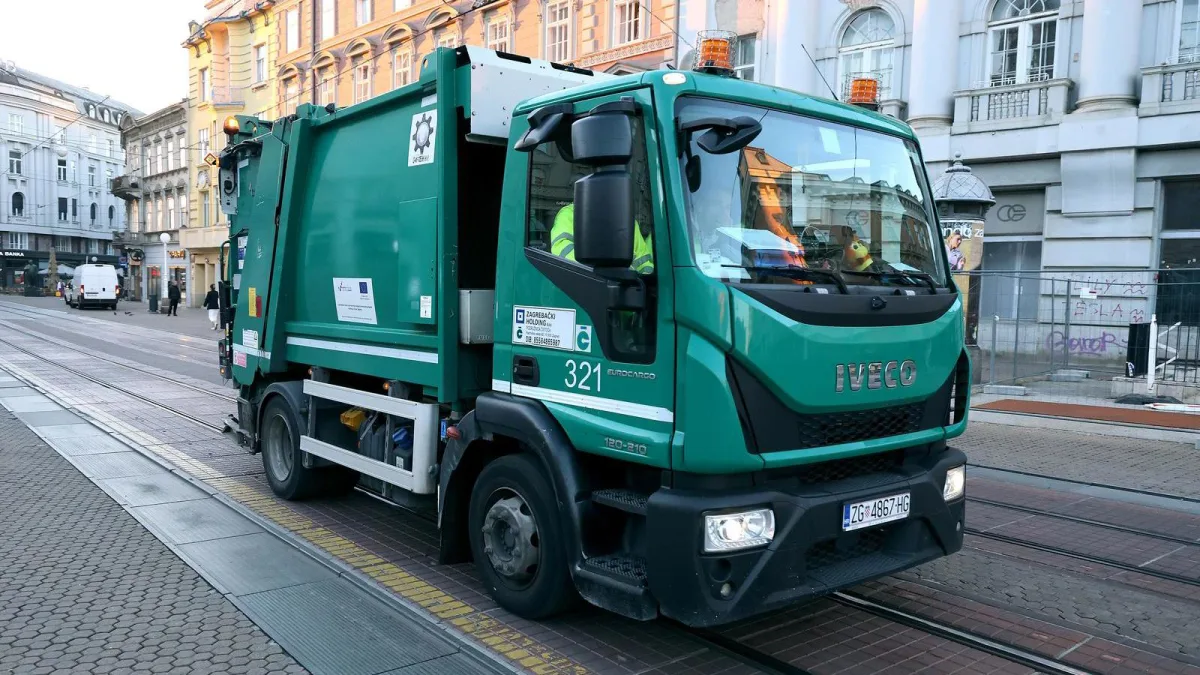
According to figures the union gave to the Croatian news agency Hina, only trams on lines 7 and 12 are running today, along with four buses on line 228 (Borongaj, KBC Zagreb) and the express line 330 from Velika Gorica to the Main Station. Vladimir Jozic, president of the ZET drivers and traffic workers’ union, confirmed this this morning. The municipal waste company Cistoca put 20 trucks on the streets, and a few workers with two vehicles are on duty at the Jakusevac landfill as a precaution against fires.
The city’s Bajs bike-sharing system has moved more bicycles to Novi Zagreb, Spansko, Precko and Vrapce, and residents have started offering free seats in their cars through the Idemo platform. Traffic is slow on Savska, Selska and Vukovarska, while on most other main routes it is moving relatively freely, according to Index.
Why did the ride to the airport jump to 56 euros?
Index checked prices on several routes from the city center at around 7:55 a.m. From the Main Station to Franjo Tudjman Airport, UberX asked 55.95 euros, while Bolt showed 43.90 euros, but with an active 20 percent discount. To Dubrava, UberX asked 34.95 euros and Bolt 17.90. To Precko the gap was 31.94 against 25.90 euros, and to the center 23.93 against 11.90 euros. On those three routes Bolt had a five percent discount. Uber warned users that “prices are higher than usual.”
The amounts hold for the moment they were checked and shift with demand and the number of free drivers, so the two apps should be compared with the discounts included.
How has the court ruled so far?
Yesterday the court rejected requests for a temporary ban on the strike in both cases. In the Zagreb Holding case the judge was Ksenija Jakovcevic, after a hearing that began after 11:30. According to N1, she delivered the ruling in these words:
“The court issues a ruling: the plaintiff’s motion for a temporary measure is rejected, as is the monetary claim.”
According to N1, the judge found that the plaintiff had proved the first condition but had not made plausible the grounds that would justify a temporary measure, because those grounds were not made concrete. The ZET case had a separate hearing at 1 p.m., with Lidija Bosnjakovic as the reporting judge. Index reports that the court rejected the requests of both the Holding and ZET.
Today’s rulings are first-instance decisions. The dissatisfied side can appeal to the Supreme Court, which must decide within five days. So even a ruling that declared the strike unlawful would not mean trams roll out onto the tracks right away. The dispute turns on two questions: whether the social peace clause applies to the unions after the collective agreements expired, and whether the strike was allowed to begin before essential services were defined. The ZET collective agreement expired on March 31, and the Holding’s on May 15. On July 29 the Holding and the unions signed an agreement to keep applying its provisions until a new contract is concluded, at the latest until December 31. The Holding holds that all provisions apply in that period, including social peace, while the unions dispute this.
What do the unions want, and what is the city offering?
The unions at ZET are demanding a 13 percent increase in the base pay, and management is offering 4.5 percent with later adjustment to inflation. Zagreb Holding made the same offer. The city and the managements point out that the base pay already rose by 4.4 percent at the start of 2026, and they calculate that with the offered increase and indexation it would rise by about 14 percent in total over a year. Mayor Tomislav Tomasevic says he will not give in to blackmail and that he is ready to sit down with the unions only once they start performing essential services. In his words, arbitration on essential services has not started because the unions are dragging their feet on naming their representative to the three-member commission.
Jozic told Hina that he will send the name of his representative to that commission today. Index also carries his statement addressed to the mayor:
“We are waiting for the court’s ruling and after it we will decide what to do next, we believe it will be in our favor, but regardless of it, we are ready for negotiations. We can meet already today, either at our place at ZET or at the City Hall.”
Jozic added, as Index reports: “It leads nowhere that they or we are in front of the cameras giving statements. It is in the interest of citizens that we reach an agreement.”
Who published the drivers’ payslips?
A list of ZET drivers’ salaries was published ahead of the ruling, sharpening the conflict. Goran Vucemilovic, president of the Croatia-Zagreb Bus and Tram Traffic Union, addressed the membership and ZET workers, and Index carries his message:
“The mayor has, unfortunately, managed to turn part of the citizens of Zagreb against ZET workers. By publishing the payslips, an attempt was made to create a picture of the workers that has nothing to do with reality and to further pit us against the citizens we serve every day. Whoever published this data without authorization will have to answer for it. We know who followed that path and appropriate legal steps will be taken.”
Vucemilovic announced legal steps, but the address as reported names neither the person who published the data nor the steps in question. Index is also taking the public’s temperature: more than 210,000 people took part in a poll among its readers, and 79 percent do not support the strike.
What is the garbage situation in the neighborhoods?
Telegraf, citing the portal Net.hr, reports that only seven percent of Cistoca workers are doing their jobs, and that this means collecting waste from hospitals, schools and kindergartens. In Tresnjevka, Knezija and Srednjaci, cardboard, biowaste and bulky waste are piling up beside overflowing containers. A Tresnjevka resident named Dubravka said she sees rats running in the evening, although the Net.hr crew, as reported, did not see any rats. Containers around Svacic Park were tidy.
Josip Pavlovic of the association Ecology of the City warned of the health risk:
“The risks of the spread of some kind of infections, of additional pests appearing, cockroaches, rats, other problems… Right now the situation is realistically what it is, we are entering the third day of this strike, and now is the moment for the city leadership to take responsibility and prevent any bigger problems and infection.”
Telegraf compared the situation to the Neapolitan garbage crisis, which peaked in 2007 and 2008, when about 100,000 tons of waste piled up on the streets and the army had to step in to clean up.