Grlic Radman Seeks $2.7 Billion in Property From Montenegro
Croatia's foreign minister said in Przno and Morinj that the ship Jadran is not the only point of dispute and that, in his view, Montenegro's negotiating chapters are closing too fast.

Croatian Foreign Minister Gordan Grlic Radman said in Montenegro that Zagreb wants more than the training ship “Jadran”: it is seeking military property he values at more than $2.7 billion, and he warned that Montenegro’s negotiating chapters are being closed too quickly. For Serbia the remarks matter because they show how the clashes of the 1990s are being carried into the accession talks of neighboring states. They also mention Serbs, whose confiscated property, he said, was returned under special laws, and Ratko Mladic. The words were spoken on Thursday, October 1, in Przno and Morinj.
What exactly does Zagreb want from Montenegro?
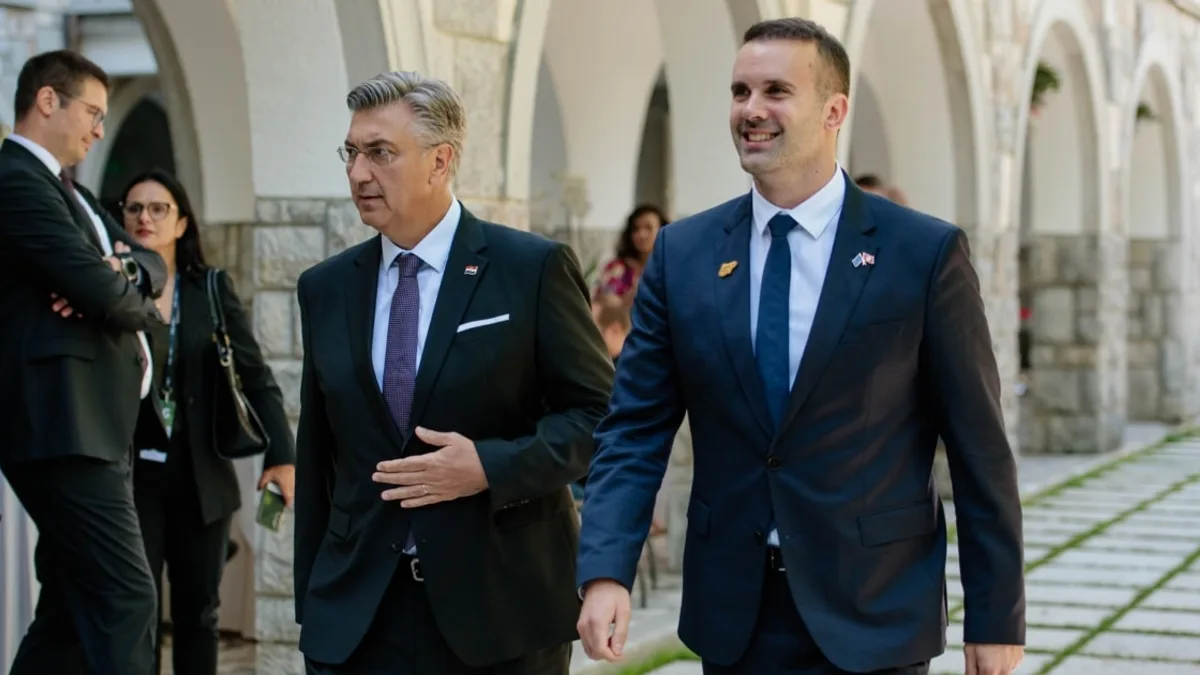
Grlic Radman spent the day at a Berlin Process foreign ministers’ meeting in Przno, which Montenegro chairs this year. Afterward he laid wreaths at the memorial plaque to Croatian detainees in the former Morinj camp, on the anniversary of its opening, together with Montenegrin Deputy Prime Minister and Foreign Minister Ervin Ibrahimovic and European Commissioner for Enlargement Marta Kos. According to HRT, civilians and defenders from the Dubrovnik area were brought to Morinj, and two of the detainees died there.
The minister told reporters that the ship “Jadran” is not the only matter under discussion. Croatia, he said, has interactive maps and documents showing the situation on May 31, 1990: at that time about 207 vessels were in Croatia and around thirty in Montenegro, while a year later the ratio was reversed. As missing property he named warships, a submarine and a military hospital.
“And where is all that property that was seized, that was sold or given to someone? That is a military succession, and it is documented. We have interactive maps and documents that can establish it. Political statements are one thing, and what we actually hold is another. And we know when, at what moment, it went to Montenegro. Quite a few vessels disappeared under cover of night, for example one submarine found its way through one country into another country, a military hospital and so on. We have all of it written down, and we are talking about property worth more than 2.7 billion dollars.”
That was Grlic Radman’s answer to reporters in Montenegro. The figure and the description of the missing property come from the Croatian side, and they are its claim, not an established fact.
Why does Zagreb think the chapters are closing too fast?
The Croatian minister maintains that Zagreb is not slowing Montenegro’s pre-accession process, but that each chapter requires a precise check on whether the conditions have been met. He singled out Chapter 14 and other chapters that call for extra attention. The Berlin Process ministerial meeting reaffirmed Montenegro’s goal of joining the European Union in 2028, provided it closes all negotiating chapters by then.
“Look, chapters cannot simply be closed because… there are some geopolitical reasons. It has to be seen precisely what is at stake. And with Chapter 14 as well, the real reasons have to be established, so we have to get to the heart of it, to the substance. It is not a matter of closing the chapter or not closing it, it has to be studied properly. That is our recommendation to others too. Because I have a feeling that those chapters are somehow being closed too fast.”
Asked whether the status of the Croatian community in Montenegro would lead Croatia to block the country’s European path, Grlic Radman replied that there is no blockade, only a need to meet the requirements on the rule of law and on human and minority rights. As an example he cited a speech about Dobrota lace in which, he said, its Croatian origin is not mentioned.
Mladic, restitution and Croats in Montenegro
Grlic Radman described Chapter 23, which also covers restitution, as the place where Zagreb will insist on the return of property taken from Croats in Montenegro.
“So, that property was taken from everyone, but if it was returned to everyone and not to Croats, then that is some kind of message.”
In Morinj the minister also alluded to the condolences that Montenegrin Parliament Speaker Andrija Mandic sent to the family of Ratko Mladic. His words were reported as follows:
“Glorifying war criminals is incompatible with European values. Ratko Mladic began his bloody path in Croatia, remember Skabrnje, Knin, the attack on Sibenik. That is not reconciliation, that is something that does not contribute to the stability of the region.”
Croatia, HRT reports, is not asking for an apology, since Montenegrin representatives expressed regret back in 2006 for taking part in the attack on Dubrovnik, but it considers confronting what happened in Morinj to be still important. Among the open issues HRT lists compensation for camp detainees and the naming of the Kotor bay swimming pool after water polo player Zoran Gopcevic, who was also one of the guard commanders at the camp.
Montenegrin Foreign Minister Ibrahimovic said in Morinj that Montenegro is ready to face its past.
“And today we are sending a message from here that Montenegro is ready to face the past and that we want to build a society on truth and justice, but also that we value all the suffering of the people who went through this former Morinj camp, and across the former Yugoslavia.”
He added that Montenegro expects other former Yugoslav states to show the same attitude toward their own citizens who went through similar fates. European Commissioner Marta Kos said in Morinj:
“When neighbors gather to remember painful events from the past together, they open the way to a shared future, and the European Union enables countries to ensure that conflicts from the past no longer determine their future.”
What comes after Morinj?
The question of the ship “Jadran” enters a formal phase on October 9, when the commissions of the two countries will meet in Zagreb for the first time. The Montenegrin commission is led by Defense Minister Dragan Krapovic, who told Radio Television of Montenegro that the government’s position on ownership of the ship has not changed. Croatia proceeds from the position that the ship’s home port is Split, which Podgorica does not accept. After the first meeting, the commissions are expected to meet in Montenegro as well.
Krapovic ruled out joint management of the ship, though he left room for joint training:
“As for joint management of the ship, as for possibly joint training, we are still open to that possibility today. However, the nature of warships, training ships, military ships is such that it can sail under only one flag.”
Zagreb’s demand for $2.7 billion, voiced eight days before that meeting, takes the topic far beyond a single training ship. The Croatian Foreign Ministry did not respond to an earlier inquiry from the Montenegrin public broadcaster about its position ahead of the talks, and the published statements do not show whether that property will be on the commissions’ table.