Poland: Navrocki Cuts Trip Short Over Constitutional Court
Judge Anna Korwin-Piotrowska took over running the Constitutional Court and suspended its president, while Navrocki turned his plane back to Warsaw and called emergency talks.
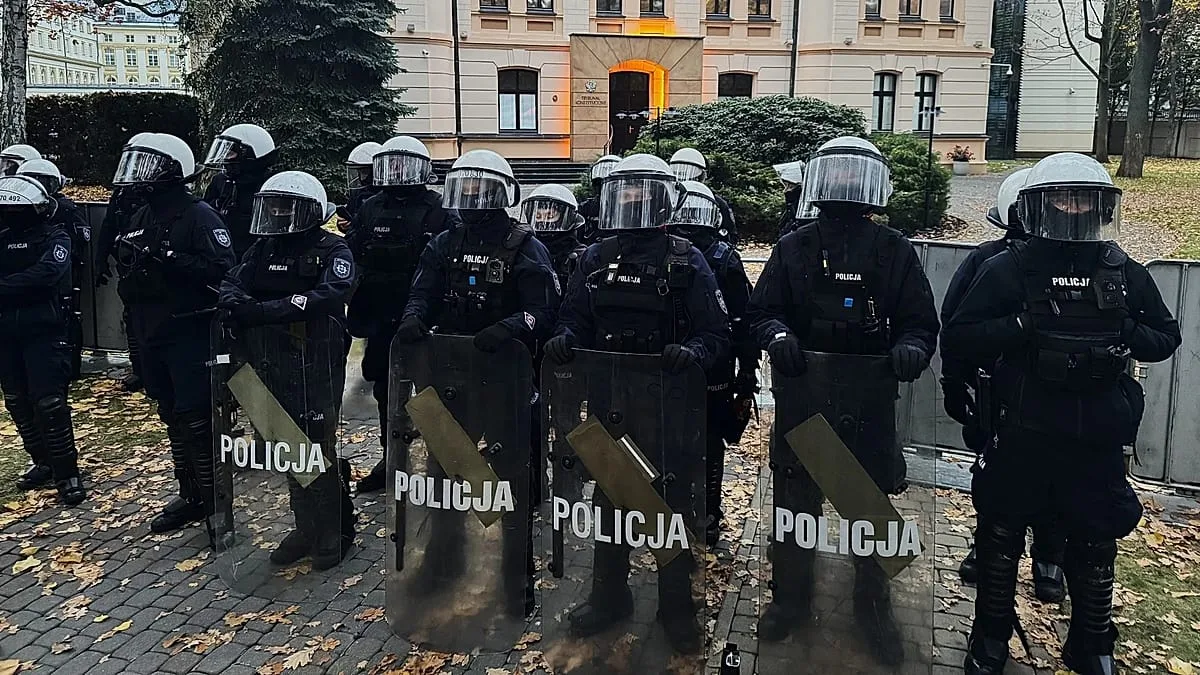
Poland’s Constitutional Court ended Friday, October 30, with two people claiming to run it, while a police cordon and demonstrators stood outside the building in Warsaw. President Karol Navrocki turned back the plane taking him to Senegal and returned to the capital, and he called emergency talks with the heads of parliamentary groups for 1 p.m. on Saturday. Serbia, a candidate for European Union membership, knows this dispute well: judicial independence and the rule of law are the yardsticks Brussels applies to member states and candidates alike, and here they are being decided at the door of a single building.
What happened inside the court?
On Friday, seven people elected by the Sejm entered the Constitutional Court building. Court spokeswoman Weronika Ścibor said security staff were ordered to pack up and leave, and that court president Bogdan Święczkowski and vice president Bartłomiej Sochański were refused entry. Ścibor believes the timing was chosen deliberately, because not all employees were present.
Judge Anna Korwin-Piotrowska then announced that she was taking over the running of the court and suspended Święczkowski. Kyiv Independent reports that the order also covers Sochański, while Euronews mentions only the court’s president. Neither source gives the length of the suspension.
The court’s current leadership disputes her position. A post on X from the court’s account, which Święczkowski controls, says she cannot run the court because the president of the state has not sworn her in, and it calls the events a coup.
Who wants immunity lifted, and why?
Justice Minister and Prosecutor General Waldemar Żurek filed five requests to lift immunity: four concern Święczkowski and one concerns Sochański, backed by 50 volumes of files. The requests are not criminal charges. The court, Żurek told reporters, has stopped working properly:
“This court has become private property; we must restore its proper functioning.”
Prime Minister Donald Tusk wrote on X: “Restoring the rule of law is our duty.” He added that after years of lawlessness under the Law and Justice (PiS) government, this is a hard process, “sometimes painful,” that demands decisive steps, and that “there is no other way.”
Navrocki at the court, a shoving match at the door
On Friday Navrocki wrote on X: “At a moment like this the president must be in Poland. I am cutting short my flight to Senegal. I am coming back.” He had been traveling to the opening of the Youth Olympic Games. On his return he met First President of the Supreme Court Zbigniew Kapiński at the presidential palace, and the two then went to the Constitutional Court together. Footage shows shoving with judges at the entrance, among them Korwin-Piotrowska.
On Saturday morning, the head of the president’s cabinet, Paweł Szefernaker, read the president’s statement outside the court:
“Overnight the constitutional order of the Republic of Poland was violated and a constitutional organ of the state was violently seized. I call for the legal order to be restored and for the forces of coercion sent there by the government to leave the Court’s premises.”
Navrocki added on X: “The last thing Poland needs is a conflict that grows into something far worse.” He justified the talks by citing a threat to internal security. Żurek replied that the president’s behavior had “deeply alarmed” him, and he called on the competent authorities to react.
Protest outside the court
Supporters of PiS and Confederation gathered outside the building, among them PiS chairman Jarosław Kaczyński, former prime minister Mateusz Morawiecki and former court president Julia Przyłębska. According to Kyiv Independent, demonstrators broke through a barrier and threw objects at police, who detained three people. Kaczyński said:
“From today Poland becomes a police state, and from there the road leads straight to authoritarianism, and then to totalitarianism.”
He called for the protests to continue. United States Ambassador to Poland Tom Rose warned all sides: “Do not take any steps that could provoke violence or further escalation.”
Resignation of the ambassador to China
The crisis has spilled into diplomacy. Poland’s ambassador to China, Jakub Kumoch, resigned on October 30 and asked to be recalled: “Given the events in the country, I have concluded that it is no longer possible for me to continue serving as ambassador of the Republic of Poland.” Foreign Minister Radosław Sikorski called the end of his mission unprofessional and added that Kumoch no longer represents Poland. Marcin Przydacz, head of the president’s Bureau of International Policy, linked the resignation to the crisis at the Constitutional Court.
University of Warsaw political scientist Ewa Marciniak is convinced that the parliamentary elections in November 2027 are sharpening the dispute: “We are already in pre-election mode and in the phase of voter mobilization. When political actors pursue goals tied to that mobilization, there is always a risk of escalation.” PiS member of the European Parliament Patryk Jaki judged that the images from the court have gone around the world and could damage the reputation of Tusk’s government.
For weeks the government has been trying to remove judges appointed by the previous PiS administration, while Navrocki blocks the candidates Tusk proposes. The dispute over the court’s composition and leadership, until now fought in politics and in the legal arena, has moved into the court’s own headquarters.