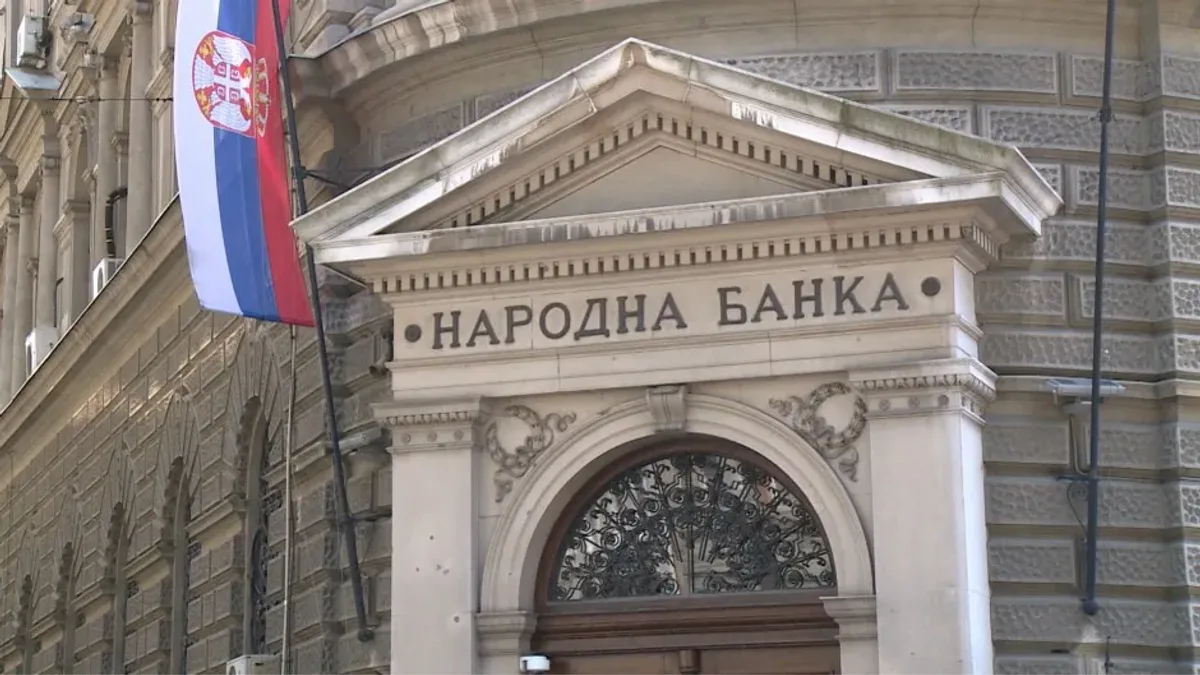
NBS holds policy rate at 5.75 per cent, inflation runs at 2.8 per cent
The National Bank of Serbia left the policy rate unchanged at 5.75 per cent at the May meeting of its Executive Board, while annual inflation in March stood at 2.8 per cent.

At its Executive Board meeting on 7 May 2026 the National Bank of Serbia held the policy rate unchanged at 5.75 per cent, extending a pause in the monetary easing cycle that began in mid-2024. The deposit facility rate remains at 4.50 per cent and the credit facility rate at 7.00 per cent, according to a statement signed by governor Jorgovanka Tabakovic on the same day.
Annual inflation in Serbia, measured by the consumer price index of the Statistical Office, stood at 2.8 per cent in March 2026, within the NBS inflation corridor of 3.0 per cent plus or minus 1.5 percentage points. Monthly inflation in April was 0.8 per cent, driven above all by seasonal rises in fresh food prices and parts of the energy basket. Core inflation, calculated excluding energy and food, remains stable at 3.1 per cent year on year.
The reasons for the pause and the projection
In its brief reasoning for the decision the NBS notes that domestic inflation pressures are under control, but that external energy turbulence in the Middle East poses a risk for the autumn of 2026, since Serbia is a net energy importer. Tabakovic added that she expects inflation to pick up from September onwards, largely on base effects, with the policy rate held as a protective measure. In its May economic report Raiffeisen Bank projects that average annual inflation for 2026 will stay in a range of 3.2 to 3.5 per cent.
In its spring report on Serbia in April, the World Bank found that economic growth in the first quarter had slowed to 2.4 per cent from 3.8 per cent in the previous year, while inflation came in slightly above earlier projections. Fiscal Council chairman Pavle Petrovic told the daily Politika that the NBS finds itself in “a classic data-watching position”: restrictive enough to keep inflation in check, but flexible enough to respond if growth keeps softening.
What this means for the bank spread
At its current level, the policy rate keeps the weighted effective rate on new dinar housing loans to households at around 6.9 per cent, according to NBS quarterly data. On euro-indexed loans, which make up 87 per cent of the household housing loan book, the average effective rate is 5.3 per cent, reflecting the six-month Euribor plus the bank’s margin. The NPL ratio across the banking system fell to 2.3 per cent in the first quarter, a historic low.
Historical context of the cycle
The current policy rate of 5.75 per cent is 100 basis points below the peak of the tightening cycle reached in July 2024, when, under pressure from the inflation peak of 16.2 per cent in October 2022, the NBS lifted the rate to 6.75 per cent. The easing cycle began in October 2024 with a run of four consecutive 25 basis point cuts, followed by a pause from February 2026. Compared with the European Central Bank, which holds its deposit rate at 2.75 per cent, the Serbian policy rate offers a 300 basis point risk premium on the dinar, historically at the lower end of the average spread.
What this means for the real economy
For the SME sector, which according to the latest Statistical Office report employs more than 67 per cent of the workforce in Serbia, the cost of dinar working-capital financing averages 8.3 per cent effective on an annual basis. The difference compared with the potential rate of 4.5 per cent that would prevail in a more accommodative monetary stance means the average firm with annual working-capital needs of 30 million dinars pays around 1.14 million dinars (about 9,700 euros) more than it would in a friendlier environment. Marko Cadez, president of the Serbian Chamber of Commerce, told the daily Politika that the static rate was “understandable from the angle of monetary stability, but generates a competitive handicap at the regional level”, since the Croatian National Bank and the ECB hold their rates 1.75 to 2 percentage points lower.
The next NBS Executive Board meeting, at which the policy rate will be considered again, is scheduled for 12 June 2026.