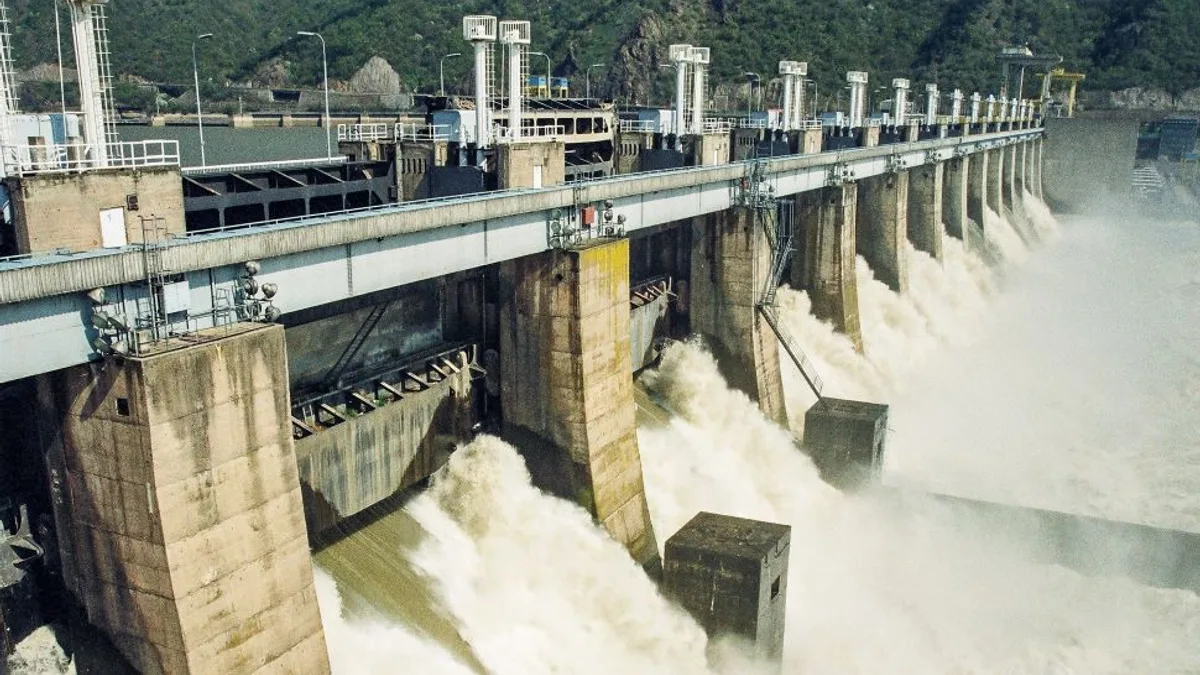
Djerdap 3 plan: up to 2,400 MW, capacity still in review
The plan calls for up to 2,400 megawatts and a first phase by 2036, while Minister Dubravka Djedovic Handanovic says analyses must settle the optimal capacity.

The Djerdap 3 pumped storage hydropower plant is planned with a design capacity of up to 2,400 megawatts and a first phase finished by 2036, but caretaker Minister of Mining and Energy Dubravka Djedovic Handanovic said in Belgrade today that analyses must determine the optimal capacity of the future plant. She spoke on October 9, 2026, at the Danube Future forum at the Aero Club.
How many megawatts will Djerdap 3 have?
The figures of 2,400 megawatts and 2036 are not a new announcement from the minister. They come from a plan that was made public earlier, and at the forum she explained why the final capacity has not been set. She recalled this year’s record low Danube water level for hydropower plants, which she gave as the reason to assess the amount of water and the plant’s optimal output through analyses before any decision.
A pumped storage plant works like a giant water battery: it stores surplus electricity when demand is low and generates power when demand peaks. The minister presented the project as one of those in which Serbia and the United States can build closer ties.
We already have projects identified where we can develop relations, and one of them is Djerdap 3. It is a project of wider regional significance, meaning not only for Serbia but potentially for Romania too, and for all of Southeast Europe. Djerdap 3 has the potential to be the largest pumped storage hydropower plant in Europe.
That is what Djedovic Handanovic said, and on the broader picture she added: “The Danube is the development axis of the region, and energy is the foundation of new investment and stronger international connections.”
What has been done on the project so far?
The public call for Djerdap 3 was issued under the Agreement on Strategic Cooperation between Serbia and the United States in the field of energy, and it stayed open until June 25. On July 9, the Serbian government adopted a conclusion on the basis for a memorandum of understanding with the Romanian government, which would ease the exchange of information on the project and allow assessments of building the plant on Serbian territory.
The forum was organized by the Pupin Initiative and opened by its president, Vuk Velebit. Aleksander Titolo, chargé d’affaires at the US Embassy in Belgrade, also spoke at the opening and, according to a report from the event, expressed satisfaction with the project’s progress. Vesna Damjanic of Bloomberg Adria moderated the conversation with the minister. The Djerdap 3 panel featured Josh Baker, vice president of Bechtel and its general manager for the Balkans, and Alina Arsani of the Romanian think tank Energy Policy Group.
Bajina Basta and renewable sources
Serbia currently has one pumped storage plant. The minister said:
When it comes to pumped storage plants, we have one in our system, Bajina Basta. It returned to our system at full capacity in March, because for two years before that it was in a major overhaul, that is, a rehabilitation, which was very intensive.
According to her, renewable capacity in Serbia has grown from about 400 megawatts in 2022 to roughly 1,300 megawatts today, more than threefold. The figure was reported by the portal EUpravo zato.
On how fast Europe rolled out renewables, the minister said:
Climate change brings us additional challenges, and it seems to me that the world is not finding answers fast enough. The development of renewable sources and technology was rushed. That brought plenty of advantages and benefits, but on the other hand it endangered transmission systems. Transmission systems did not develop at the pace at which generation capacity and technology did, so a certain fatigue set in across European countries, from the United Kingdom and the Netherlands to Southern Europe, Spain and Portugal.
Gas: the first five kilometers next week
The minister judged that Europe was wrong to give up on gas:
Europe gave up on gas very easily seven or eight years ago, and I think that was a mistake, because countries that relied on coal for decades and have no source of nuclear energy cannot replace baseload capacity with renewables overnight. We were quite cautious there and did not rush into reckless moves, but are going step by step, in phases. Of course that takes time, because you cannot replace thermal power plants of 1,000 or 2,500 megawatts overnight.
The gas interconnection between Serbia and North Macedonia is 145 kilometers long, with a planned annual capacity of 1.5 billion cubic meters of natural gas. The route through Serbia runs from Orljane via Leskovac and Vranje to the border. Construction of the first five kilometers begins next week, and on the remaining works the minister said: “This is a project that will be carried out largely next year and in the first part of 2028.”
The Macedonian side has signed a contract with a contractor and starts its share of the works in early 2027.