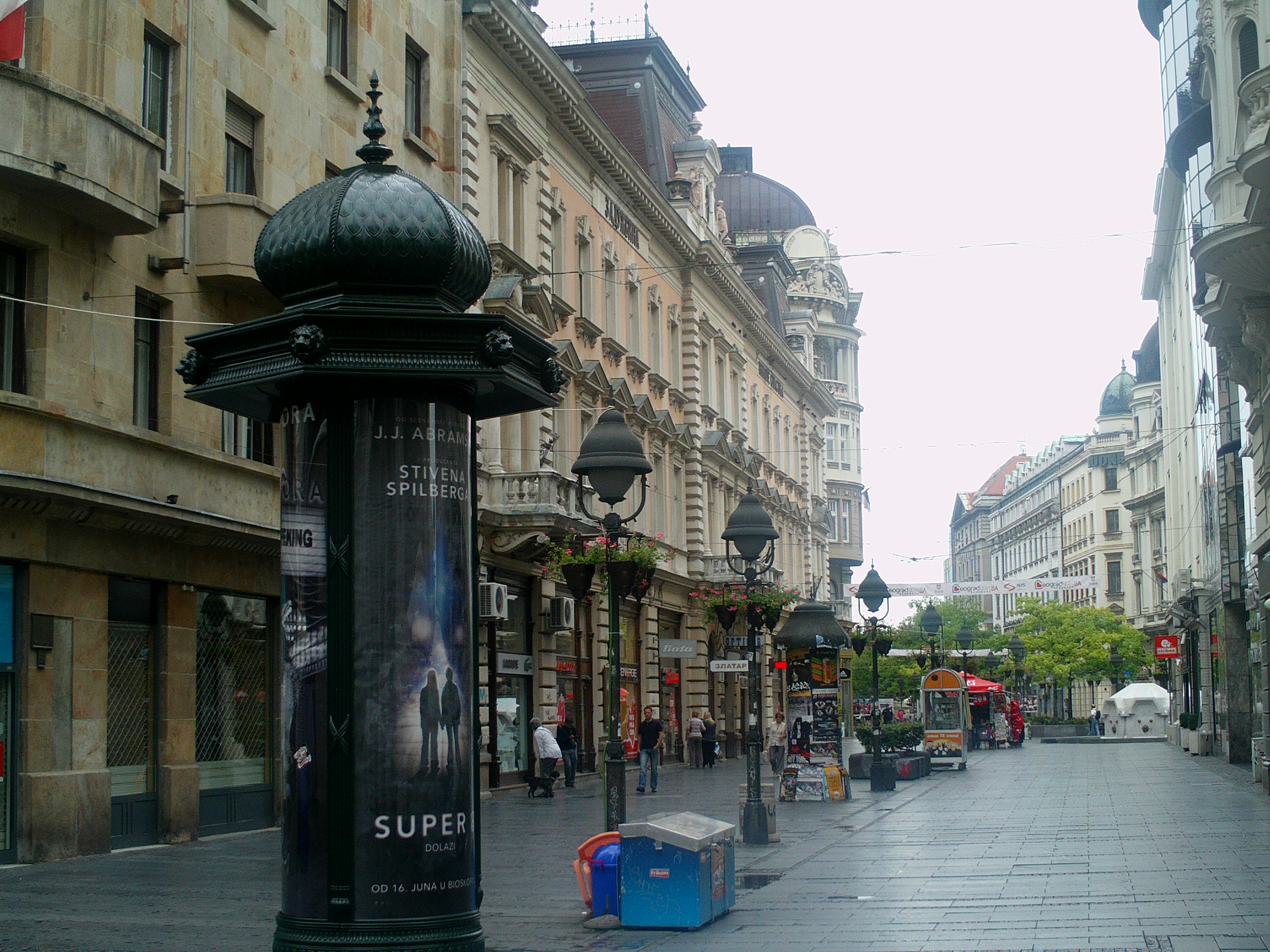
The Tavern Has Stayed, but the Conversation With a Stranger Is Gone
In a kafana where twenty years ago I exchanged words with people I did not know, today people sit in closed parties of three or four. No one asks, no one answers, no one knows the name at the next table. Sennett called this the fall of public man. We still call it modernity.

- Tavern sociability in Belgrade has shifted from a space of encounter between strangers to a space of closed groups.
- Richard Sennett in "The Fall of Public Man" explains the retreat into intimacy as a historical change, not a moral failing.
- The Serbian sociologist Ratko Bozovic describes the tavern scene as a historically central element of urban modernity in Serbia.
- The loss of conversation with the stranger is the loss of a skill in public conduct that is not inherited but practised.
In the tavern Tri lista duvana near Kalenic market, on a Tuesday at around eleven in the morning, I sat at a table by the window. I had two hours between two meetings. I ordered a coffee and tried to overhear what I could around me.
At the five tables around me sat twenty-one people. Two tables of three, one of four, one of two, one of five. What struck me in the first twenty minutes was the absence of something. Nobody looked toward the next table. Nobody offered a cigarette to an unknown person. Nobody asked a question of the universal kind, of the “excuse me, do you know what time it is or where the toilet is” variety.
I was the only customer sitting alone. I remained so until the end. No one approached me; I approached no one.
The tavern that was a public sphere
I have to stop here, because this is a sociologically significant difference. Twenty years ago, in the same tavern, I would have exchanged at least three sentences with strangers at the next table over the course of an hour. That was the norm. Pensioners at the next table would have asked me what I did, a driver would have commented on the weather, the man at the window would have offered me a cigarette when I took out my own pack.
None of them was my friend. None of them entered my life. The exchange ended the moment one of us stood up and left. But while it lasted, it was politically and sociologically meaningful. It was the practice of publicness, as the American sociologist Richard Sennett defined it.
A pivot to Sennett
I pivot to the sociology of Richard Sennett, whose principal work on this subject is the book “The Fall of Public Man” (Knopf, 1977; Serbian translation, Mediterran Publishing, 2010). In it Sennett formulates a thesis that today reads like a description of the Serbian tavern in 2026:
Modern crowded intimacy has become a kind of tyranny, gradually erasing the space for relations that might unfold between strangers without the exchange of private content. With that, the practice of publicness is lost, which historically rested on the capacity to talk to a stranger about things that are not private.
Sennett’s thesis is partly historical, partly sociological. Historically, he argues that in the nineteenth century the European tavern, the European pavement, the European park were places where strangers could exchange ideas, jokes, short stories without needing to disclose who they were. That was the public in an operative sense, not an abstract one.
Over the twentieth century, especially after the Second World War, this practice has systematically shrunk. People moved into the private space of the home, of intimate circles, of telephone conversations, later of screens. Conversation with the stranger became suspect because it had no obvious function.
The Belgrade tavern as a Serbian case
The Serbian sociologist Ratko Bozovic, in the book “Trials of Free Time” (Cigoja Press, 2010), describes the history of the Belgrade tavern as the history of Serbian urban modernity. For Bozovic, the tavern in Serbia was more than a place for coffee. It was:
- a political forum where electoral deals were forged
- a literary sphere where poets read to one another
- an economic space where deals were sealed with a handshake
- a civic university where the skills of dealing with the stranger were learned
- a democratic space where rank and status were temporarily suspended
All these functions, Bozovic notes, rested on something that today seems simple but sociologically was not. On the capacity of an unknown person to approach another unknown person, to begin a conversation, and for the conversation to unfold by rules nobody had explicitly stated.
The counter-argument about caution and safety
Here comes the counter-argument that has gained ground in the Serbian public scene over the past fifteen years. By that logic, people no longer speak to strangers not because they are atomised but because they are properly cautious. In a setting where the media have been filled with stories of fraud, theft and abuse of trust, the rational strategy is not to approach a stranger, because you do not know what they want.
The argument has partial truth. The number of street scams really has risen, especially those targeting pensioners. Media really have exaggerated such scenes. There really is a rational ground for reserve.
But the argument is only half right. Sennett would say that the retreat into intimate groups is not the result of caution but the consequence of a structural change in which more and more of the expectations once placed on the public space have migrated into the private. The phone replaces the chance conversation. The app replaces the question to the waiter. The network of friends on the screen replaces the network of acquaintances at the next table. Caution is the consequence, not the cause.
A skill that is not inherited
I return to Tri lista duvana. Toward the end of the second coffee, when I stood up and paid, I passed a table where two women in their seventies were sitting. One of them, whom I did not know, looked up and said:
We have seen you a long time now, thank you for coming every Tuesday.
I was confused. I had never seen her. I let it show on my face. She smiled and added:
I am old, so I mix people up. But I like it when someone comes, even a stranger. You remind me of someone I loved. Goodbye.
The exchange lasted about twenty seconds. It was irregular, in some respects even impolite by contemporary standards. But sociologically it was central. That older woman had a skill of speaking to a stranger that she had learned somewhere in her twenties, and that had stayed in her body even after the rest of society had lost it.
The question that stayed with me as I stepped out onto the street, which I share with those who have read to the end, runs roughly like this. If the skill of conversation with the stranger is not inherited but is learned through practice in public space, what happens to generations that no longer have such a space. And, the harder sociological question, can we still call public a society whose publicness has shrunk to the screen.