Knez Mihailova as a Shop Window: Why the City Centre Is No Longer Ours
Weekly retail rents on Belgrade's Knez Mihailova have crossed €50 per square metre. That means the Serbian capital's central street is no longer a space of shared purpose, but a market shelf leased to global brands.
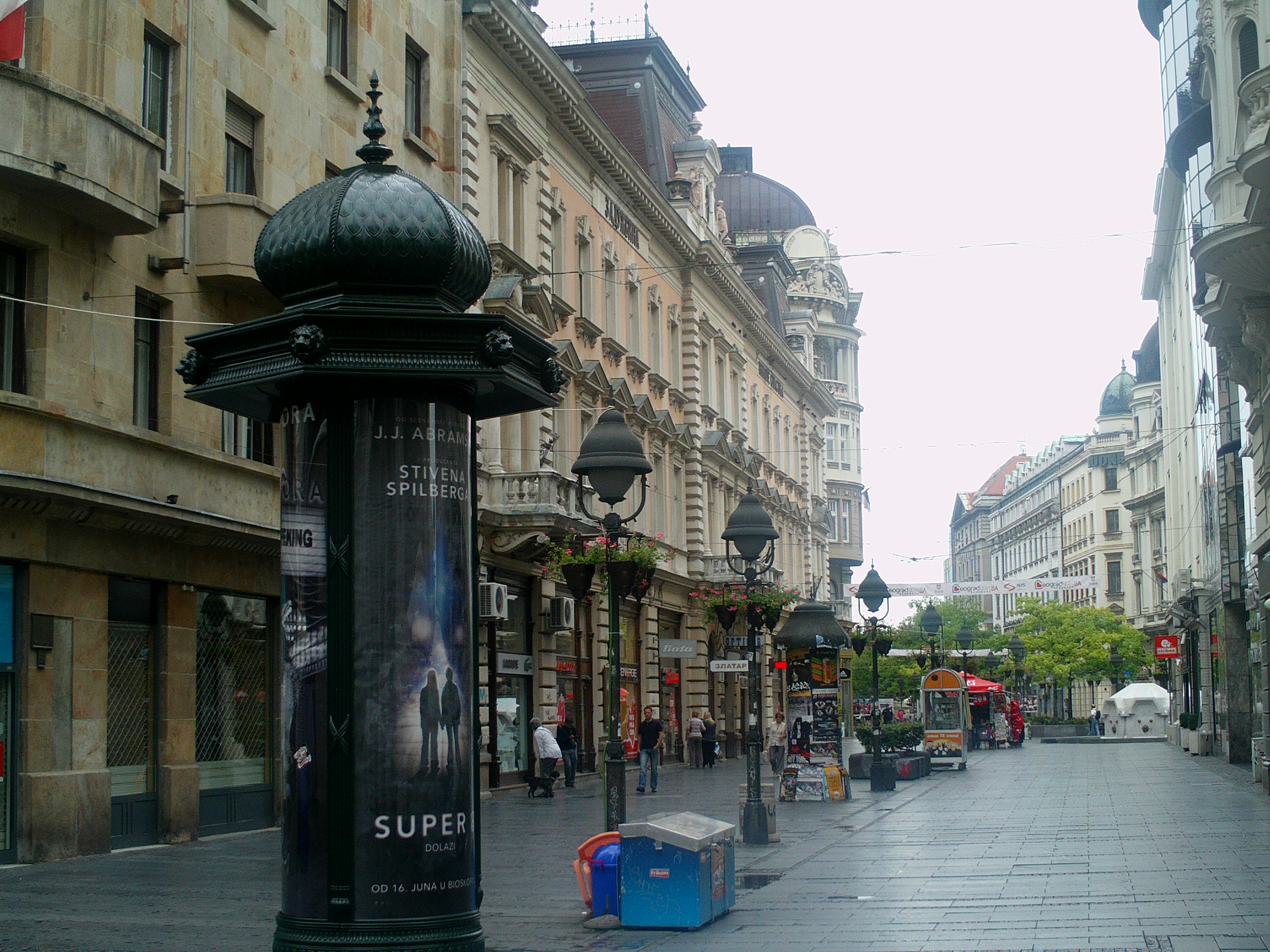
Two Saturdays ago, I walked Knez Mihailova from Kalemegdan to Republic Square. Exactly eleven minutes. I counted the shops. It was not a piece of reporting work, just a habit I have kept for years on that route.
From the corner with Pariska to Theatre Square, I counted sixty-four shops on the ground floors of the buildings. Of those sixty-four, sixty-one were some form of retail (clothing, footwear, accessories, cosmetics, restaurant, cafe, mobile phone, bank, exchange office). The other three were:
- the National Theatre as a building
- an entrance to an underground garage
- a small philatelic shop surviving on foreign tourists
A bookshop, anything resembling a ground-floor cultural institution, not one. Twenty years ago, on the same street, there were seven bookshops, two galleries with exhibitions, three offices of civic organisations, two lecture halls with public entry.
Not nostalgia, but a sociological datum
I bring this tally not as nostalgia (the word “nostalgia” in the Pavlovic register is on this column’s banned list). I bring it as a sociological datum.
Knez Mihailova 2026 is not the end of the world because of commercialisation. Trade has moved into city centres across Europe. The sociological point on which this street stands out is the question of which kinds of business can operate, and which have disappeared.
In Vienna, on Kärntner Strasse, alongside retail there is a city coffee house from 1876, a theatre box office, a small museum of automata, a tourist information bureau with live staff. On Knez Mihailova, what survives next to retail survives as buildings (the National Theatre, the Serbian Academy of Sciences and Arts, the Ethnographic Museum), not as ground-floor businesses with public entry. The street, in its ground-floor exchange with the passer-by, has become exclusively a market.
Sennett and the fall of public man
I pivot to the sociology of public space. In “The Fall of Public Man” (Knopf, 1977), American sociologist Richard Sennett develops the idea that the city in the modern era has been turned into a stage on which citizens watch one another as spectators rather than participants.
Sennett’s argument concerns New York and Paris boulevards of the late 19th century, but applies to Knez Mihailova in 2026:
If a street consists only of retail, the passer-by passes as a buyer, or as a visitor who is not buying, which makes him out of place, with the uneasy sense that the street is not for him.
Sennett calls this the “passivisation of public space.” Active public space requires places where a person can be without buying, can sit, talk, wait, at no cost.
€50 per square metre per week
Here are the figures that confirm it. According to research by CBS International (one of the leading brokers of commercial space in Belgrade), weekly rents on Knez Mihailova in the first quarter of 2026 crossed €50 per square metre.
A commercial space of eighty square metres costs €4,000 a week, around €17,000 a month. To cover that rent, sales per square metre have to be at least several hundred thousand euros a year, which rules out almost everything on the Serbian market other than international chains and a handful of domestic brands with foreign capital.
Knez Mihailova did not choose to become a chain street. It was architecturally squeezed into a place where only chains could survive. The rest were pushed out.
What a city loses when a street becomes a window
Someone could object, fairly, that Knez Mihailova is still heavily visited, that people stroll there on Sundays, that tourists flock to the terraces of Domaca Kuca. All of this is true. But sociologically, a visited street and a living street are not the same.
A visited street can be, like Las Ramblas in Barcelona 2010-2019, packed with people walking through it as if through a corridor, but not belonging to it. A living street is one in which the passer-by recognises other passers-by, because there is temporal regularity (the same people pass at similar hours).
The latter, which sociologist Jane Jacobs (in “The Death and Life of Great American Cities,” Random House, 1961) called a “street community,” requires a mixed functional structure:
- residents living above the shops
- workers in the shops walking home
- children going to school on the same street
Knez Mihailova no longer has that mixed structure. Housing above the shops is luxury (the Belgrade Waterfront pattern), workers mostly live in peripheral municipalities, children are practically absent because there is no school on the street.
Tourism as counter-argument, and its limits
A counter-argument often heard from urbanists. There is a reading, especially common in international urban planning offices that have worked on Belgrade’s centre since 2014, according to which the commercialisation of the centre is a natural and desirable consequence of tourism development. By that logic, Knez Mihailova is a souvenir-export window for a country that expects tourism revenue to rise from two-something to five percent of GDP in the coming years.
The argument has its rationale. Belgrade needs tourism revenue. Knez Mihailova as a shop window brings it. Fair enough. But the question is sociological, not economic. What does the city lose economically when it loses the street as a shared space.
What it loses is something that does not enter GDP but the kind of human relationship the city can produce. And that kind of relationship, once dismantled, does not return with rising revenues. It remains a permanent void that a foreign tourist will not notice (his stay lasts three days), but that every Belgrader over seventy will feel daily.
No one is responsible for keeping Knez Mihailova a cultural street
One more thing should be said. The commercialisation of Belgrade’s streets is not accidental, it is the product of a planned choice by the city government over two terms in 2018-2026. International chains have been supported systematically:
- weaker urban planning rules (the fine for deviation from the plan is 60,000 dinars, about €510, less than a single day’s rent in the zone)
- streamlined procedures for opening commercial properties (less than thirty days from application to opening)
- abandonment of regulating the street’s composition in terms of ground-floor mix
The old 1986 regulation on preserving the cultural identity of the central zone, which required a minimum quota of cultural businesses in non-commercial functions (bookshop, gallery, cultural club), has not been updated in seventeen years and is not enforced in practice.
No one is responsible any more for keeping Knez Mihailova a cultural street. Consistent with that, it has not remained one.
Passive public space
I return to that Saturday walk. After eleven minutes, when I reached Republic Square, I sat on a bench and watched people. Most carried bags from Zara, H&M, or Reserved. Those without bags wore expressions that did not suggest belonging to the street, but visiting it as tourists.
No one was unhappy, no one was happy, people simply walked. That is the sociological definition of passive public space.
The question that remains, and that belongs not only to the city authorities but to all of us who use Knez Mihailova as a thoroughfare, runs roughly like this. If our main street is no longer ours, in the sense that any of us could be at ease there without money, what is left of the common city. And where, when this street is no longer ours, are there still streets that are.