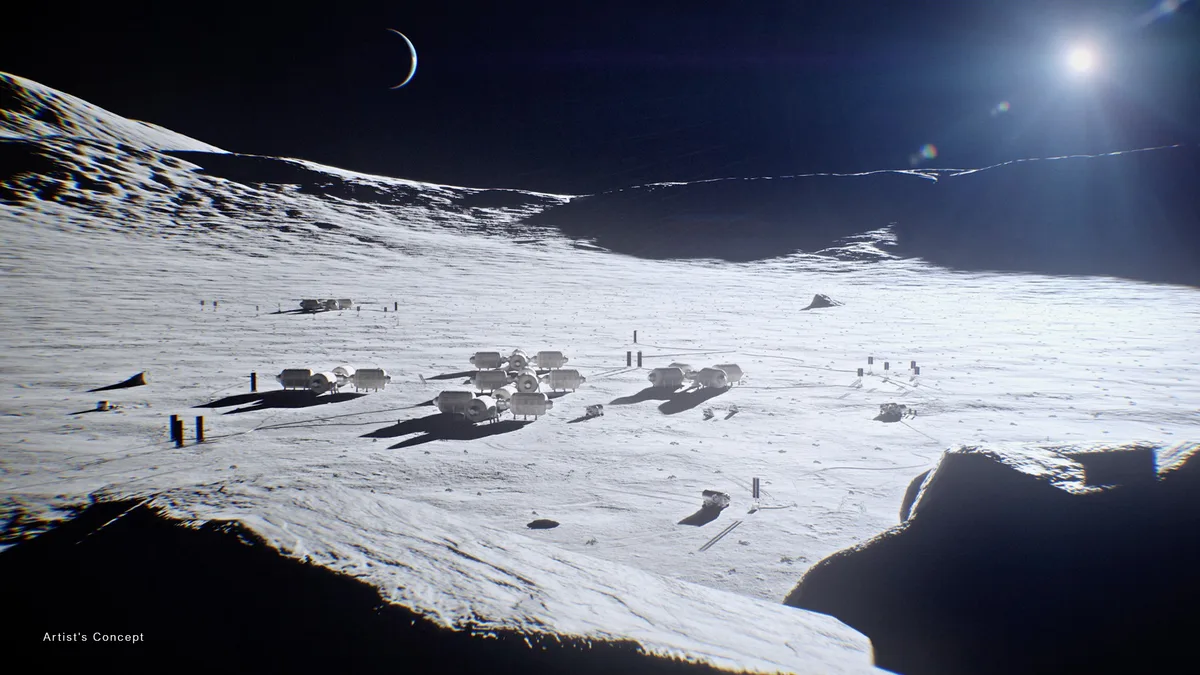
NASA unveils plan for a permanent base at the Moon's south pole today
Administrator Jared Isaacman and the Moon Base programme are facing the press with new industrial partners and a mission schedule; permanent infrastructure at the south pole is to be built between 2032 and 2036.

NASA has scheduled a press conference for 26 May 2026 at 14.00 Eastern Time at the agency’s Washington headquarters, at which administrator Jared Isaacman will set out a new plan for developing a permanent human base at the Moon’s south pole. Alongside Isaacman, the briefing will feature Lori Glaze, acting deputy administrator for space exploration systems development missions, and Carlos García-Galán, programme manager of the Moon Base initiative. The conference will be carried on NASA+ and the agency’s official YouTube channel.
The Moon Base programme is not a stand-alone mission but an infrastructure upgrade layered on top of the Artemis programme, which since 2017 has been geared toward returning astronauts to the Moon after a gap of more than five decades. What this briefing is supposed to show the public for the first time is a specific timetable for setting up a permanent base in the Moon’s south-pole region, working from the agency’s internal materials this would run from 2032 to 2036, with an estimated total investment of approximately 20 billion dollars spread across a phased build-up.
The choice of a site in the south-pole region, particularly near Shackleton crater, has been made because radar measurements and observations from NASA’s Lunar Reconnaissance Orbiter have documented significant reserves of water ice in permanently shadowed regions. The presence of water is critical for the future production of propellant, oxygen and drinking water in situ, which is what makes the cost of a permanent base technologically justifiable compared with one-off missions. Technologies for harvesting lunar ice are being developed in partnership with private companies, whose names will be officially announced for the first time at today’s briefing.
What the announcement does NOT guarantee
While the 2032-2036 timetable is ambitious, it is worth remembering that NASA has, over the past eight years, repeatedly delayed key steps in the Artemis programme. The Artemis II mission, the first crewed lunar fly-by since Apollo 17, was originally planned for 2023 but has been delayed several times because of problems with the Orion capsule’s heat shield and slippage in the development of the Space Launch System (SLS). Artemis III, which is to land the first astronaut at the Moon’s south pole, is now scheduled for 2027, although independent auditors think that deadline could also slip into 2028 or 2029.
The plan for a permanent base also depends on the political continuity of funding. The US Congress has approved a budget of approximately 25.4 billion dollars for NASA for fiscal year 2026, but with significant cuts to budget lines for scientific missions outside the lunar programme. The proposed 20-year cost envelope for Moon Base may be reopened in every following budget cycle, which makes the phased targets realistically achievable only with multi-decade political consensus. That means the unveiling of the plan does not guarantee that the base will be built on the announced timetable, but provides a framework for negotiations with Congress and with the international partners in the Artemis Accords, which have so far been signed by 56 countries.
A further element of relevance is NASA’s relationship with commercial partners. SpaceX has already secured a contract worth 4.05 billion dollars within the Human Landing System programme to develop the lunar version of the Starship rocket, while Blue Origin is in parallel developing its own Blue Moon Mark 2 lander. García-Galán’s team is expected to name today the additional companies that will participate in building habitats, power systems and rovers for the permanent base. The next step will most likely be the issuing of specific tenders for partners in the third quarter of 2026.
On the international front, the European Space Agency (ESA) has signed a cooperation framework with NASA under which European astronauts will be part of the team at the permanent base, while the Canadian Space Agency (CSA) is developing the Canadarm3 robotic system, to be installed on the Lunar Gateway orbital station. Japan and Australia have also confirmed specific technical contributions, ranging from the development of pressurised rovers to expedition science gear. Today’s briefing is, then, part of a wider process of formalising the international commitments that will provide the basis for a sustained human presence at the Moon’s south pole.