

NASA ESCAPADE: both probes head to Mars after Earth flyby
Blue and Gold fired their engines at closest approach to Earth on November 7 and 9 and set off for Mars. NASA says it is the first time this maneuver has been used on a trip to the planet.
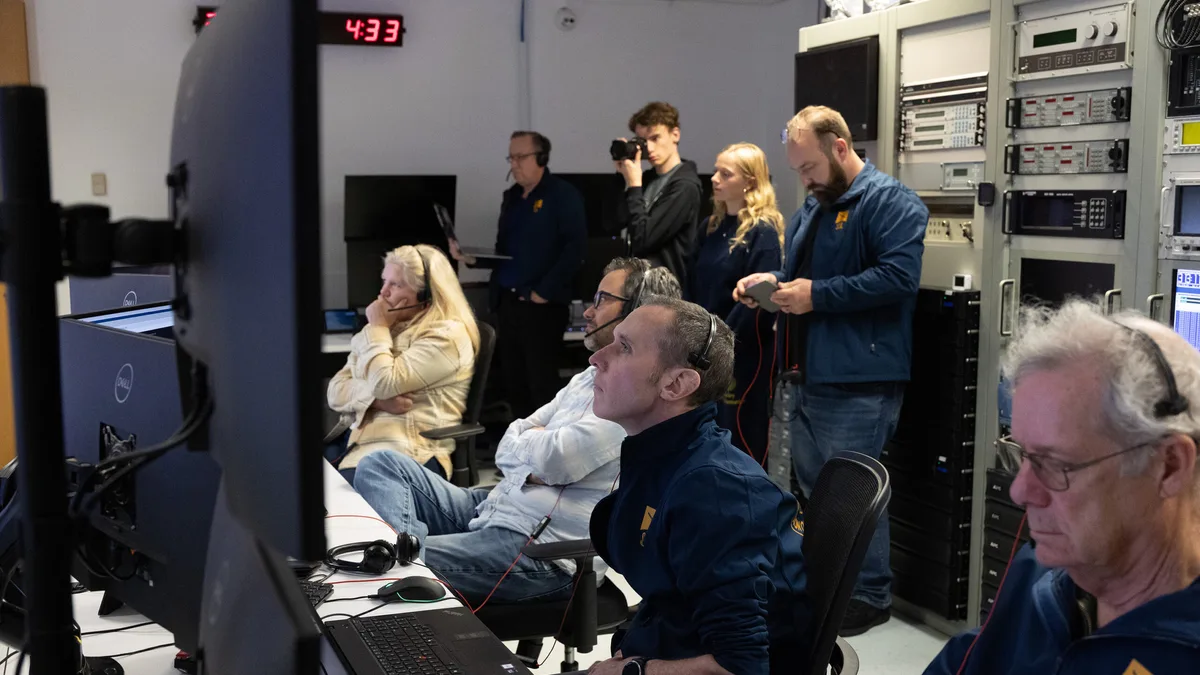
The two spacecraft of the ESCAPADE mission have completed a powered flyby of Earth and are now on their way to Mars. The first, called Blue, performed the maneuver on Saturday, November 7, 2026, and the second, Gold, followed on Monday, November 9. Both fired their engines at closest approach and used Earth’s gravity to gain the speed that sends them toward Mars, NASA and the University of California, Berkeley said.
What did the maneuver look like?
Blue fired its engine at about 5 a.m. Eastern time, roughly 11 a.m. in Serbia. The burn lasted a little over nine minutes, with the spacecraft about 1,000 miles (1,700 kilometers) above Earth. Gold did the same on November 9 at about 6 a.m. Eastern time, roughly noon in Serbia, at an altitude of about 650 miles (1,000 kilometers).
According to NASA’s November 2 preview, each burn was meant to raise the spacecraft’s speed by more than 1,000 miles per hour (about 1,600 kilometers per hour), from about 6.3 to about 6.7 miles per second. Berkeley says the spacecraft first had to cross Earth’s radiation belts, which can cause a system to shut down suddenly.
NASA says no spacecraft bound for Mars has successfully performed a powered flyby, also known as an Oberth maneuver. Berkeley goes further and calls it the first successful maneuver of this kind for any space mission. The two claims differ in scope, so NASA’s is the more precise one: this is the first such maneuver on the way to Mars.
Asal Naseri, acting associate director for flight in NASA’s heliophysics division, said in a November 9 statement:
This is the first time NASA has used a powered Earth flyby to speed a spacecraft toward Mars, and we have now done this maneuver twice, flawlessly, in just two days.
Rob Lillis, the mission’s principal investigator at the Space Sciences Laboratory in Berkeley, told Berkeley News:
Our fantastic operations team at the Space Sciences Laboratory in Berkeley put in 110 percent on this critical maneuver, prepared the spacecraft and watched it like a hawk for possible problems. We are excited that we can now focus on interplanetary travel. Onward to Mars!
Why did the spacecraft wait a year?
The spacecraft were launched on November 13, 2025, from Cape Canaveral on Blue Origin’s New Glenn rocket, when Earth and Mars were on opposite sides of the Sun. Instead of heading straight for Mars, they entered a waiting orbit around the Lagrange point L2, about a million miles from Earth, where they stayed for nearly a year. Once the planets lined up, they returned toward Earth for a gravity assist.
Jeff Parker, the mission’s chief designer at Advanced Space, said in the same statement:
With this waiting orbit and Earth flyby, ESCAPADE opens a new strategy for getting to Mars. This method gives the flexibility to launch at almost any time and then use Earth’s gravity to get a boost toward Mars, instead of waiting every two years to launch directly when the planets are aligned.
Mark Lewis, head of the mission control center in Berkeley, added for Berkeley News:
It is a standard Hohmann transfer, but nobody else has done it with a powered gravity assist, in other words, with the engine firing while the gravity boost is happening. That would open up the possibility of launching between transfer windows, loitering, and then departing when it is convenient.
During the wait, the spacecraft collected data in a distant part of Earth’s magnetic tail. NASA says no spacecraft has directly explored that region before, and it has announced results for later.
What comes next on the way to Mars?
The trip takes about ten months. Mars orbit insertion is planned for September 7 and 9, 2027, and each engine burn will then last about 11 minutes. The sources disagree on the order: NASA’s November 2 preview puts the first spacecraft, Blue, on September 7, while Berkeley says Gold enters orbit on September 7 and Blue on September 9.
Science operations begin in June 2028. It will be the first mission in which two spacecraft fly in formation around Mars and track how the solar wind, a stream of particles moving at about a million miles per hour, affects the Martian atmosphere and carries it into space. Six months later one spacecraft moves away to observe the incoming solar wind while the other stays closer to the planet, in a campaign lasting five months. Lillis said:
This will be the first science mission to choreograph two orbiters around Mars, and the first time we will be able to make coordinated observations of the Martian environment from two different locations at once.
The mission is led by the University of California, Berkeley’s Space Sciences Laboratory, with partners Rocket Lab, NASA’s Goddard center, Embry-Riddle Aeronautical University, Advanced Space and Blue Origin. It is funded by NASA’s heliophysics division through the SIMPLEx program for smaller missions. The mission’s cost is not given in the statements.
What does this not prove?
The statements confirm that the flyby and engine burns succeeded and that the spacecraft are on a path toward September 2027. That does not mean the trip is over: NASA said in advance that the team would learn within a few days of the burns how well the spacecraft are aimed, and that it would perform several trajectory corrections along the way. The new method has been tried only twice, on the same mission, so the claim that it allows launching at any time remains the designers’ estimate, not a result confirmed across many flights. The science data from Mars, the reason the mission was built, arrives in June 2028 at the earliest.


