NASA Moon Base: Eight Firms, Up to $10 Billion in Contracts
The CLPS 2 framework contract is capped at $10 billion, and the nuclear-powered PROMISE rover is due to head for the Moon's south pole in late 2028.

NASA announced a package of contracts and decisions for its Moon Base program on Saturday, November 7, 2026, at the MAX POWER air and space show at Kennedy Space Center in Florida. The program aims to establish a permanent presence at the Moon’s south pole. The largest item is a new framework, CLPS 2, for commercial cargo deliveries to the Moon, with a combined ceiling of $10 billion. Alongside it come a decision to build the nuclear-powered PROMISE rover and transport orders worth about $1.3 billion.
NASA Administrator Jared Isaacman said in the agency’s statement that the base is being built step by step:
We are building a Moon base mission by mission. Today’s decisions expand almost every part of that campaign, following the recipe NASA carried through its greatest eras: fly often, learn, apply those lessons, and become better and more capable with every mission. When our astronauts return to the Moon, the first pieces of the base will already be waiting for them on the surface.
The statement was published in English; the quote above is reproduced as NASA worded it.
Eight Firms Under CLPS 2: What Does Selection Actually Mean?
For the next phase of CLPS (Commercial Lunar Payload Services), NASA selected eight companies: Blue Origin, Firefly Aerospace, Intuitive Machines, ispace-U.S., Lockheed Martin Space, Northrop Grumman Space Systems, SpaceX and Voyager Technologies. Their job is to build and operate landers that carry NASA’s science, technology and infrastructure instruments to the lunar surface.
CLPS 2 is a ten-year, multiple-award framework contract with no fixed number of deliveries. Being selected only gives a firm the right to compete for future missions, and money arrives through individual task orders, none of which has been announced yet.
At the same time, the value of the existing CLPS 1.0 contract was raised from $2.6 billion to $4.2 billion to cover the first Moon Base targets. It runs until November 2028, with another five years, to November 2033, left for completing deliveries already awarded.
The PROMISE Rover: Mars Parts for the Lunar Night
NASA is continuing development of the PROMISE rover (Polar Rover for Observation, Mapping, and In-Situ Exploration). The six-wheeler will land at the Moon’s south pole to describe the surface and subsurface, assess resources and gather data for choosing landing sites and planning future infrastructure. Its nuclear power source lets it work through the long lunar night and in permanently shadowed craters, which are believed to hide ice.
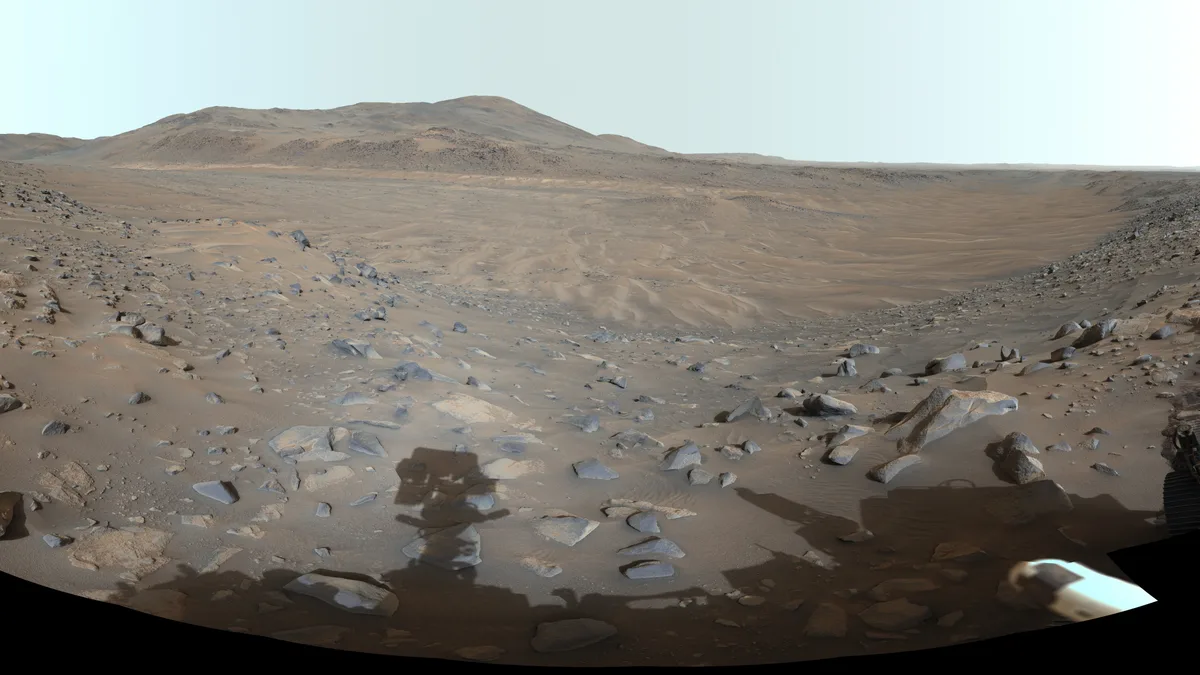
The Jet Propulsion Laboratory (JPL), part of Caltech, is building the rover and will run the mission. It is assembled from spare flight parts and test models made for the Curiosity and Perseverance Mars rovers, which NASA cites as a way to shorten build time and cut cost. The agency says it has verified that the equipment can withstand conditions near the lunar south pole.
The rover carries a drill that goes about one meter into the ground to collect regolith samples, spectrometers for chemical composition, temperature and radiation sensors, and visible-light cameras. It will also test NASA’s radiation-tolerant High Performance Spaceflight Computing. Launch is planned for late 2028, and the mission is meant to last 18 months.
The rover would reach the south pole aboard Blue Origin’s Mark 1 lander. The company received a base contract of $94 million, with an option for up to $140 million more based on performance, for a total of up to $234 million. This extends an order from May 2026, when Blue Origin was hired to carry two lunar terrain vehicles to the Moon.
Transport, Drones and a Power Pillar
Six orders for launch and in-space transport, about $1.3 billion in total, went to Arrow Science and Technology, Blue Origin and Impulse Space under the VADR contract, which has a ceiling of $5 billion. The missions include the CAPSTONE 02 spacecraft, which is to verify maneuvers, navigation and communications around the Moon, and NASA’s MoonFall drones, meant to scout terrain before astronauts arrive. The rockets are New Glenn (Blue Origin), Terran R (Relativity Space) and Falcon 9 (SpaceX), and in-space transport comes from Blue Origin, Firefly Aerospace, Impulse Space and Quantum Space.
SpaceX was separately selected to carry communications satellites into the space between Earth and the Moon on a Starship in 2028, in a demonstration called the Cislunar Communications Deployment Demonstration.
For the miniCAST pillar, which joins power and communications, NASA chose Honeybee Robotics (a Blue Origin company) for energy storage, Redwire for power generation and Yank Technologies for wireless power transfer. Assembly and testing will take place at NASA’s Marshall Space Flight Center in Huntsville, and a separate call for complete power systems is expected in early 2027.
Moon Base program manager Carlos Garcia-Galan assessed what has been accomplished since the program began, in the same statement:
In the eight months since Ignition, we have taken incredible steps toward achieving the nearly impossible: a permanent outpost on the surface of the Moon. We have brought many efforts together into one streamlined program, evolving our human exploration architecture into a phased and enduring campaign to develop and deploy lunar base technology. Most importantly, we have acted, awarding new contracts and forming new partnerships to speed up development.
What the Announced Figures Do Not Say
The figures in the statement are ceilings on framework contracts and values of individual orders, not money spent. Of the $10 billion for CLPS 2, no specific mission has been awarded so far, so the statement does not show how much will actually be spent or which of the eight firms will get which delivery.
The same applies to schedules: late 2028 for PROMISE is a target NASA cites, not a launch date. Work on the miniCAST pillar begins in the coming months, but for now it covers components, not a complete system.