

Roman second-century shrine uncovered beneath Cologne city hall in Praetorium complex
Archaeologists from the Romano-Germanic Museum in Cologne announced on May 22, 2026 the discovery of a well-preserved second-century lararium and a late first-century stone staircase in the Praetorium, the palace of the Roman governor of Lower Germany.
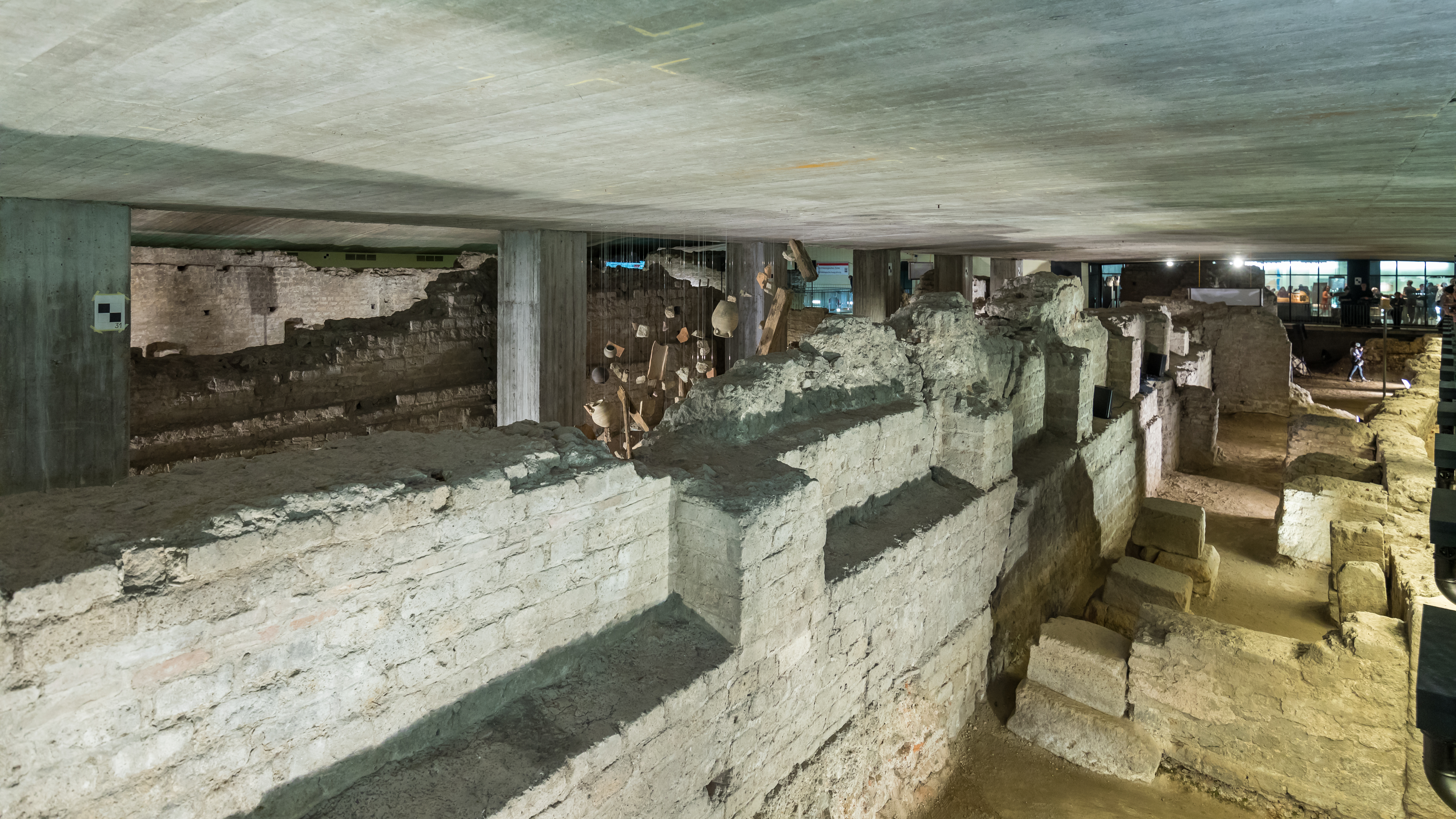
Archaeologists at the Romano-Germanic Museum in Cologne, led by Marcus Trier, announced on May 22, 2026 that excavations beneath the city hall square in the centre of the city had uncovered a well-preserved second-century Roman shrine and a late first-century stone staircase.
Both elements belong to the Praetorium, the palace of the governor of the Roman province of Lower Germany. Roman administrators began building this palace after Cologne was declared a Roman colony, Colonia Claudia Ara Agrippinensium, in AD 50.
The shrine is a household altar known in Latin as a lararium, dedicated to the lares, the guardian spirits of the home and family.
The site in context
The Cologne Praetorium has long been recognised as one of the most important archaeological sites of Roman administrative architecture north of the Alps. The first systematic digs took place in the 1950s during postwar reconstruction of the city hall.
Part of the complex has since been open to the public as an underground museum. Other sections remained under-explored because of access difficulties below modern buildings. The new findings emerged during preparation for a major reconstruction of the city hall, which had to undergo archaeological evaluation before construction.
What was found
The lararium takes the form of a wall niche about 1.2 metres tall, with surviving fresco fragments. The frescoes depict the genius of the family and two household lares in the traditional toga.
The niche contained:
- remains of a small ceramic vessel for food offerings to the deities
- three bronze figurines about 8 centimetres tall
- pigment traces on the wall frescoes
The decorative style and finds date the assemblage to between AD 130 and 160, the era of emperor Antoninus Pius. The stone staircase, which leads from the ground floor to the basement, shows signs of repeated use and repair over about two centuries, consistent with the continuous function of the Praetorium until the fourth century.
Conservation methodology
The team used ground-penetrating radar to map the space before any physical excavation. This avoided unnecessary cuts through the structure. Once the wall features were identified, the walls were carefully cleaned and consolidated.
The frescoes were treated with conservation agents that do not alter the original colour appearance. The mineral composition of the pigments was identified by X-ray fluorescence and showed the use of Egyptian blue. This pigment is typical of high-quality second-century Roman decoration but rare in northern Europe.
What the discovery does NOT change
The find is significant for its state of preservation, but it does not change the basic understanding of the Roman presence in Cologne. That has been documented over more than sixty years of archaeological research. The Praetorium has long been identified as the central administrative building of the province, and a series of other buildings, temples and private houses has already provided rich material for reconstructing life in Roman Cologne.
The value of the new find is that it offers a unique case of a domestic shrine inside a public building. That suggests the governor or senior Roman official who lived there also maintained a private religious space in the official residence.
A second limitation is that the frescoes and figurines will not remain in their original location. The city hall reconstruction plan calls for the lararium to be relocated to the refurbished underground Praetorium museum. That gives archaeologists better control over conservation conditions but strips the object of part of its archaeological context. There has been debate about whether the transfer is the best solution, with some community members in Cologne arguing for in situ display behind transparent panelling.
Relevance for Serbian archaeology
The discovery is interesting for its parallels with Roman sites in Serbia, in particular Sirmium in Sremska Mitrovica and Viminacium near Kostolac. Both sites had major administrative functions in Roman provinces. Both have already produced similar household chapels of Roman officials, though with less preserved decoration.
How much more would we understand about Roman Sirmium if we used ground-penetrating radar before every dig?
Share your view: which kind of archaeological research should be the priority in Serbia? Tell us in the comments.


