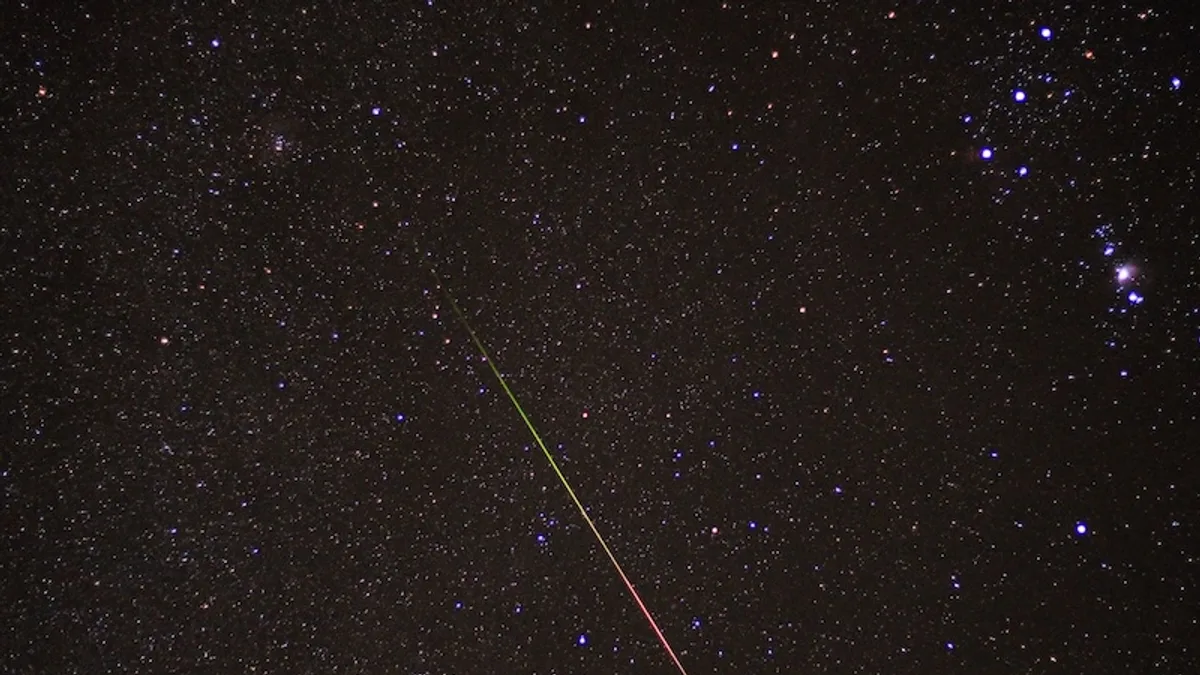
June Bootids: Year's Most Unpredictable Meteor Shower Peaks
The June Bootids peak on the night of June 26 to 27. The number of meteors is wildly unpredictable, from just a few to as many as a hundred per hour, and visible to the naked eye.

- The June Bootids peak on the night of June 26 to 27 and can be watched with the naked eye.
- Meteor counts are wildly unpredictable, from just two or three per hour to as many as a hundred during rare outbursts.
- The shower comes from dust shed by comet 7P/Pons-Winnecke, which orbits the Sun roughly every 6.4 years.
- The radiant sits in the constellation Bootes, and no equipment is needed, only a dark sky away from city lights.
Late June could bring one of the least predictable meteor showers of the year to skies over Serbia. The June Bootids peak on the night of June 26 to 27, are visible to the naked eye in the direction of the constellation Bootes, and how many will appear is something no one can say for certain in advance. That uncertainty is exactly what makes the shower interesting to astronomers and casual observers alike.
Unlike better known showers such as the Perseids or Geminids, where meteor counts stay relatively stable from year to year, the June Bootids behave unpredictably. In most years they yield only two or three meteors per hour, a modest figure even for a patient watcher. Yet the shower is known for sudden outbursts. During one such event, in 1998, the rate climbed to around a hundred meteors per hour, turning what usually passes almost unnoticed into a genuine spectacle.
The source of this shower is comet 7P/Pons-Winnecke. It orbits the Sun roughly every 6.4 years, and on each pass it leaves behind a trail of fine dust particles. When Earth crosses that cloud along its orbit, the particles enter the atmosphere at high speed and burn up, and we see them as bright streaks across the sky. The cloud is not equally dense everywhere, which is why the meteor count varies from year to year, depending on which part of the trail Earth passes through.
How and when to watch the June Bootids?
The best time to observe is during the early night hours, when the radiant, the point in the sky from which the meteors appear to emerge, sits high above the horizon. The radiant lies in the constellation Bootes, after which the shower is named. You do not need to find that constellation precisely to see meteors, since they can appear anywhere in the sky, but facing the northeast improves your chances.
No equipment is needed. A telescope or binoculars do not help here, and in fact they narrow your field of view and reduce the odds of catching a fast streak. The naked eye, patience and, above all, a dark sky are enough. The observer’s biggest enemy is light pollution, so it pays to get away from city lights to a spot with an open view of the sky. The eye needs ten to twenty minutes to adjust to the dark, so it is best to avoid looking at a phone while watching.
Why are they so hard to forecast?
The unpredictability of the June Bootids is not a matter of chance. It stems from the very nature of the dust cloud the comet leaves behind. Astronomers can calculate where Earth is heading, but precisely mapping the density of each strand of that trail, especially older ones that have spread and deformed over decades, remains very difficult. As a result, outbursts are usually recognised only after they happen rather than reliably predicted in advance.
For 2026 there is no official forecast of a strong outburst. That makes a modest shower with a few meteors per hour the more likely scenario. Still, precisely because of its history of surprises, this shower remains one worth watching, if only for the unlikely but not impossible chance that the sky comes unexpectedly alive. This piece describes what typically happens and what the shower can offer, but it does not predict how many meteors you will actually see on a given night, since that remains uncertain until the moment of observation.
If the weather and the sky allow, will you use the night of June 26 to 27 to look up and see for yourself just how generous the June Bootids prove to be this year?