

Orionids 2026: peak tonight, up to 20 meteors an hour
The shower born of Halley's Comet dust peaks overnight between October 21 and 22, but a waxing Moon washes out fainter streaks until late in the night.
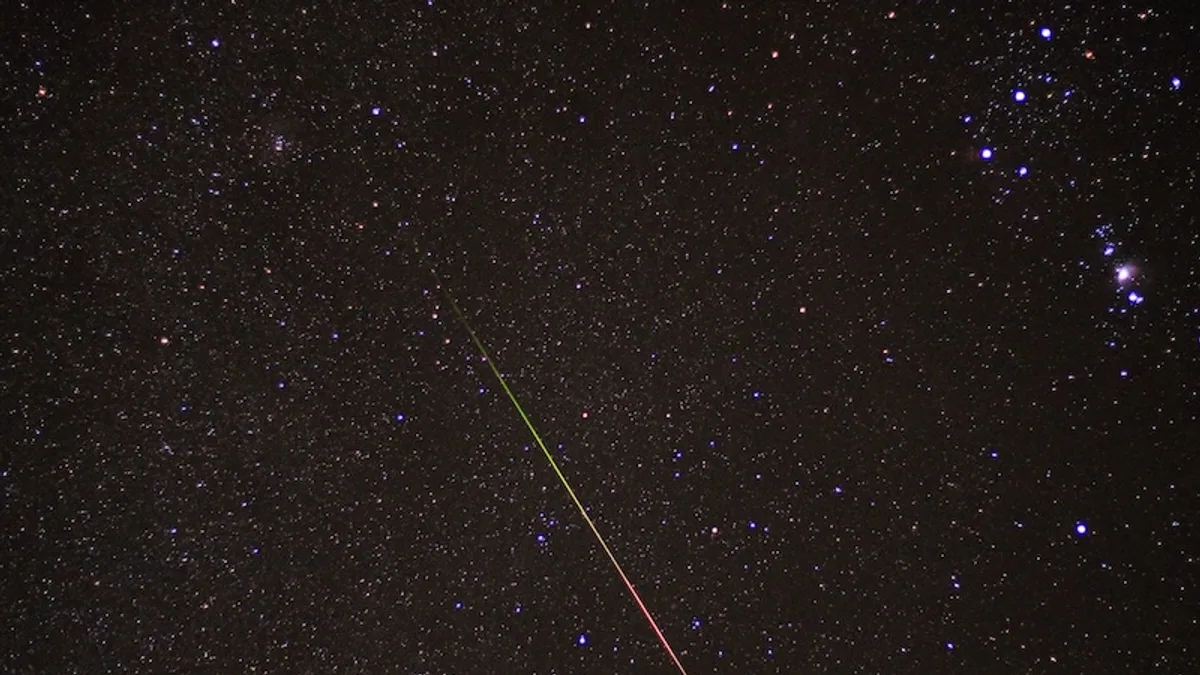
The Orionids meteor shower peaks overnight between Wednesday, October 21, and Thursday, October 22, 2026, which means tonight. Under dark skies, about 20 meteors an hour are expected, but the waxing Moon will drown out fainter streaks until late in the night, so the best window for watching is before dawn.
The Orionids come from dust left behind by Halley’s Comet (1P/Halley), which circles the Sun roughly every 76 years. It was last seen in 1986 and returns in 2061. Every autumn Earth crosses its path, and grains of dust, often smaller than a grain of sand, hit the atmosphere at about 66 kilometers per second. Earth cuts through the same trail in May, when the Eta Aquariids appear, so the comet feeds two showers a year.
When exactly should you watch the Orionids?
The RASC Observer’s Handbook, cited by EarthSky, puts the peak at 18:00 UTC on October 21, which is 8:00 p.m. in Serbia on summer time. At that hour the radiant, the point from which meteors seem to originate, has yet to rise: it climbs in the constellation Orion before midnight and stands highest around six in the morning. The peak is also broad and lasts several nights, so the sky is worth a look on the nights of October 20-21 and 22-23 as well.
The Moon is waxing. Farmers’ Almanac puts its illumination at about 80 percent, while the International Meteor Organization (IMO) and the Star Walk app, as reported by Sortiraparis, say 70 to 80 percent. It sets in the middle of the night, a few hours before sunrise, so the darkest window runs from moonset to dawn. While the Moon is up, the advice is to put a tree or a building between it and yourself. The full Moon arrives on October 26.
How many meteors can you expect?
Estimates differ by source and by conditions:
- The IMO expects about 20 meteors an hour under almost completely dark skies
- EarthSky says 10 to 20 an hour
- Farmers’ Almanac says 15 to 25 an hour away from cities, and 5 to 10 in a suburb with light pollution
The sources also disagree on when the shower is active. EarthSky sets it from September 26 to November 22, while Farmers’ Almanac and Sortiraparis, citing NASA, say October 2 to November 7. The American Meteor Society points out that the numbers are not constant:
“In exceptional years, such as 2006 to 2009, peak rates were comparable to the Perseids, at 50 to 75 per hour. In recent years activity has been weak to average.”
According to EarthSky, there is no way to know what this year’s peak will look like, so it recommends counting on 10 to 20 meteors an hour.
Where should you look?
There is no need to stare straight at Orion. The radiant lies north of the reddish star Betelgeuse, near the Hunter’s raised club, but meteors show up all over the sky, often some thirty degrees away from the radiant. Sortiraparis advises looking southeast before dawn and letting your gaze take in a wide stretch of sky. Binoculars and telescopes are not needed, and the spot should be dark and far from city lights.
Some meteors leave a trail that lingers for several seconds, and according to Farmers’ Almanac about one in 30 Orionids is a fireball. EarthSky says most look white or faintly yellow, with an occasional green or orange tint.
All of these figures are estimates for ideal conditions, with no clouds and no light pollution, and they do not apply to any specific location in Serbia. The sources give moonset times either loosely or for US locations, so the exact moment for your own town should be checked in a local table. How many meteors you actually see depends on the sky above you, and no forecast can replace that.


