Wandering black hole: software found it, not an astronomer
A supermassive black hole of about a million solar masses is tearing a star apart 30,000 light-years from its galaxy's core. The flare was flagged by a program switched on three months earlier.

How do you spot a black hole that gives off no light and is not where anyone thought to look? You wait for it to eat a star. That is exactly what happened: for the first time, a wandering black hole has been confirmed shredding a star far outside the core of its galaxy, in a paper published in The Astrophysical Journal Letters.
The black hole sits about 9.3 kiloparsecs, or roughly 30,000 light-years, from the center of the galaxy WISEA J014656.04-152214.7. That galaxy is about 750 million light-years away, in the constellation Cetus. Its mass is estimated at around a million solar masses, close to what the black hole at the center of the Milky Way carries. There is no visible galaxy around it.
What is a tidal disruption event?
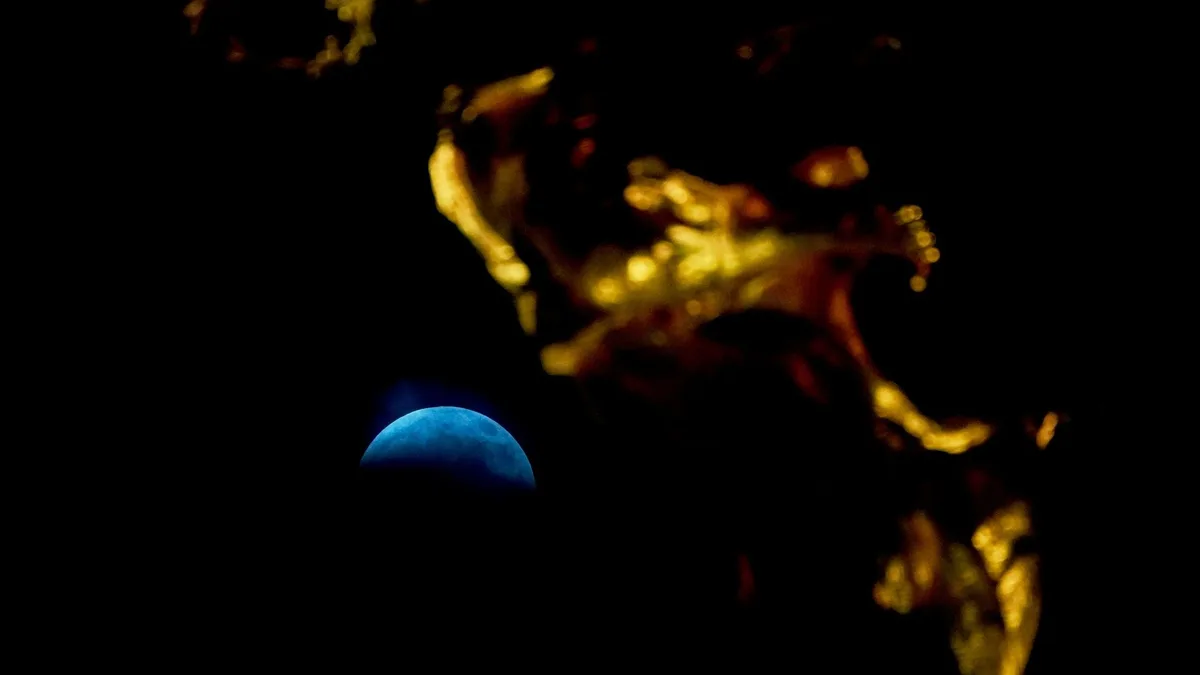
When a star drifts too close to a black hole, gravity pulls it apart. The debris stretches into a disc and heats up, and that flare reaches Earth long before the black hole itself would ever show up. This one stayed brighter in ultraviolet than its entire host galaxy for months.
At its peak it shone like about 10 billion Suns, at roughly 30,000 degrees Celsius. That was the whole trick. Nobody saw the black hole, everyone saw its meal.
Robert Stein, a researcher at the University of Maryland and NASA’s Goddard Space Flight Center and lead author of the paper, explained in a NASA statement why this class of event was the target in the first place.
We’ve been searching for these star-shredding events as a way to find otherwise invisible supermassive black holes that are wandering far from the galactic nuclei they usually inhabit.
The method came before the find. The find arrived faster than anyone planned for.
The software got there first
The timeline is short:
- August 2025: a machine learning program goes live, sifting through sky survey images looking for flares like this one
- November 2025: the Zwicky Transient Facility at Palomar Observatory in California catches the flare, three months after the program started running
- after that: follow-up observations by the SOAR telescope in Chile, the Lowell Discovery Telescope, and NASA’s Neil Gehrels Swift Observatory through its UVOT and XRT instruments
- July 27, 2026: the result goes public, in a paper titled “TDE 2025abcr: A Tidal Disruption Event in the Outskirts of a Massive Galaxy”
That middle detail is easy to skip past. Three months from switching the software on to the first serious catch, then roughly eight more to a published paper.
Why it counts as a surprise
Because the working assumption has been that supermassive black holes stay where they formed, in galactic centers. Suvi Gezari, associate professor of astronomy at the University of Maryland and a co-author, put it plainly in a University of Maryland statement: “Until now, we’ve started with the assumption that supermassive black holes reside in the centers of massive galaxies.”
Her colleague Sylvain Veilleux, professor of astronomy at the same university, went further: “To have such a big black hole outside of a galaxy is surprising to me.”
An object that heavy normally has a whole galaxy wrapped around it. This one does not, which leaves the open question of how it ended up 30,000 light-years from the core in the first place.
The team expects the Vera C. Rubin Observatory in Chile to turn up considerably more events of this kind, with NASA’s Nancy Grace Roman Space Telescope joining the hunt. If that holds, this stops being a one-off and becomes the first of a set, and wandering black holes move from a theoretical possibility to a population somebody can count.