NOAA: Fast Solar Wind Due September 14, Possible G1 Storm
NOAA and EarthSky report that fast solar wind from two coronal holes on the Sun is expected to reach Earth on September 14 and 15, with a chance of a brief, weak G1 geomagnetic storm.
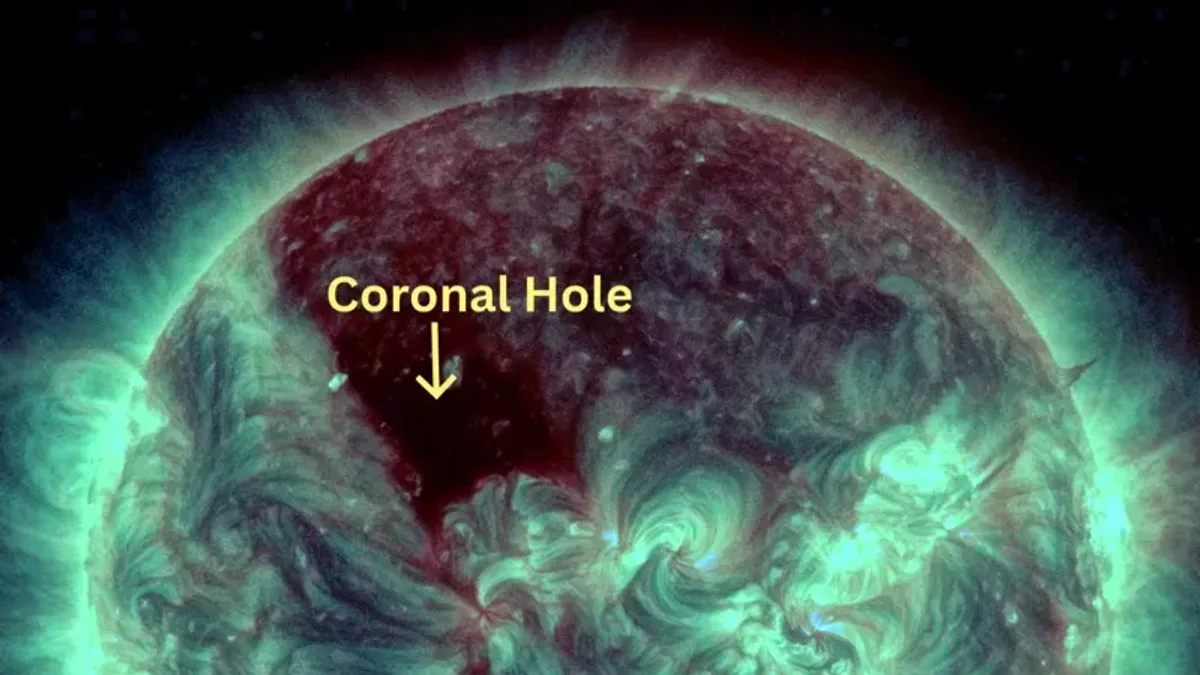
NOAA’s Space Weather Prediction Center issued a three-day forecast on September 13, 2026, at 12:30 UTC, saying fast solar wind from two large coronal holes on the Sun is expected to reach Earth on September 14 and 15. The astronomy site EarthSky carried a similar forecast the same day, reporting that the combined effect of the two streams could push geomagnetic activity to the threshold of a weak G1 storm.
Coronal holes are large, temporary regions of the Sun’s outer atmosphere, the corona, where plasma is cooler, less dense and carries a weaker magnetic field that opens out into interplanetary space. Fast streams of solar wind flow out of them, and when they hit Earth’s magnetosphere they can trigger geomagnetic disturbances of varying strength. According to EarthSky, two such holes currently face Earth. The southern one has already rotated into a position that acts directly on Earth, so the first wave of fast wind from it is expected late on September 13 and through September 14, while a second stream, from the northern hole, should arrive around September 15.
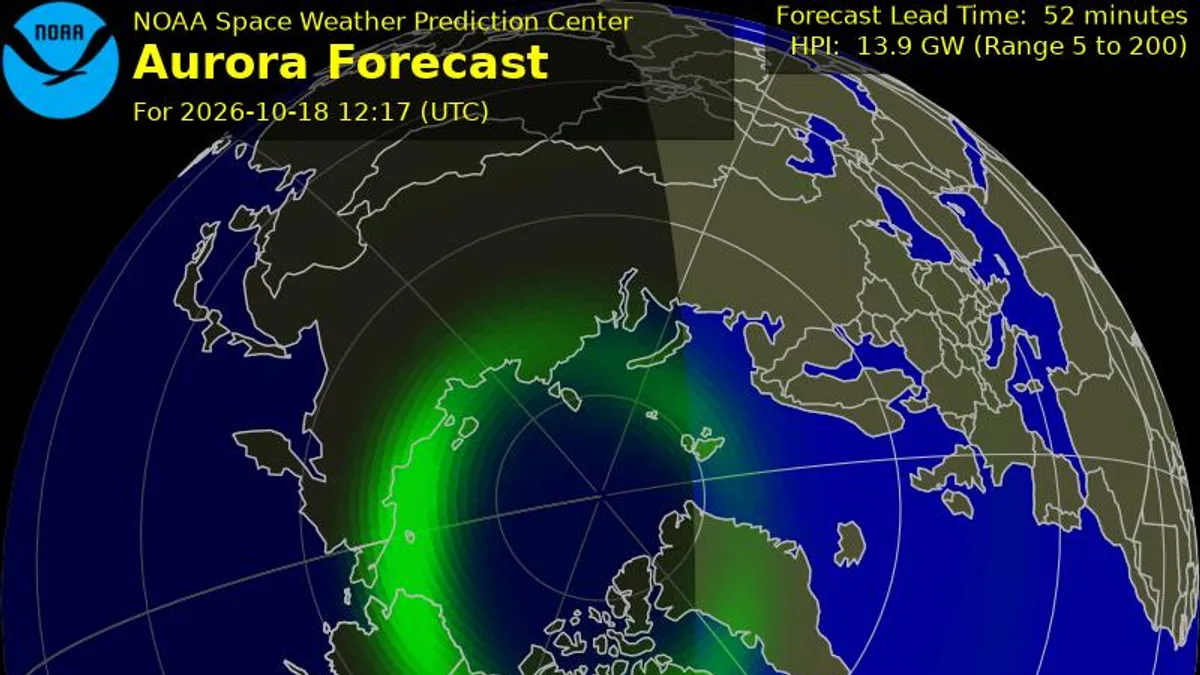
NOAA builds its forecast on the Kp index, which measures planetary geomagnetic activity on a scale of 0 to 9. The highest three-hour value recorded in the past 24 hours was 3, while the highest value forecast for September 13 through 15 is 3.67. Peaks are expected on September 14 from 03:00 to 06:00 and 18:00 to 21:00 UTC (05:00 to 08:00 and 20:00 to 23:00 in Serbia), then again on September 15 from 03:00 to 06:00 UTC (05:00 to 08:00 in Serbia). In its forecast notes, the agency says there is a chance of an isolated G1 storm period on September 14 and 15, when the second fast solar wind stream from the coronal hole reaches a geoeffective position relative to Earth.
Why NOAA and EarthSky Don’t Fully Agree
The two sources don’t fully agree on emphasis here, and the gap is worth spelling out rather than glossed over. NOAA’s numerical model for this period does not exceed a Kp of 3.67, below the Kp 5 threshold that formally defines a G1 storm, so the agency describes only a chance of an isolated period, not a certainty. EarthSky goes a step further, saying individual periods with Kp 5, in other words a weak G1 storm, are entirely possible on September 14, with a similar outcome possible again on September 15. Part of the difference comes from the fact that NOAA’s number is an averaged, modeled value for a three-hour window, while a brief spike above the threshold within that same window doesn’t necessarily lift the average on paper, and that kind of brief spike is exactly what EarthSky points to as a possibility.
The Sun was relatively quiet over the past 24 hours while the new forecast was being prepared. Solar wind speed hovered around 400 kilometers per second, a typical level before a new stream arrives. A total of 13 flares were recorded, one of class C and 12 of class B, with the strongest a C5.8-class flare that peaked at 17:20 UTC on September 12, from active region AR4521. That region sits at position N09W80 and is currently rotating off the western edge of the Sun’s visible disk, so its contribution to solar activity is about to end. For the same period through September 15, NOAA puts the probability of a solar radiation storm at 1 percent, the probability of weaker R1 to R2 class radio blackouts at 10 percent, and the probability of stronger R3-and-above blackouts at 1 percent.
Where the Aurora Might Be Visible
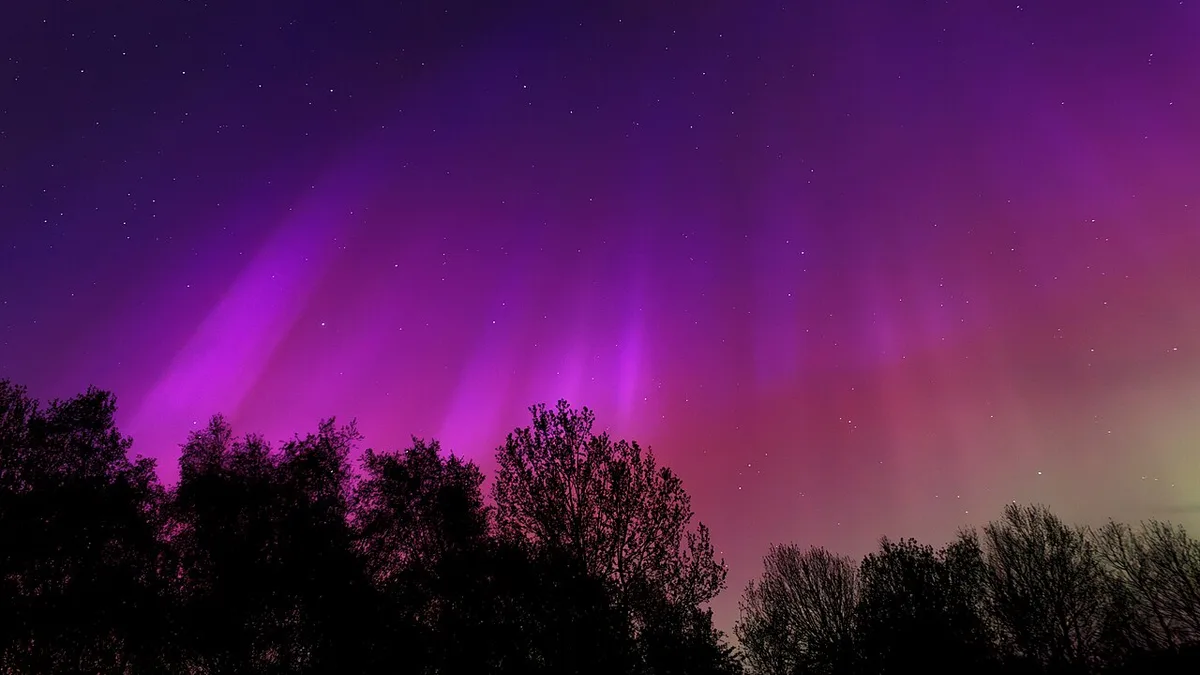
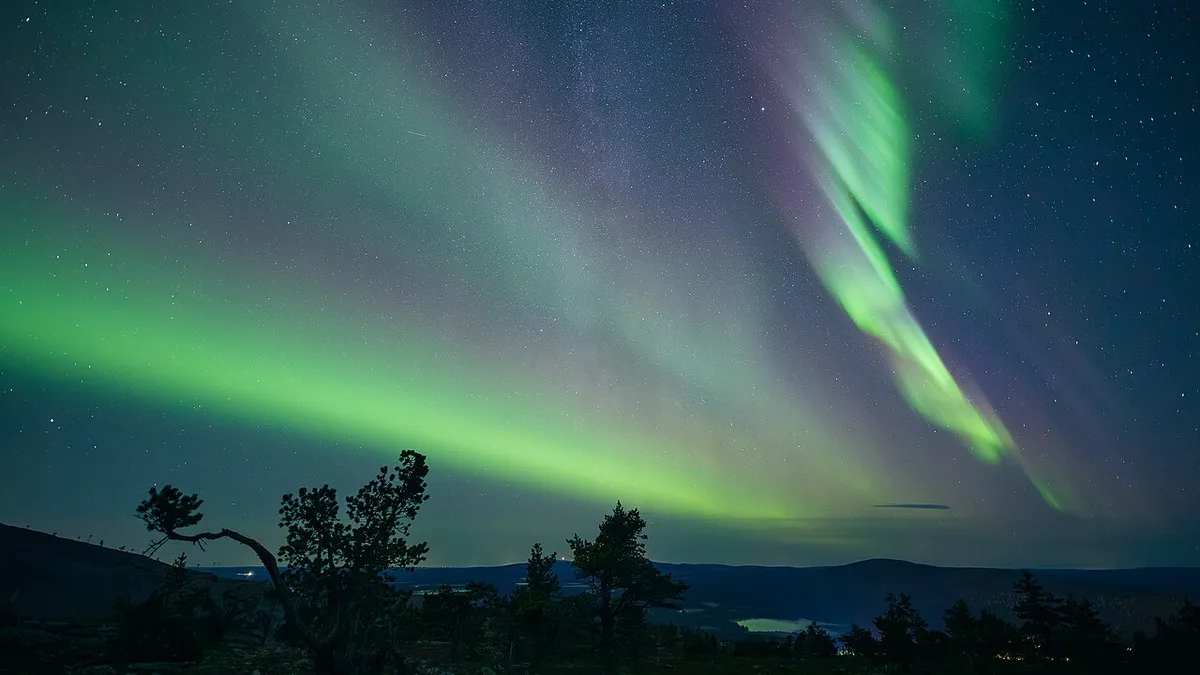
If the forecast holds, EarthSky estimates that enhanced aurora could be visible as far south as northern Scotland and locations at a similar latitude. That is a typical range for a G1-class storm, the weakest category on NOAA’s five-step scale of geomagnetic storms, which as a rule has no significant effect on satellites or electrical systems on Earth.
Like any forecast, this one has its limits. NOAA itself says there is only a chance, not a certainty, of an isolated G1 storm period, and the exact timing and strength depend on when and at what angle the solar wind stream from the coronal hole reaches Earth’s magnetosphere, something that is only known for certain once instruments on satellites, stationed about an hour’s flight time ahead of Earth, actually detect the stream itself. The three-hour Kp index in the forecast is an averaged, modeled value, and it does not rule out brief spikes above or below that number, which is exactly what the gap between NOAA’s figure and EarthSky’s estimate points to. Nothing in the data so far points to a storm stronger than G1, or to significant radiation or radio activity, whose probability NOAA puts below 15 percent across all three categories through September 15.