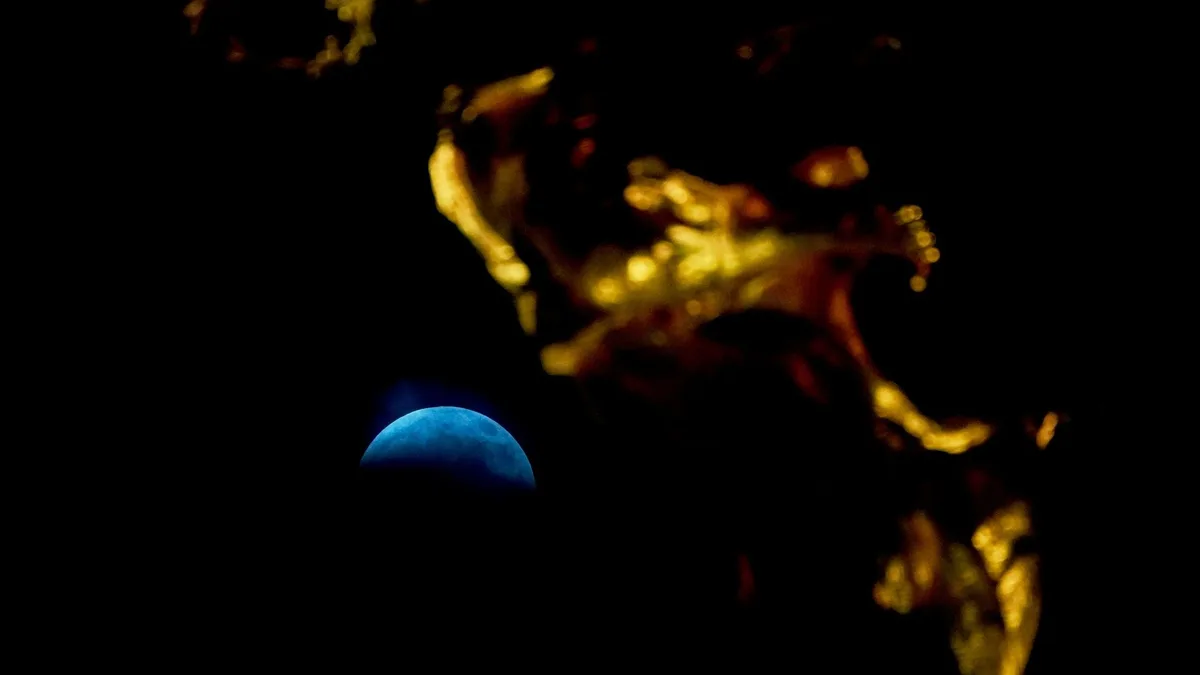
Sakurai's Object Six Times Hotter After Rebirth
The University of Manchester reports that Sakurai's Object, a star that unexpectedly came back to life in 1996, has grown six times hotter over the past three decades.

The University of Manchester published measurements on September 16 showing that the star known as Sakurai’s Object has grown six times hotter over the roughly three decades since it unexpectedly came back to life in 1996. The study appears in Monthly Notices of the Royal Astronomical Society, and besides the university’s Jodrell Bank Centre for Astrophysics, the research team included astronomers from the Valongo Observatory, the Royal Observatory of Belgium and the University of Innsbruck.
Sakurai’s Object was discovered by Japanese amateur astronomer Yukio Sakurai in 1996, at a point when the star had already become nearly a white dwarf, the hot, dense remnant of a core left behind once nuclear burning ends in a Sun-like star. At that moment the star went through a rare event astronomers call a very late thermal pulse: a layer of helium deep inside the already “dead” star reignited, causing the star to expand suddenly, cool down and eject a large amount of material into space, briefly sending it back to an earlier stage of its life. That is where the name “reborn” star comes from. Until now, only one other star has ever been directly observed going through such a rebirth, V605 Aquilae, roughly 80 years ago.
As Professor Albert Zijlstra of the Jodrell Bank Centre for Astrophysics explains in the University of Manchester’s statement, events like this are extremely rare because stars typically evolve slowly.
“Most stars evolve so slowly that major changes happen on timescales far longer than a human lifetime.”
The new temperature measurement of Sakurai’s Object was carried out using the Very Large Telescope (VLT), operated by the European Southern Observatory in Chile, together with the ALMA radio telescope. The team compared the light they collected against computer models that simulate the atmospheres and winds of Wolf-Rayet stars, and found clear traces of carbon and helium in the spectrum, from which they calculated the star’s temperature, chemical makeup and the properties of its stellar wind.
According to these measurements, the surface temperature of Sakurai’s Object today is between 27,000 and 36,000 kelvin (about 48,000 to 64,000 degrees Fahrenheit), compared with a temperature close to the Sun’s three decades ago. In the meantime the star has entered a Wolf-Rayet phase and developed the powerful stellar wind typical of that stage, while the material it ejected during the 1996 eruption now occupies a volume roughly the size of the entire solar system.
“Sakurai’s Object offers something much rarer. It’s one of the few stars known to have changed dramatically within just a few decades.”
Zijlstra said the speed and direct measurability of the change in Sakurai’s Object gives the team a chance to watch stellar evolution unfold in real time, rather than piecing it together, as is usually the case, by comparing different stars caught at different stages of their lives.
The researchers also checked how quickly the star is heating up against existing theoretical models.
“Our measurements show that the star is reheating more gradually than some earlier models predicted.”
The results also show that Sakurai’s Object is currently at an earlier stage of this evolution than V605 Aquilae, the star that went through a similar event roughly 80 years ago, giving the team a basis for comparing two rare “reborn” stars at different points along their respective paths.
The measurements themselves speak only to the current state of Sakurai’s Object’s temperature, chemical composition and stellar wind, not to the exact pace at which the rebirth will run its course. Because Sakurai’s Object and V605 Aquilae are the only two stars of this kind ever directly observed, the possibility of comparing them with other examples remains limited, and the researchers say they plan to keep tracking the star as it makes its way back toward becoming a white dwarf. The full study, titled “The emergence of a [WC] star in Sakurai’s object,” is available under DOI 10.1093/mnras/stag1533.