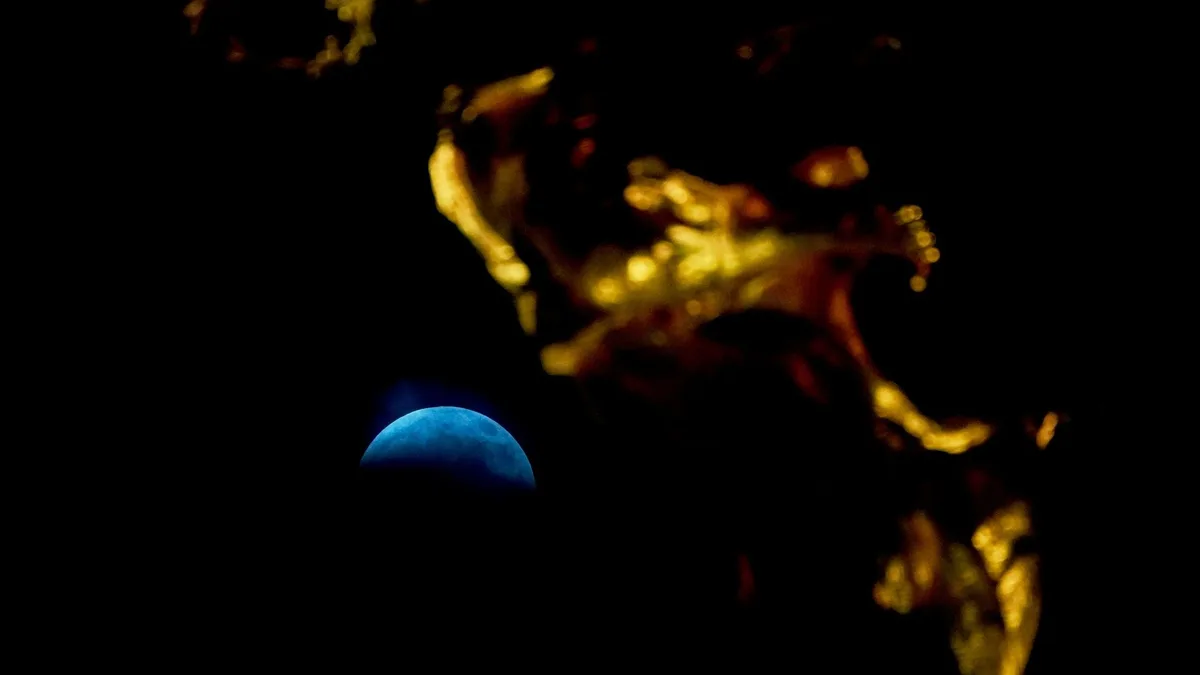
Neptune Turns 180, Nearest to Earth on September 26
180 years after Neptune was found by mathematics at the Berlin Observatory, it reaches opposition on Saturday, September 26, its closest point to Earth this year, still invisible to the naked eye.

Exactly 180 years ago, on September 23, 1846, German astronomer Johann Gottfried Galle and his assistant Heinrich d’Arrest discovered Neptune from the Berlin Observatory. It was the first planet ever found through mathematics rather than by chance observation of the sky. The anniversary is back in focus because Neptune reaches opposition on Saturday, September 26, the point in its orbit where it sits closest to Earth all year.
The discovery grew out of an anomaly in the motion of Uranus. Astronomers noticed that the seventh planet was not moving exactly as calculations predicted, and they suspected an unknown body farther out was tugging at it with gravity. French mathematician Urbain Le Verrier used those irregularities to calculate where such a planet should be, and sent the prediction to Galle in Berlin for a look. Working independently, British astronomer John Couch Adams was chasing the same problem, though neither man knew of the other’s work at the time.
Galle found Neptune only 1 degree from the position Le Verrier had predicted, while Adams’s estimate was off by 12 degrees. The discovery immediately sparked a dispute over who deserved the credit, Le Verrier or Adams, sharpened further by the political tension between France and the British Empire at the time. Today the credit is usually shared among all three, including Galle as the first person to knowingly see the planet through a telescope. Notably, Galileo Galilei had already recorded Neptune back in 1612, but since he never tracked its movement over several nights, he logged it as a star by mistake.
The University of Wroclaw is marking the anniversary in its own way, since Galle, born in 1812 and who died in 1910, was a professor there from 1851 to 1897 and director of its astronomical observatory. At 2 p.m. the university is unveiling a plaque commemorating him and his discovery, and from 10 p.m. to midnight it is hosting a public observation session for anyone who wants to look at Neptune.
The opposition itself falls on Saturday, September 26, though sources differ slightly on the exact moment. The app Star Walk puts it at 1:28 a.m. GMT (3:28 a.m. local time), while EarthSky rounds it to roughly 2 a.m. UTC. At that point Neptune sits 28.9 astronomical units from Earth, or about 240 light minutes away, its shortest distance from us this year. The planet is currently in the constellation Pisces, rising in the east at dusk and standing highest in the sky around midnight.
Despite the best positioning of the year, Neptune stays invisible to the naked eye. Its brightness at opposition is magnitude +7.8, roughly five times fainter than the dimmest star visible without instruments under a clear, moonless sky. Seeing it takes binoculars or a telescope, and to actually resolve Neptune as a tiny disk rather than a point of light like a star, observers need about 200x magnification and a calm night free of atmospheric turbulence.
Observing conditions get harder still because a full moon falls on the very same day, September 26, at 4:49 p.m. GMT (6:49 p.m. local time). Brighter moonlight washes out faint objects in the sky, so anyone hoping to catch Neptune should factor in that extra interference.
The next planet to reach opposition is Saturn, on October 4 at 12:21 p.m. GMT. Unlike Neptune, Saturn will be bright enough at that point, at magnitude 0.3, to see with the naked eye.
None of this changes the basic limit on observing Neptune. Even at its best moment of the year, the planet never becomes visible without optical aid, and through modest equipment its disk looks like little more than a bright point. Getting an actual view of the disk, and possibly its largest moon, Triton, takes a mid-sized telescope and some observing experience.