

Hunter's Moon: full Moon peaks at 5:12 a.m. on October 26
The peak comes on Monday, the first full Moon since Serbia switches to winter time. The Moon sits in Aries and forms a large triangle with Saturn and the star Algenib.
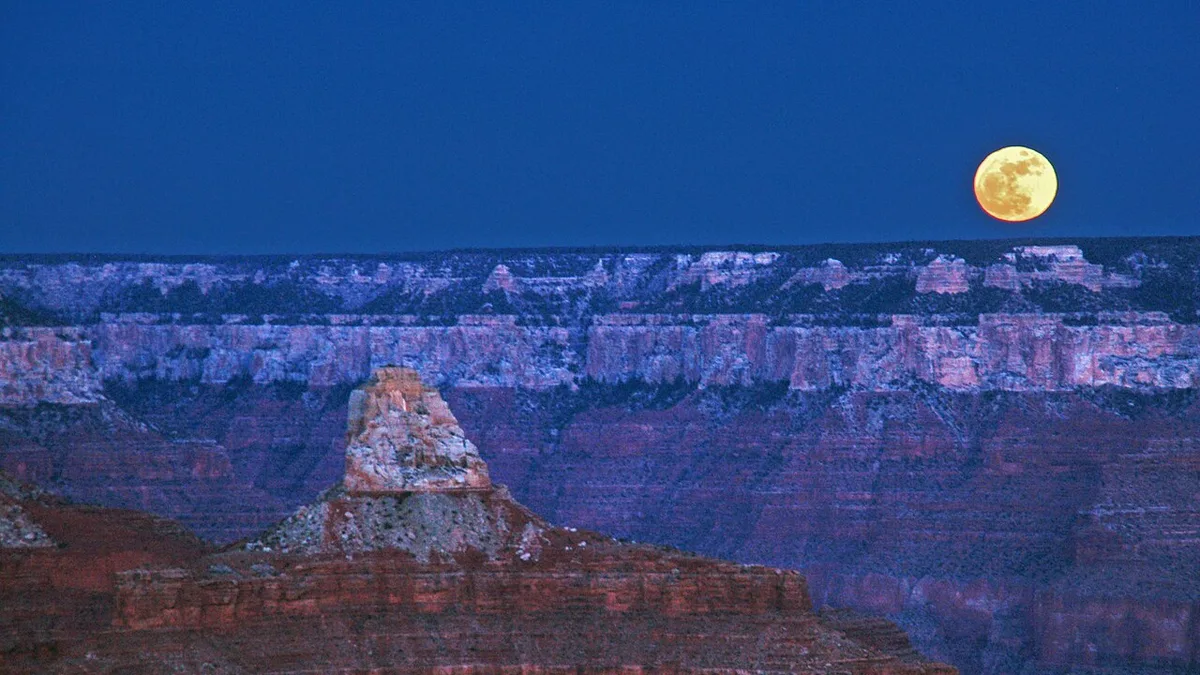
The full Moon peaks on Monday, October 26, 2026, at 04:12 Coordinated Universal Time (UTC), according to the astronomy site Star Walk and the American Farmers’ Almanac. The site Moongiant calculates 04:11, so the sources differ by one minute. Serbia will already be on winter time, which starts on Sunday, October 25, so here the peak falls at about 5:12 a.m. This is the October full Moon, known in the Northern Hemisphere as the Hunter’s Moon.
Why is it called the Hunter’s Moon?
The name goes to the first full Moon after the Harvest Moon, which this year came on September 26. It is tied to the start of the Anglo-Saxon hunting season: the harvest was in, the fields were bare, and game was easier to spot on the stubble under bright moonlight. The Farmers’ Almanac says the name crossed the Atlantic with English settlers and has stayed in use longer than most colonial almanac names.
The same sources list other names for the October full Moon: the Falling Leaves Moon, the Dry Grass Moon and the Travel Moon. There is also a Blood Moon, but it has nothing to do with an eclipse. The name referred to the reddish or copper color the Moon takes on when it rises and its light passes through thick, smoky autumn air. There is no total lunar eclipse on October 26, 2026.
When and where to watch it?
The Moon looks practically full from October 25 to 27, because the change in illumination is too gradual to see without measuring. Star Walk recommends watching the Moonrise on the evening of October 25 or 26. The Farmers’ Almanac calculates that on Sunday the Moon rises close to sunset, and on Monday about an hour after sunset. Its advice is to look east about 20 minutes before sunset, with no equipment at all.
Near the horizon the Moon can look golden, orange or reddish, because its light passes through a thicker layer of atmosphere. Beside trees or buildings it also seems larger, but that is the familiar Moon illusion, not a change in its diameter. The Farmers’ Almanac adds that at this time of year successive Moonrises are only about 30 minutes apart instead of the usual 50, so moonlight arrives early and lasts for several evenings in a row. The exact Moonrise time for your location should be checked in a calendar or an app, since it depends on coordinates and obstacles on the horizon.
What can you see beside the Moon?
At the moment of the peak, the Moon is in Aries, which it entered shortly before from Pisces. The star Sheratan (apparent magnitude 2.6) sits about 4 degrees from it, and Hamal (magnitude 2.0) about 7 degrees. The lower the magnitude, the brighter the star, but the glare of a full Moon is enough to wash out stars of this strength. Star Walk advises blocking the Moon with a wall, a roof or a tree, or sweeping the sky with binoculars.
On the evening of October 25 and through the night into the 26th, the nearly full Moon, the planet Saturn (magnitude 0.4) and the star Algenib (magnitude 2.8) form a large, nearly equilateral triangle. The Moon and Saturn are easy to pick out with the naked eye, while Algenib will be harder to see because of the moonlight, so binoculars help here too.
What comes after the full Moon?
By Halloween, on October 31, the Moon will already be waning. Star Walk estimates it will be about two thirds illuminated and will rise long after sunset, leaving a darker start to the evening. The next full Moon on Halloween itself is not until October 31, 2039. Before the October full Moon, the last quarter fell on October 3 at 13:25 UTC, the new Moon on October 10 at 15:50 and the first quarter on October 18 at 16:12, according to Moongiant. The next full Moon is on November 24 at 14:53 UTC, or 15:53 in Serbia. The Farmers’ Almanac calls it the start of a run of three consecutive supermoons, while Star Walk states explicitly that the October one does not meet the supermoon criteria.
What these figures do not tell you
All the times are calculated in advance, not measured, and the sources differ by a minute. Serbian time was derived by adding one hour to UTC, so the peak is best read as about 5:12 a.m. rather than an exact boundary. This is an ordinary lunar phase, and the cultural and spiritual meanings attached to the Hunter’s Moon are not properties of the astronomical event.


