

Hunter's Moon: Full Moon at 5:12 a.m. Serbian Time
October's full moon arrived this morning at 5:12 a.m., the first since the clocks went back. Here is when to watch it tonight and tomorrow, and how it got its name.
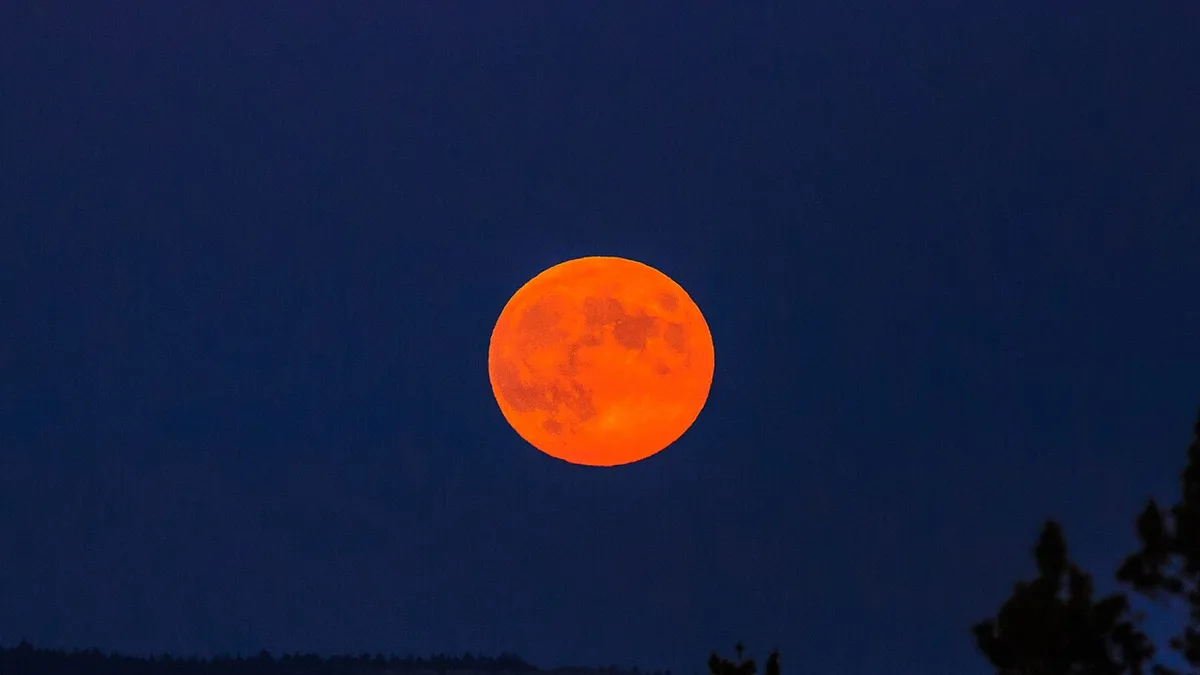
The Hunter’s Moon, October’s full moon, arrived this morning, Monday, October 26, 2026, at 4:12 a.m. Universal Time. In Serbia that is 5:12 a.m., a conversion we made ourselves: the clocks went back on Sunday, so Serbia is now on UTC+1. The Royal Observatory Greenwich and the American Farmers’ Almanac give the same moment, and it is the first full moon since the switch to winter time.
The Farmers’ Almanac points out that the moon turns full at the same instant for the whole planet, so only the time on the clock changes from one zone to the next. Its author, Melissa Mayntz, notes that in Eastern Daylight Time it was 12:12 a.m.
When is the best time to watch the full moon tonight and tomorrow?
To the naked eye the moon looks full for about a day before and after the exact moment. That makes both the night of October 25 to 26 and this evening good for watching. The Royal Observatory says the moon was clearly visible on the night of October 25 to 26 from about 5:30 p.m. to 6 a.m. British time, in the constellation Pisces. It looks equally full all night, because the exact moment of fullness cannot be seen by eye.
The Farmers’ Almanac advises stepping outside about 20 minutes before sunset and looking east. At moonrise the moon can look orange. The astronomers in Greenwich explain this as light passing through the atmosphere, and the American almanac adds that haze and smoke near the horizon deepen the color. Once the moon climbs higher, the color fades.
This is not an eclipse. The Farmers’ Almanac states explicitly that there is no total lunar eclipse anywhere on October 26, 2026, so the old folk name “blood moon” is something different from the eclipse that carries that name in headlines today.
At this time of year the moon rises only about 30 minutes later each night, instead of the usual 50 or so. Strong moonlight therefore arrives early and lasts for several evenings in a row. It also interferes with watching the Orionid meteors, which peaked on the night of October 21 to 22. The almanac lists up to 20 meteors per hour under dark skies for that peak, and the Greenwich observatory up to 15.
Where does the name Hunter’s Moon come from?
The name belongs to the first full moon after the Harvest Moon, the full moon closest to the autumn equinox. The Harvest Moon fell on September 26, 2026. According to the Farmers’ Almanac, the name comes from an Anglo-Saxon custom: once the harvest was in, game fattened on leftover crops and was easier to spot on the bare stubble fields under bright moonlight, so the hunting season opened then. The Royal Observatory adds that both American tribes and early European farmers began preparing meat for the winter in October, and the moon was a natural signal to start.
What comes next: the Pleiades, Halloween and the November full moon
On the night of October 24 to 25, the moon sat very close to Saturn, from roughly 9 p.m. to 3 a.m., according to the Royal Observatory. A guide published by Jeffrey L. Hunt on the website When the Curves Line Up says that on October 26, two hours after sunset, the moon is 99 percent illuminated and stands more than 20 degrees above the eastern horizon. It is 9.7 degrees from Hamal, the brightest star in the constellation Aries, and 15 degrees from the Pleiades.
The same guide says that on October 27 the moon, 95 percent illuminated, passes in front of the Pleiades stars. None of the sources we read says whether this occultation is visible from Serbia, so we do not claim that here.
Halloween, October 31, is five nights away. The Farmers’ Almanac notes that a full moon on that night is rare: the last one was in 2020, and the next arrives only in 2039. The next full moon, the Beaver Moon, comes on November 24, 2026, at 9:53 a.m. Eastern Time. The Farmers’ Almanac says it opens a run of three consecutive supermoons that close out 2026 and open 2027. That does not apply to the October full moon.
What the sources do not confirm
This is an astronomical forecast, not a study, so there is no sample and no peer-reviewed paper. The full moon times agree across all sources, but none of them gives local moonrise and moonset times for Serbia, so check a calendar for your own location. The same goes for the Pleiades occultation: the source only describes that it happens, without saying where it can be seen from.


