

Rubin Observatory Finds Two New Milky Way Companions
Two papers, one on an ultra-faint galaxy and one on a star cluster hidden behind dust, show what Rubin saw in a survey covering just 7 percent of the sky.
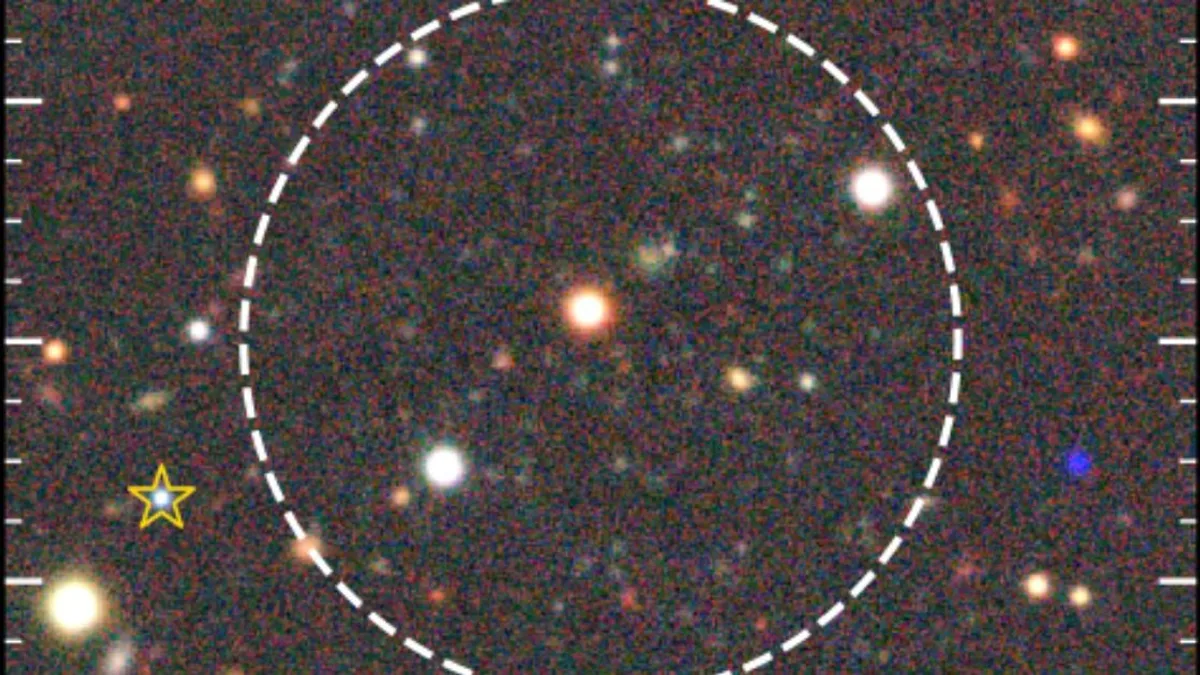
Astronomers have found two previously unknown companions of the Milky Way in data from the Vera C. Rubin Observatory in Chile: an ultra-faint galaxy called Aquarius IV and a star cluster named Rubin-GC1. Yale University, whose researchers are listed on both papers, reported the findings in early November. The first paper appeared in Research Notes of the American Astronomical Society, and the second has been accepted by The Astrophysical Journal Letters.
What are Milky Way companions, and how many are known?
Large galaxies like ours are surrounded by smaller systems: dwarf galaxies and star clusters. Many of them hold so few stars that they are hard to spot. About 65 dwarf companions of the Milky Way and about 40 globular clusters in its halo are known so far, and some estimates put the number of undiscovered companions in the hundreds.
The halo is a huge, roughly spherical region around the main disk of the galaxy, scattered with stars, gas and dark matter. The difference between the two kinds of object matters for the rest of this story. Ultra-faint dwarf galaxies may contain only a few hundred stars, yet dark matter dominates them. Globular clusters, with rare possible exceptions, have none.
What is Aquarius IV?
The first object is also designated Rubin J2201-0234 and is described as an ultra-faint companion in the outer halo of the Milky Way. According to Yale’s statement it lies about 355,000 light-years from us, while Live Science gives about 350,000. Its apparent magnitude is 18.3, and its stars are old and poor in heavier elements.
The authors are cautious about what kind of object it is. Its properties match the faintest confirmed ultra-faint dwarf galaxies, but it could also be an unusually large star cluster. Settling that takes deeper images and spectroscopy, meaning the light of many stars split into its components. Images from the Dark Energy Camera have confirmed that the object exists.
What is Rubin-GC1, and why is it hard to find?
The second object, Rubin J1628-1735, is most likely a faint globular cluster in the constellation Ophiuchus. It lies in the direction of the Milky Way’s central bulge, where stars are packed densely and thick interstellar dust blocks the view.
The cluster’s age is estimated at about 9.2 billion years, with a moderately high content of heavier elements. The most likely explanation is that the Milky Way acquired it from the leading arm of the Sagittarius stream, the tidal tail of the Sagittarius dwarf galaxy that our galaxy is slowly absorbing. The first author of the paper is Ashay Pai of the University of Chicago, and William Cerny is the second author.
How did Rubin find them in preview data alone?
The observations were made with the Simonyi Survey Telescope, which has an 8.4-meter primary mirror and sits on Cerro Pachon in the Chilean Andes. Its 3.2-gigapixel camera is described as the largest digital camera ever built. The observatory is jointly funded by the US National Science Foundation and the Office of Science of the US Department of Energy.
Both objects turned up in the Early Data Preview 2 dataset. The observations were collected from April 2025 to January 2026 and cover about 7 percent of the night sky, which means they predate the start of the ten-year LSST sky survey in June. Aquarius IV was picked out by automated search algorithms. For Rubin-GC1 the team used a smoothed map of star density, filtered by isochrone: the filter suppresses field stars according to their position on the color-brightness curve and so brings out faint structures.
The papers also carry the names of institutions including the universities of Chicago, Virginia, Washington, Tampa, Duke, Toronto, Colorado Boulder and Lund, as well as Dartmouth, NSF NOIRLab and the Andalusian Institute of Astrophysics.
What do the authors say?
William Cerny, a graduate student in astronomy at the Yale Graduate School of Arts and Sciences and first author of the Aquarius IV paper, says in Yale’s statement: “What I’m especially excited about is that these discoveries are only the beginning for Rubin.” He continues:
If the observatory can find systems this faint and this hard to find with only data from the preview, its full ten-year survey of the sky will no doubt bring us many more discoveries of Milky Way companions.
In the same statement Cerny added what he expects from the companions:
These new companions will give us new opportunities to test models of galaxy formation, trace the assembly history of the Milky Way and explore the nature of dark matter.
Marla Geha, professor of astronomy and physics in Yale’s Faculty of Arts and Sciences and a co-author of both papers, pointed out how long such a find has been awaited:
Finding new Milky Way companions in Rubin Observatory data has been an exciting future possibility for most of my career.
Geha then said: “It is remarkable that this is now reality.” She added: “These discoveries are incredibly promising.” Finally, she said:
Further discoveries will allow us to complete the census of galaxy companions around the Milky Way, which is key to understanding how the faintest galaxies form.
Ultra-faint galaxies are of interest because they hold only a small fraction of the stars of large galaxies, while dark matter makes up most of their mass. By observing their properties and motions, researchers can test how dark matter behaves.
What do these discoveries not prove?
For Aquarius IV the classification is not settled: it may be a dwarf galaxy or a large cluster, and that cannot be resolved without spectroscopy. For Rubin-GC1, the “most likely” reading, including the origin in the Sagittarius arm, is an interpretation. The paper on that cluster has only just been accepted by the journal.
The figure of hundreds of undiscovered companions is an estimate, not a result of these papers. Two objects from a survey covering seven percent of the sky show what Rubin can do, but they do not say how many companions there will be in the end. The distance to Aquarius IV also differs between sources (about 355,000 versus about 350,000 light-years), so it should be read as approximate.


