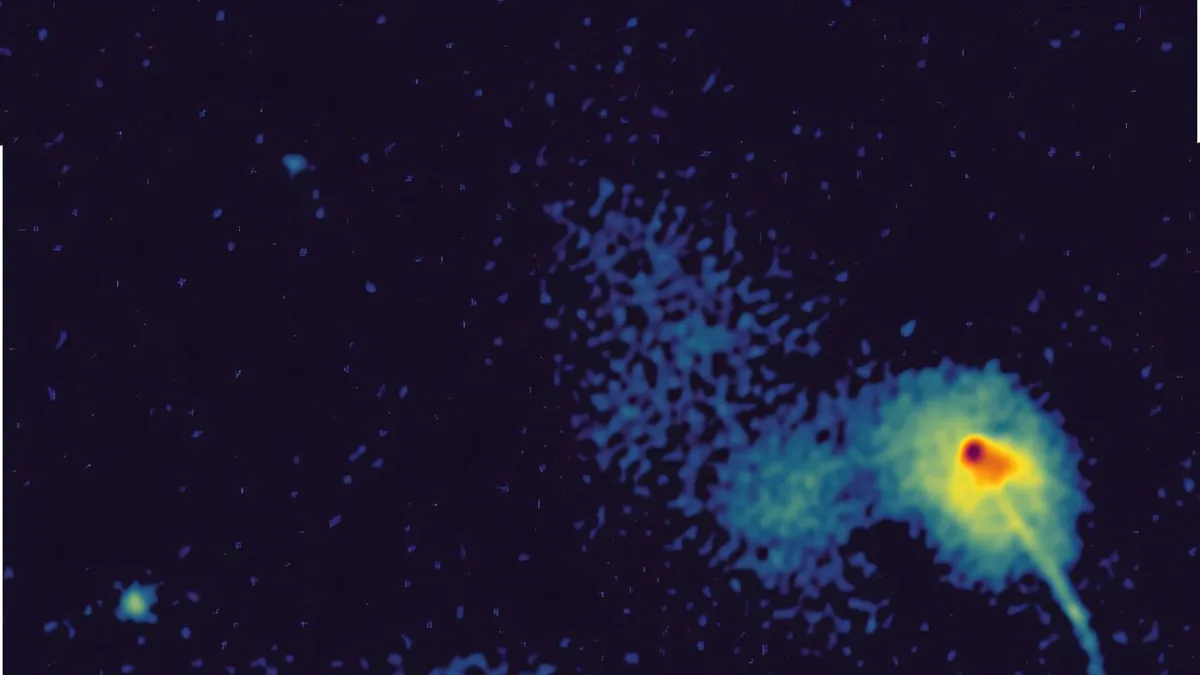
VST Telescope Finds 47 Dwarf Galaxies Near NGC 5068
An INAF-led team found 47 candidate dwarf galaxies around NGC 5068, NGC 5084 and NGC 5087 using the VST telescope in Chile, replacing the four previously known there.

An international team led by the Italian National Institute for Astrophysics (INAF) has catalogued 47 candidate dwarf galaxies around three known host galaxies, in a patch of sky where only four had previously been identified. The findings, from a survey called VST-SMASH, were published on September 16, 2026, in the peer-reviewed journal Astronomy & Astrophysics. The three hosts are the spiral galaxy NGC 5068, the lenticular galaxy NGC 5084 and the elliptical galaxy NGC 5087, sitting 17, 80 and 100 million light-years away respectively. The latter two lie at the edge of the Virgo Supercluster.
Dwarf galaxies are the most common type of galaxy in the universe, but their faint light also makes them the hardest to detect. Most known examples so far have turned up close to the Milky Way, in what’s called the Local Group. For decades, the number of observed dwarf galaxies hasn’t matched what the standard cosmological model predicts, a mismatch known as the “missing satellites problem.” According to data cited in the new study, that problem has recently flipped in some cases, with certain surveys now finding more satellite galaxies than simulations expect rather than fewer. Their arrangement in space is also debated: around the Milky Way, they mostly line up in a plane perpendicular to the host galaxy’s disk. To find out whether that’s a quirk of our own cosmic neighborhood or a broader pattern, the researchers extended their search beyond the Local Group.
The images came from VST (the VLT Survey Telescope), an Italian instrument operated by INAF at the European Southern Observatory’s Paranal site in Chile, paired with the OmegaCam camera. The survey covered roughly six square degrees of sky, about twelve times the area of the full Moon. Automated detection software wasn’t used, since it would simply miss objects this faint. Instead, three of the paper’s co-authors independently reviewed the images by eye, in both individual filters and color, masking out foreground starlight that would otherwise drown out the galaxies’ weak signal. The candidates’ estimated masses range from one million to one billion solar masses.
The survey’s lead investigator, Crescenzo Tortora, an INAF researcher, described the significance of the work in a statement from INAF carried by phys.org:
Studying these islands of almost invisible stars isn’t just astronomical stamp collecting. It’s the only way we have to solve some of the biggest puzzles in the cosmological model.
Co-author Rosella Ragusa, an INAF postdoctoral researcher, explained in the same statement what the deep imaging let the team do:
Thanks to VST’s deep observations, we managed not only to better “see” some extremely faint galaxies, but also to characterize their light profiles.
The spatial layout of the newly found objects suggests they’re likely satellites of the three host galaxies, and around NGC 5084 there’s already a hint of an arrangement similar to the Milky Way’s satellite plane. Their light profiles aren’t as steep as those of elliptical galaxies, resembling disk galaxies instead, and their color runs redder toward the center and less red toward the edges, matching the pattern seen in most galaxies of comparable mass. The preliminary results fit a “monolithic collapse” scenario, in which a galaxy forms from a single cloud of gas.
The VST-SMASH survey was deliberately designed so that all three target galaxies fall within the field of view of the European Space Agency’s Euclid space telescope, whose first public data releases are expected within the next few months. Several of the paper’s co-authors, including Tortora and Ragusa, are also involved in the Euclid mission and expect its data to confirm or revise the current catalog.
Until spectroscopic observations are carried out to measure each object’s distance and velocity, the 47 galaxies found remain candidates rather than confirmed dwarf galaxies. Their nature has so far been judged only by color and structural traits that match known dwarf galaxies, which isn’t the same as direct confirmation. The paper also doesn’t prove that the satellite arrangement around NGC 5084 is truly planar like the Milky Way’s, only that the evidence points that way. And the findings apply strictly to the surroundings of these three galaxies; on their own, they don’t settle the wider dispute over how many dwarf galaxies the universe holds compared with what cosmological simulations predict.