Hera reaches Didymos, detailed images due November 25
The European Space Agency probe flies a rectangular path 25 to 30 kilometers from the twin asteroids, and a new image shows a sharp ridge on Didymos's equator.
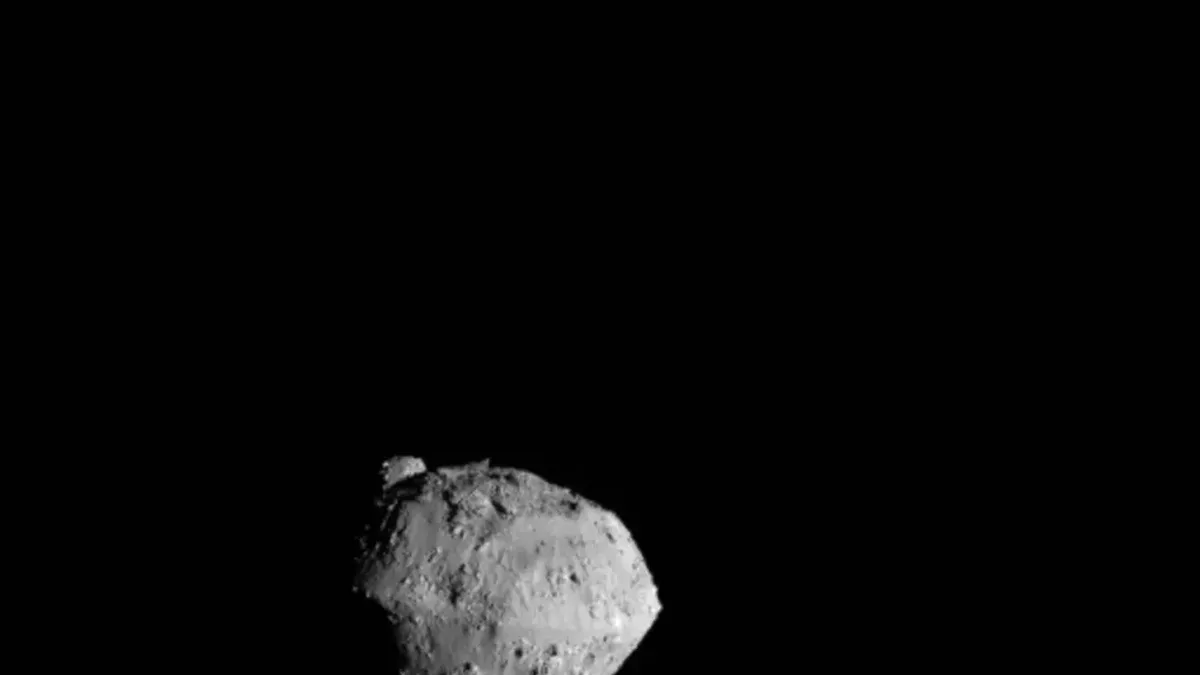
The European Space Agency (ESA) announced on November 11, 2026 that its Hera probe has reached the binary asteroid system of Didymos and Dimorphos. Hera is the agency’s first planetary defense mission, and it is about the size of a small car. ESA today released a new image of Didymos, with the smaller Dimorphos partly visible behind it, and said detailed images of both asteroids will be shown on November 25.
Where is Hera now?
The probe was launched on October 7, 2024 and now sits 25 to 30 kilometers from the asteroid pair. It is in what is known as the early characterization phase, in which it captures the general picture of both bodies before moving closer. The outlet Starlust reports that this phase will last at least a few more weeks, while ESA says detailed characterization begins next month, from a distance of about 20 kilometers.
The mission is run from ESA’s ESOC control center in Darmstadt. Contact with the probe lasts about eight hours a day, across a distance of 196.5 million kilometers, through four 35-meter antennas in Argentina, Spain and Australia.
Why does Hera fly a rectangular path?
Didymos is 780 meters across, and its gravity is about 40,000 times weaker than Earth’s. Dimorphos is 151 meters across, with gravity about 200,000 times weaker, and orbits a little over a kilometer from the larger body. In such conditions a classic circular orbit is not workable.
So Hera circles the shared center of mass of both bodies at about 12 centimeters per second, moving in nearly straight lines. According to ESA, it flies a three-day leg and then a four-day leg while moving away from the asteroids, then fires its thrusters and changes course by 90 degrees, which produces a series of rectangular paths. The layout was borrowed from the experience of the Rosetta mission to a comet. If a thruster burn fails, the probe simply drifts away from the asteroids rather than colliding with them, and each maneuver uses very little fuel.
What does the new image show?
The image was taken from a distance of 56 kilometers. It shows one side of Didymos with large boulders, smoother areas and a sharp ridge along the equator. Didymos rotates once every 2.2 hours, and ESA says this could be moving material toward the equator. It is also possible that such fast rotation threw off some of the material that formed Dimorphos.
Mission scientist Michael Kueppers described the goal of this phase:
“Our goal right now is to collect the most important general findings that support the mission’s planetary defense objectives. During this phase our images will show for the first time what a small asteroid looks like as a whole, after a high-speed impact in the first asteroid deflection test, when NASA’s DART spacecraft struck it in 2022 to change its path. Earlier predictions from our impact models suggested many different ways the asteroid might react, but Hera will reveal which prediction was correct, if any of them were!”
Kueppers said this in an ESA statement on November 11.
What came before?
NASA’s 580-kilogram DART spacecraft hit Dimorphos on September 26, 2022 at 6.1 kilometers per second. The debris cloud spread out to 10,000 kilometers, and the time Dimorphos takes to orbit Didymos was shortened by about 33 minutes. Hera is to determine whether the impact left a crater or changed the shape of the asteroid, as well as the composition, internal structure and mass of Dimorphos. In the coming months it will also release two small satellites the size of shoe boxes, Juventas and Milani, which are to test the link between satellites and eventually land on Dimorphos.
The images so far are early previews from a long distance. They say nothing about craters, internal structure or the mass of Dimorphos, because Dimorphos is mostly hidden in the latest image. ESA expects answers to those questions only from the detailed phase.