More than twenty arrested after Slavija, interior ministry cites attacks on police
The Interior Ministry reports 23 arrests after clashes near Pionirski Park that broke out half an hour after the student rally at Slavija formally ended.

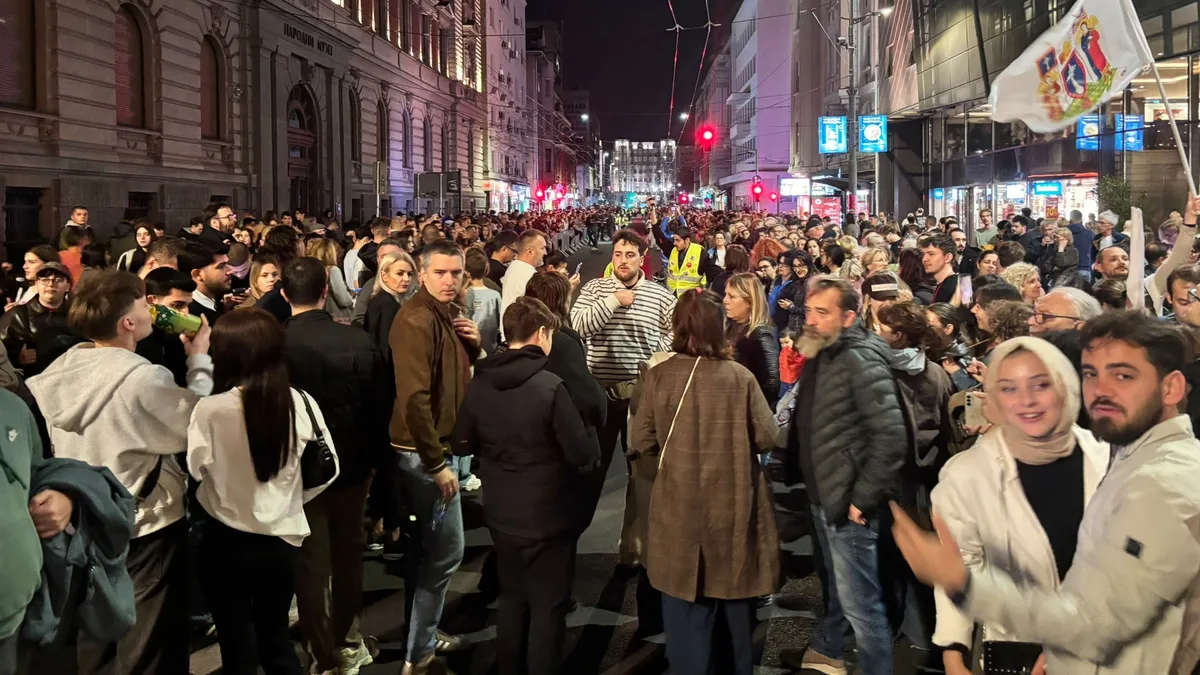
The Interior Ministry said on 24 May that 23 people had been arrested after the disorder that broke out around half an hour after the close of the student rally at Slavija Square on 23 May. The clashes, according to the statement, began near Pionirski Park, where a temporary stage for pro-government supporters had been set up. According to the same statement, protesters threw bottles, flares and signal rockets at police; the clashes later moved towards the Faculty of Law and Cvetni Trg, where a police cordon broke up smaller groups.
Interior Minister Ivica Dacic told a press conference on Mihajla Pupina Boulevard on 24 May that there had been “a drastic breach of public order” and “attacks on police”, and that the police “carried out their work without attacking anyone”. Dacic said pyrotechnic devices, stones, bottles and even manhole covers had been thrown at officers. According to ministry figures, seven police officers and two protest participants were injured, one of whom remained in hospital.
What does the other side say?
The student plenums said the Slavija rally had been peaceful and ended on the announced schedule. Andrej Tanko, a coordinator from the Faculty of Philosophy, said the clashes broke out among pro-government supporters who had been organised to be brought to Pionirski Park and some demonstrators who were heading back from Slavija. By his account, some of those detained had simply been passing through the area and had taken no part in any phase of the clashes.
Red Star president Vladimir Dugalic, who had been at Slavija in support of the students, told the weekly Vreme that the clashes “came as a planned response” and that the arrival of “encampment groups near Pionirski Park” before protesters began leaving Slavija was “a pre-emptive move to provoke an incident”. University of Belgrade Rector Professor Vladan Djokic on 25 May asked the Interior Ministry for “transparent data” on those arrested, including age structure, time of arrest and the point at which they had been detained.
What happens next in the cases against those arrested?
According to the Belgrade Basic Public Prosecutor’s Office, 16 of the 23 detainees had by Sunday evening completed misdemeanour proceedings for breach of public order. Seven people were referred for further procedure. Of those, three are being held in police custody, the weekly Vreme has learned, and are charged with violent conduct, while four face proceedings for attacks on officials, a criminal offence under Article 23 of the Criminal Code. Under procedure, the prosecution must rule within 48 hours on whether to detain them or release them pending proceedings.
Belgrade Centre for Human Rights programme director Milan Antonijevic said the arrest procedures should be under particular scrutiny by public prosecutors, particularly because of “the number of detainees whose role in the clashes has not been established”. Antonijevic recalled that the Belgrade Bar Association’s lawyer team, responding to on-the-spot calls, had already dispatched twelve defence counsel under an April 2026 agreement between the Bar Association and the student plenums.
From the ruling Serbian Progressive Party, executive committee president Darko Glisic said the clashes had “confirmed that the opposition segment of the rally had destructive intent”. An exchange between Glisic and Party of Freedom and Justice deputy leader Marinika Tepic, published in the 25 May edition of the daily Politika, contained a sharp argument over who had organised the presence of pro-government supporters at Pionirski Park.
From the opposition Serbia Centre coalition, party leader Zdravko Ponos called on the Republic Public Prosecutor’s Office to take over supervision of the proceedings amid suspicions of “disproportionate use of force” and bias in the arrests.
According to the Protector of Citizens (ombudsman), which has received more than 40 complaints from detainees and their counsel, the ombudsman’s office has opened a formal procedure to examine police conduct during the events at Slavija on 23 May. Ombudsman Zoran Pasalic, in a brief statement on 25 May, said the report would be submitted to parliament by 15 June and would include recommendations for corrective measures.
Will the competent prosecutor decide by Friday on detention for the seven held in custody?