Tivat Summit Ends Without Joint Leaders' Declaration
The EU and Western Balkans summit in Tivat featured strong enlargement rhetoric but produced no joint declaration. Montenegro received the clearest signal.

- The EU and Western Balkans summit in Tivat ended without a joint declaration from the leaders.
- European Council President Antonio Costa chaired the meeting, hosted by Montenegrin President Jakov Milatovic.
- The European Commission began drafting an accession treaty with Montenegro, the first since 2013.
- For Albania, the closing of three negotiating chapters was proposed.
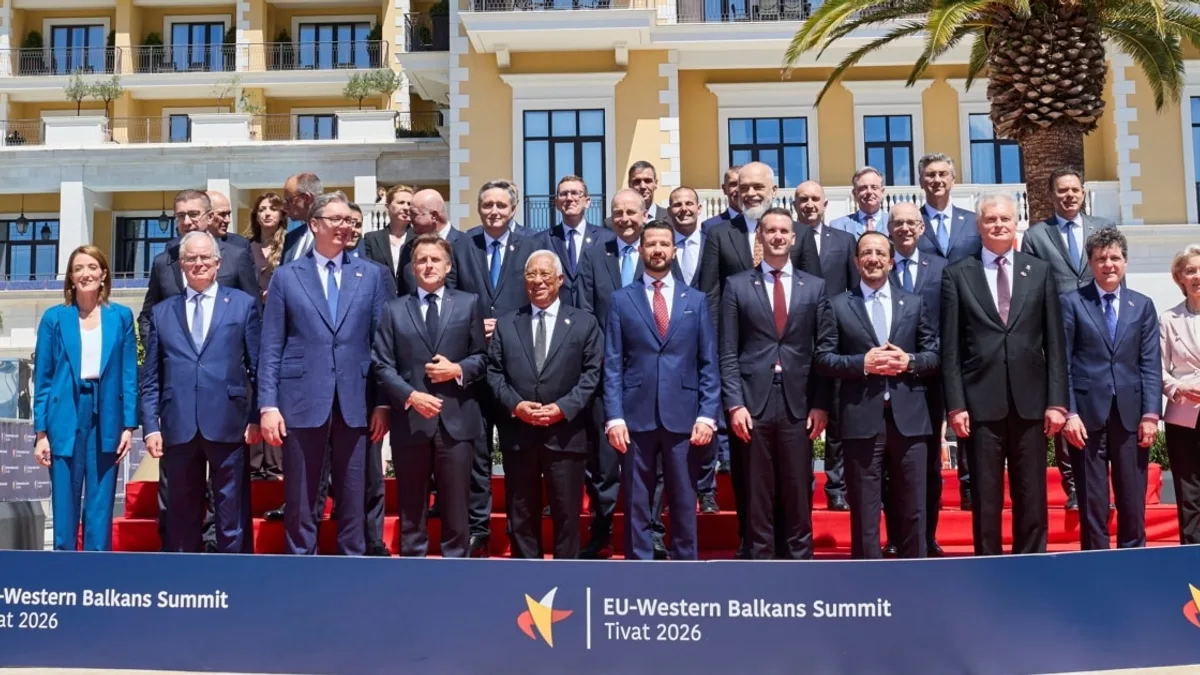
The European Union and Western Balkans summit held in Tivat on June 5, under the slogan “Shared Prosperity and Stability of the EU and the Western Balkans,” concluded without a joint declaration from the leaders. The meeting was chaired by European Council President Antonio Costa, with Montenegrin President Jakov Milatovic acting as host.
Although the gathering was marked by strong rhetoric on enlargement, the absence of a common document defined its close. According to the European Western Balkans portal and N1 television, a joint declaration had not been expected, and no official reasons were given. The most concrete outcome went to Montenegro.
What did the summit bring for Montenegro and Albania?
The European Commission announced that it had begun drafting an accession treaty with Montenegro. The step, it stressed, was being taken for the first time since 2013, with a timeline pointed toward 2028. Montenegrin President Jakov Milatovic reiterated his country’s goal of EU membership by 2028.
For Albania, the closing of three negotiating chapters was proposed during the summit. Brussels reiterated that the enlargement process is based on merit, meaning the progress each country makes through its own reforms.
- Montenegro: start of accession treaty drafting, the first since 2013, membership goal by 2028.
- Albania: a proposal to close three negotiating chapters.
- Region: no joint leaders’ declaration, but a renewed message on enlargement.
European Commission President Ursula von der Leyen summed up her message on the region in a single line.
There is no Europe without the Western Balkans.
European Council President Antonio Costa said the region’s future lies in the Union and that enlargement is a merit-based priority.
The future of the Western Balkans is in the European Union, seize the opportunity and the current momentum.
Why does the missing declaration matter?
A joint declaration at such gatherings typically serves as a written framework of agreed commitments and a direction for cooperation. Its absence in Tivat does not necessarily signal a standstill, but it leaves room for differing interpretations of how much unity there was among participants on the pace and terms of enlargement.
Brussels representatives presented the signal to Montenegro as confirmation that the process is advancing for those who meet the conditions. At the same time, the lack of a common document shows that a consensus on the regional approach was not easy to capture in a single text.
The open question is whether individual progress, such as Montenegro’s, will accelerate the rest of the region or whether differences in pace will deepen the gap among candidates. How do you read the messages from the Tivat summit?